Province
of Newark
Pope Pius XI established the Province of Newark New Jersey
I have seen all of the cathedrals in New Jersey, except for
the Trenton and Camden co-cathedrals.
The only ones I have been able to visit are Cathedral-Basilica in Newark
and the Cathedral in Metuchen. The
Cathedral-Basilica of the Sacred Heart is well worth a visit to Newark.
Map of the Province

Catholic History of New Jersey
The first Catholics to settle in New Jersey came to
Elizabeth and Woodbridge (both near New York City) in 1672 and the first Mass celebrated
in New Jersey was in Woodbridge in that year.
Since New Jersey was an English colony, Catholics were often
persecuted. William Douglass was elected
to the General Assembly in 1668 but was barred from attending the Assembly
because he was Catholic. Father John Ury,
who ministered to Catholics in New Jersey , was
arrested on false charges and executed in New
York City St. Joseph ’s
Church in Philadelphia in 1733—at the time the
only Catholic church in Pennsylvania , New Jersey , and New
York
In 1808, northern New Jersey
became part of the Diocese of New York and southern New Jersey New
Jersey , additional parishes were opened including those in Paterson (1820), Newark
Pope Pius IX created the Diocese of Newark in 1853, which
consisted of all of New Jersey. At that
time, there were about 40,000 Catholics in New Jersey New Jersey New Jersey
Archdiocese of Newark
The Archdiocese of Newark consists of 4 counties in northern
New Jersey. The archdiocese has 1.4 million Catholics (47 percent of the total
population) in 219 parishes.
Bishops of Newark
James R. Bayley (1814-1877), first Bishop of Newark
(1853-1872).
- Born in New York City, ordained an Episcopal priest in 1839, converted to Catholicism in 1842, and ordained a priest for the Catholic Diocese of New York in 1844.
- Also served as Archbishop of Baltimore (1872-1877).
James Bayley was a former Episcopal priest, nephew of St.
Elizabeth Ann Bayley Seton, and relative to two future presidents (Theodore
Roosevelt and Franklin Roosevelt).
Bishop Bayley’s Diocese consisted of the entire State. Bayley invited religious orders to work in
the Diocese including the Benedictines and the Sisters of Charity. He
established Seton Hall University and helped found the North American
College in Rome. He wrote several books
on U.S. church history and stressed the importance of Catholic education—by
1872 there were 20,000 students in Catholic schools in New Jersey. He was named Archbishop of Baltimore in 1872.
Michael A. Corrigan (1839-1902), Bishop of Newark
(1873-1880).
- Born in Newark and ordained a priest for the Diocese of Newark in 1863.
- Also served as coadjutor archbishop of New York (1880-1885) and Archbishop of New York (1885-1902).
Bishop Corrigan was only 34 at the time of his appointment
and was the youngest bishop in the United States at the time. He built many hospitals and charitable
institutions and he established Catholic reform schools because the State
reform schools forced their Catholic inmates to attend Protestant services. Corrigan also focused on the needs of Italian
immigrants. He supported the Catholic
Temperance Union and the Catholic Union—a lay group that defended Catholics
against bigotry. He was named coadjutor
archbishop of New York in 1880.
Winand M. Wigger (1841-1901), Bishop of Newark
(1881-1901).
- Born in New York City and ordained a priest for the Diocese of Newark in 1865.
Bishop Wigger spoke English, German, French, and Italian. He established German parishes and schools to
allow German immigrants to better maintain their Faith, and also worked with
Italian immigrants. He was a strong
supporter of Catholic schools and unsuccessfully sought state funding for them,
but he opposed a plan to incorporate parochial schools into the public school
system. He also started construction for
the Cathedral of the Sacred Heart in 1889.
Despite the creation of the Diocese of Trenton, the number of Catholics
increased during his time as Bishop from 145,000 to 300,000, and the number of
priests and parishes doubled as well. He
died in 1901.
John J. O’Connor (1855-1927), Bishop of Newark
(1901-1927).
- Born in Newark and ordained a priest for the Diocese of Newark in 1877.
Population growth continued during O’Connor’s time as
Bishop—more than doubling the Diocese’s population. Bishop O’Connor improved educational
opportunities through the construction of new high schools and through the
Confraternity of Christian Doctrine. He
was also a supporter of increased roles for lay and religious women in the
Diocese. He died in 1927.
Archbishops of Newark
Thomas J. Walsh (1873-1952), Bishop of Newark
(1928-1937), and first Archbishop of Newark (1937-1952).
- Born in Pennsylvania and ordained a priest for the Diocese of Buffalo, New York, in 1900.
- Also served as Bishop of Trenton (1918-1928).
Walsh’s installation as Bishop was the first time the unfinished
Cathedral of the Sacred Heart was used for worship. Walsh established the diocesan newspaper, emphasized
Catholic education, and established a social work guild. He built Immaculate Conception Seminary and was
a strong supporter of Seton Hall University.
He died in 1952.
Thomas A. Boland (1896-1979), Archbishop of Newark
(1952-1974).
- Born in Orange, New Jersey, and ordained a priest for the Diocese of Newark in 1922.
- Also served as auxiliary bishop of Newark (1940-1947) and Bishop of Paterson (1947-1952).
Archbishop Boland dedicated the completed Cathedral of the
Sacred Heart in 1954 and chaired the Bishops’ Study Committee at the Second
Vatican Council. During the civil rights
movement of the 1960s, he emphasized the rights of African Americans under the
Constitution, countering criticism from some priests that he had not done
enough. He established lay organizations
and increased help for the disadvantaged.
Boland built four high schools and four homes for the elderly. He led the Archdiocese through the Newark
riots in 1967 and he retired in 1974.
Peter L. Gerety (1912-2016), Archbishop of Newark
(1974-1986).
- Born in Connecticut and ordained a priest for the Diocese of Hartford in 1939.
- Also served as coadjutor bishop of Portland, Maine (1966-1969) and Bishop of Portland (1969-1974).
Archbishop Gerety established an Annual Appeal to drive down
the Archdiocesan debt (which he paid off) and allow for new projects. He created the Renew program for spiritual
renewal—a movement that spread across the country. He also began a ministry for divorced and
separated Catholics. Archbishop Gerety,
a strong pro-life advocate, sent a letter to Jimmy Carter protesting the 1976
Democratic Party Platform on abortion.
Gerety retired in 1986 and lived to be 104.
Theodore E. McCarrick (1930- ), Archbishop of Newark (1986-2000).
·
Born in New York City and ordained a priest for
the Archdiocese of New York in 1958.
·
Also served as auxiliary bishop of New York
(1977-1981), Bishop of Metuchen (1981-1986), and Archbishop of Washington
(2000-2006). He was named a Cardinal by
Pope John Paul II in 2001.
Archbishop McCarrick improved the Archdiocese’s ministry to
Hispanics, spoke out against abortion, established a capital campaign for the
Archdiocese, and organized the Tenth Archdiocesan Synod to make plans for the
future of the Archdiocese. He also began
a ministry for those with HIV/AIDS and those with drug addictions. An evangelization office was started to serve
the Archdiocese’s many cultural and linguistic groups. He also was successful in encouraging
vocations to the priesthood—he ordained 200 priests for the Archdiocese. He also started a stewardship program in each
parish to encourage parishioners to donate their time, talent, and treasure for
the people of God. McCarrick traveled to
many countries to assess human rights conditions and humanitarian needs for
both the U.S. Bishops and for the U.S. Government. He was named Archbishop of Washington in 2000
and made a Cardinal the following year.
John J. Myers (1941-
), Archbishop of Newark (2001-2016).
·
Born in Illinois and ordained a priest for the Diocese
of Peoria in 1966.
·
Also served as coadjutor bishop of Peoria
(1987-1990) and Bishop of Peoria (1990-2001).
Myers was installed as Archbishop shortly after the
September 11 attacks on New York and many people in the Archdiocese were deeply
affected by these attacks. Myers
encouraged parishes to remain open for longer hours to allow people to come to
the church and pray. He also wrote a
pastoral letter concerning the attack.
He wrote a pastoral letter on human sexuality in response to the sexual
abuse crisis and sought to raise awareness to the scourge of human
trafficking. Myers did receive criticism
for the cost of his residence. Myers was
active in the Canon Law Society of America and has even co-authored a science
fiction novel.
Current Archbishop
Joseph W. Tobin,
C.Ss.R., was appointed Archbishop of Newark by Pope Francis in 2016, who
named him a Cardinal the same year. He
was born in Michigan in 1952 (the oldest of 13 children) and was ordained a
Redemptorist priest in 1978. He
previously served as general
superior of the Redemptorists (1997-2009), as secretary of the Vatican
Congregation for Institutes for Consecrated Life and Societies of Apostolic
Life (2010-2012), and as Archbishop of Indianapolis (2012-2016). As Archbishop of Newark, Tobin also
serves as superior of the Mission "Sui Juris" of Turks and Caicos. In addition to English, Tobin speaks Italian,
Spanish, French and Portuguese.
The Cathedral
The Cathedral Basilica of the Sacred Heart
St. John Eudes was a 17th Century French priest
who preached the loving nature of the Sacred Heart of Jesus. Later in the same century, a French nun, St.
Margaret Mary Alacoque had visions of Jesus revealing that his Sacred Heart was
filled with love and mercy for all people.
The Feast of the Sacred Heart of Jesus is celebrated on the Friday after
the second Sunday after Pentecost. Many
Catholics also show devotion to the Sacred Heart by attending Mass and
receiving the Body and Blood of Christ on the first Friday of each month.
O most holy heart of Jesus, fountain of every blessing, I
adore you, I love you, and with lively sorrow for my sins I offer you this poor
heart of mine. Make me humble, patient, pure and wholly obedient to your will.
Grant, Good
Jesus, that I may live in you and for you. Protect me in the midst of danger.
Comfort me in my afflictions. Give me health of body, assistance in my temporal
needs, your blessing
on all that I do, and the grace
of a holy death. Amen.
The Diocese of Newark was established in 1853 and Bishop James
Bayley’s Cathedral was St. Patrick’s on Washington Street in downtown
Newark. St. Patrick’s parish had been
established in 1848.

Bishop Bayley and Newark’s Catholics planned a new Cathedral
and established St. Columba’s parish in 1869 to be the Cathedral parish, but
this cathedral was never built. [I have
not been able to determine why.] Bishop
Bayley purchased the land for the current Cathedral in 1859, and a small Sacred
Heart parish church would be built in 1889, but it would not be until 1898 that
construction began on the current Cathedral.
The first public use of the then-unfinished Cathedral was the
installation Mass for Bishop Thomas Walsh in 1928. Construction of the Cathedral was not
completed until 1954.
The Cathedral was designed by Jeremiah O’Rourke initially in
an English-Irish Gothic style, which was later changed to a French Gothic
style. The building is 365 feet long and
the nave is 50 feet wide and encompasses 40,000 square feet of space. The front towers are 232 feet high. The east Jesu Tower doors depict the
Suffering and Resurrected Christ as well as Saints Anthony, Benedict, and
Scholastica. The west Mater Dolorosa
Tower portrays Our Blessed Mother with Saints Clare and Francis of
Assisi. This tower has 14 bells made in
Italy.


The top picture is from the parish website and the second is from Wikipedia.
Above the Cathedral’s main altar is a marble baldachin with
a statue of the Sacred Heart of Jesus.
Below this statue is one of Mary, the Immaculate Conception. The pillars of the baldachin feature statues
of the Apostles, the Evangelists, Doctors of the Church, and the Archangels,
Michael and Gabriel. The sanctuary
crucifix has a bronze cross with a corpus made of rose marble and Carrara
marble. The reredos behind the altar are
carved from Appalachian oak and include symbols of virtues and of Christ and
the Church. The choir stalls have statues of the Roman Emperor Constantine and
his mother, St. Helen.
The Cathedral’s main bronze doors were made in Rome and
feature Christ and his Mother as well as the Evangelists and several patriarchs
and prophets. Surrounding the sanctuary
are several chapels: the Chapel of Our Lady of Lourdes (with a kneeler
used by Pope John Paul II), the Chapel of St. Patrick (with statues of English, Irish, Scottish, and Welsh saints),
the Chapel of St. Lucy Filipini (with windows depicting Italian saints), the
Chapel of St. Boniface (with windows
featuring German saints), the Chapel of St. Stanislaus (with windows showing Slav-Magyar
saints), the Chapel of St. Anne (with
windows featuring saints of diverse ethnicity), and the Chapel of St. Joseph. The
Lady Chapel contains a Carrera altar and the Cathedral Basilica’s tabernacle. This chapel is used for daily Mass and has
windows with Marian themes.
The east transept is dedicated to St. Paul and also has
statues dedicated to other of Christ’s witnesses, St. John the Baptist and St.
Mary Magdalen. The east rose window
depicts Christ with the Four Evangelists.
Smaller windows depict saints who died young. The west transept is dedicated to St. Peter. The west rose window features Our Lord with
patriarchs, prophets, and saints.
The Cathedral has over 200 stained glass windows. The rose windows were made by Franz Zettler
of Munich, Germany. The 36-foot gallery
rose window depicts the Last Judgement with Christ the Judge at its center
surrounded by angels and archangels, the Apostles, and the Four Horsemen of the
Apocalypse. The Stations of the Cross
are made of marble. The Botticino marble
baptismal font has statues of Moses, John the Baptist, Justin, Anselm, Cyprian,
Hilary, Clement of Alexandria, and Peter Damian. Windows around the font depict
baptismal themes.
The Cathedral hosted St. Mother
Teresa in 1995. Later that year Pope
John Paul II celebrated Mass with President and Mrs. Clinton in attendance,
supposedly the first time a pope and a U.S. president have attended the same
church service. That night, the Pope
announced that the Cathedral had been raised to the status of a minor
basilica. Basilica is an honorary title
bestowed on a church by the Pope because of the church’s antiquity, dignity,
historical importance, or significance as a center of worship. The Cathedral of the Sacred Heart and the old
cathedral of St. Patrick’s are both listed on the National Register of Historic
Places.


All of the pictures are from the parish website, except the last, which is from pinterest.
The Cathedral’s website, cathedralbasilica.org
has a very thorough virtual tour with pictures and an explanation of much of
the symbolism. The Archdiocese’s website
is rcan.org. The Cathedral is located
about a mile north of downtown Newark and has four weekend masses, including
one in Spanish.
Also in the
Archdiocese is Our Lady of Deliverance Cathedral in Bayonne. This is the Cathedral for the Syrian-rite
Diocese of Our Lady of Deliverance—the only Syrian-rite diocese in the United States. About 25,000 Syrian-rite Catholics live in
the United States and Canada and are served by eight parishes and two missions
located in five states and two Canadian provinces.
Diocese of Trenton
The diocese consists of 4 counties in central New
Jersey. The diocese has 830,000
Catholics (41 percent of the total population) in 107 parishes.
Bishops of Trenton
- Born in Ireland and ordained a priest in Ireland in 1855.
Bishop O’Farrell took charge of a Diocese with 40,000
Catholics, about 70 churches, and 51 priests.
He built many new parishes and charitable institutions, including an
orphanage and s home for the aged. He
was noted for being an eloquent speaker and gifted writer. He died in 1894.
James A. McFaul (1850-1917), Bishop of Trenton
(1894-1917).
- Born in Ireland and ordained a priest for the Diocese of Newark in 1877.
Bishop McFaul was noted for his speaking and writing
abilities. He gave a speech in 1909 that
accused some university professors of teaching their students information that
was in conflict with accepted moral standards.
He was one of the founders of the American Federation of Catholic
Societies. The Catholic population of
the Diocese had grown to almost three quarters of a million by the time of his
death—due to immigration from Italy and Eastern Europe. As a result, he built many new churches and
schools—including Mount St. Mary’s College—and established several Catholic
service institutions while maintaining the Diocese’s solid financial
standing. He died in 1917.
Thomas J. Walsh (1873-1952), Bishop of Trenton
(1918-1928).
- Born in Pennsylvania and ordained a priest for the Diocese of Buffalo, New York, in 1900.
- Also served as Bishop of Newark (1928-1937), and first Archbishop of Newark (1937-1952).
Bishop Walsh established 45 elementary and 11 secondary
schools and that is all I know about him.
He was named Bishop of Newark in 1928.
John J. McMahon (1875-1932), Bishop of Trenton
(1928-1932).
- Born in New York and ordained a priest for the Diocese of Buffalo, New York, in 1900.
Not even Wikipedia has any information on Bishop
McMahon. He died in 1932.
Moses E. Kiley (1876-1953), Bishop of Trenton
(1934-1940).
- Born in Canada and ordained a priest for the Archdiocese of Chicago in 1911.
- Also served as Archbishop of Milwaukee (1940-1953).
The Canadian-born Moses Kiley was appointed fifth Bishop of
Trenton in 1934. According to Wikipedia,
Bishop Kiley’s most notable achievement was refinancing $10 million of church
obligations. He was appointed Archbishop
of Milwaukee in 1940.
William A. Griffin (1885-1950), Bishop of Trenton
(1940-1950).
- Born in Elizabeth, New Jersey, and ordained a priest for the Diocese of Newark in 1910.
- Also served as auxiliary bishop of Newark (1938-1940).
All I know is that Griffin died of a stroke in 1950.
George W. Ahr (1904-1993), Bishop of Trenton (1950-1979).
- Born in Newark and ordained a priest for Diocese of Newark in 1928.
Bishop Ahr attended the Second Vatican Council and
implemented the changes called for by the Council including the establishment
of a permanent diaconate program. He
also established 50 new parishes and constructed over 250 new churches,
schools, and other buildings, to keep up with an almost 300 percent increase in
the Catholic population in the Diocese.
Ahr started a weekly Diocesan newspaper and rebuilt St. Mary's Cathedral after it was destroyed by fire.
Bishop Ahr retired in 1979.
John C. Reiss (1922-2012), Bishop of Trenton (1980-1997).
- Born in Red Bank and ordained a priest for the Diocese of Trenton in 1947.
- Also served as auxiliary bishop of Trenton (1967-1980).
Bishop Reiss was the first priest of the Diocese to become
its bishop. Reiss implemented programs
to improve lay (Renew) and priestly (Emmaus) spirituality and began an
endowment fund for the Diocese that raised close to $40 million. He also called the Fourth Diocesan Synod in
1991—the first such meeting in 60 years.
He built a nursing and assisted living facility for the laity as well as
a retirement home for priests. Bishop
Reiss retired in 1997.
John M. Smith (1935-
), Bishop of Trenton (1997-2010).
- Born in Orange and ordained a priest for the Archdiocese of Newark in 1961.
- Also served as auxiliary bishop of Newark (1987-1991), Bishop of Pensacola-Tallahassee, Florida (1991-1995), and coadjutor Bishop of Trenton (1995-1997).
Bishop Smith initiated the Bishop’s Annual Appeal in 2000
and served on the board of directors of Catholic Relief Services. Smith improved Diocesan communications
through the establishment of the Diocesan website, an award-winning teen talk
program on cable television, and a Spanish-language television program. He established an institute to train the
laity in ministry. He also consolidated
parishes and set guidance for the continued operation of parish schools. Smith
retired in 2010.
David M. O'Connell, C.M., was appointed coadjutor Bishop of
Trenton by Pope Benedict XVI in 2010 and became Bishop later the same year. He was born in Philadelphia in 1955 and
ordained a Vincentian priest in 1982. He
previously served as president of The Catholic University of America
(1998-2010).
The Cathedrals
Trenton, New Jersey
08608
The Cathedral is named for Mary, the mother of Jesus, and
therefore, the Mother of God. From the
earliest days of the Church, Christians believed that Mary, upon her death, was
assumed body and soul into Heaven by her Son.
This belief was formalized in 1950 by Pope Pius XII, who declared that
the Assumption of the Blessed Virgin Mary was a dogma of the Catholic
Faith. The Feast of the Assumption is
celebrated on August 15.
Almighty and eternal God, who hast
taken up into the glory of Heaven, with body and soul, the immaculate Virgin
Mary, Mother of thy son: grant us, we pray, that we may always strive after
heavenly things and thus merit to share in her glory. Amen.
St. Mary’s parish was established in 1868 and the first
church opened in 1871. The church stands
on the site of the headquarters of the Hessian commander during the 1776 Battle
of Trenton. This church became the
Cathedral for the new Diocese of Trenton in 1881. A 1956 fire killed the rector and two
housekeepers and destroyed the building.
The current Cathedral was completed in 1959 in a modern
Romanesque style. It is made with Mount
Airy granite and has a single 98-foot bell tower. The ten bells from the old Cathedral were
relocated to the bell tower. Other items
salvaged from the old Cathedral include a clock, bronze doors, communion rail,
and some stained glass windows.
Some additional information can be found on the Cathedral
website at stmaryscathedral-trenton.org and on the Diocesan website at
dioceseoftrenton.org. The Cathedral website has pictures that I can not download. The Cathedral is
located in downtown Trenton and has five weekend masses, including three in
Spanish, to serve 1,000 parish families.


The first picture is from the Diocesan website and the second from Flicker.
St. Robert Bellarmine Co-Cathedral
61 Georgia Road
Freehold, New Jersey 07728
St. Robert Bellarmine
was born in Italy in 1542 and was ordained a Jesuit priest in 1570. He later became an archbishop and
cardinal. He is best known for his
theological works—including one that attacked the divine-right-of-kings
theory—which was controversial at the time.
He was a leader in the Counter-Reformation, led an austere lifestyle,
but also played a key role in the Church’s admonition of Galileo. Bellarmine
died in 1621, was canonized in 1930, and declared a Doctor of the Church in
1931. His feast day is September 17.
Blessed Jesus, St Robert is the patron saint of catechumens because he
wrote two catechisms and devoted much of his time to teaching the Faith to
children. I ask him to pray for those in the Church who teach the Faith, and
for their students. Bless the teachers,
Lord, and anoint the minds of those receiving instruction to understand it so
powerfully that their lives are changed by it forever. Raise up more opportunities—including parish
missions—for Church members to learn the Faith more deeply, and inspire large
numbers of people to attend these events. St Robert, pray for us. Amen.
The expansive nave has stained glass windows depicting St.
Robert Bellarmine, American saints, and the Mysteries of the Rosary. The main altar, ambo, and tabernacle pedestal
are made of green Carrera marble.
Additional information can be found at strobert.com. The Co-Cathedral is located 30 miles east of
Trenton and has five weekend masses.


All pictures are from the Co-Cathedral website.
Diocese of Camden
The diocese consists of 6 counties in southern New
Jersey. The diocese has 494,000
Catholics (33 percent of the total population) in 65 parishes.
Bishops of Camden
Bartholomew J. Eustace (1887-1956), first Bishop of
Camden (1938-1956).
- Born in New York and ordained a priest in 1914 for the Archdiocese of New York.
Bishop Eustace expanded the role of the laity—years before
the Second Vatican Council. He also
established St. Mary Catholic Home and Our Lady of Lourdes Medical Center. He recruited priests from outside the Diocese
and established ministries for minorities.
South Jersey’s rapid growth after World War II resulted in the
establishment of 31 new parishes, 25 missions, and three new high schools. Bishop Eustace died in 1956.
Justin J. McCarthy (1900-1959), Bishop of Camden
(1957-1959).
- Born in Pennsylvania and ordained a priest for the Diocese of Newark in 1927.
- Also served as auxiliary bishop of Newark (1954-1957).
Bishop McCarthy established a ministry for
Hispanics—especially for the 20,000 farm workers from Puerto Rico—through the
use of a mobile chapel called Capilla Rodante Santa Ana. He built new and expanded existing Catholic schools
and greatly increased the number of students attending Confraternity of
Christian Doctrine classes. Bishop
McCarthy also encouraged active lay organizations. He died of a heart attack the day after
Christmas in 1959.
Celestine Damiano (1911-1967), Bishop of Camden
(1960-1967).
- Born in New York and ordained a priest in 1935 for the Diocese of Buffalo.
- Also served as apostolic delegate to South Africa (1952-1960).
Archbishop Damiano—he was given the personal title of
Archbishop due to earlier diplomatic service for the Vatican—built or expanded
several Catholic elementary schools and high schools, including the erection of
new buildings for Camden Catholic High School in Cherry Hill and Holy Spirit
High School in Absecon. He also
established a Diocesan board of education, Our Lady of Lourdes School of
Nursing, and a pre-natal clinic in North Camden. He improved the Diocese’s Hispanic ministry,
in part through the opening of a center in Vineland. He also established a fundraising program to
fund the Diocese’s human services. Archbishop
Damiano attended all sessions of the Second Vatican Council and died in 1967.
George H. Guilfoyle (1913-1991), Bishop of Camden
(1968-1989).
- Born in New York and ordained a priest in 1944 for the Archdiocese of New York.
- Also served as auxiliary bishop of New York (1964-1968).
Bishop Guilfoyle established facilities to meet health care
needs of the poor and housing needs for the elderly. He led devotions to the Blessed Mother as
patroness of the Diocese, including a Diocesan pilgrimage in 1970 to the
Basilica of the National Shrine of the Immaculate Conception in Washington. He sought to improve the spiritual renewal of
priests through the Emmaus program and of the laity through the RENEW
program. He expanded the Diocese’s
Hispanic ministry. He opened a Pro-Life
Office in 1973 and instituted changes as a result of the Second Vatican
Council, including the establishment of pastoral councils and the ordination of
the first permanent deacons. He
established eight new parishes and built several more parish buildings. He also built a retreat house, nursing homes,
and homes for the aged. He retired in
1989.
James T. McHugh (1932-2000), Bishop of Camden
(1989-1998).
- Born in Orange and ordained a priest in 1957 for the Archdiocese of Newark.
- Also served as auxiliary bishop of Newark (1987-1989), coadjutor Bishop of Rockville Centre, New York (1998-2000), and Bishop of Rockville Centre (2000).
Prior to becoming Bishop, McHugh worked for the U.S.
Conference of Catholic Bishops from 1965 to 1978 on family life and pro-life
issues and is considered a founder of the U.S. pro-life program. As Bishop, he continued emphasis on the
sanctity of human life and the importance of religion to all people. He also emphasized Catholic education and
created an endowment fund to aid parish schools and religious education
programs. He conducted a Diocesan synod
in 1992 in which thousands of Catholics were able to participate in future
plans for the Diocese. He was named coadjutor
Bishop of Rockville Centre, New York, in 1998 and became Bishop in 2000.
Nicholas DiMarzio (1944- ), Bishop of Camden (1999-2003).
- Born in Newark and ordained a priest in 1970 for the Archdiocese of Newark.
- Also served as auxiliary bishop of Newark (1996-1999) and serves as Bishop of Brooklyn, New York (since 2003).
Bishop DiMarzio was a national spokesman for Catholic
bishops on immigration issues and created ministries within the Diocese to
serve recent immigrants from Korea and other countries. He established a scholarship fund so that
low-income families could send their children to Catholic schools and he established
new Catholic schools. DiMarzio also encouraged
vocations through the establishment of Nazareth House in Camden and co-founded
the Catholic-Jewish Commission to improve relations between the two groups. He was named Bishop of Brooklyn in 2003.
Joseph A. Galante (1938- ), Bishop of Camden (2004-2013).
- Born in Philadelphia and ordained a priest in 1964 for the Archdiocese of Philadelphia.
- Also served as auxiliary bishop of San Antonio (1992-1994), Bishop of Beaumont, Texas (1994-1999), and coadjutor bishop of Dallas (1999-2004).
Bishop Galante hosted 138 meetings with Diocesan
Catholics—clergy, religious, and laity—in the first 15 months after his
installation on the ministerial priorities of the Diocese. This was an effort to meet challenges and to
revitalize parish life. This outreach
also led Galante to reorganize the Diocese’s parishes from 124 to 70 (now there
are 65) and this was met with some opposition.
Bishop Galante also greatly increased the circulation of the Diocesan
newspaper and established a virtual university to provide education in ministry
and Church administration. Bishop
Galante retired in 2013.
Current Bishop
Dennis J. Sullivan was appointed Bishop of Camden by Pope Benedict
XVI in 2013. He was born in New York in
1945 and ordained a priest in 1971 for the Archdiocese of New York. He previously served as auxiliary bishop of New
York (2004-2013).
The Cathedrals
Cathedral of the Immaculate Conception
Many Christians believe that humans are born into sin—known
as original sin. This sin is erased
through baptism and the saving grace of Jesus Christ. Catholics believe that Mary, through the
grace of God, was conceived without the stain of original sin—the Immaculate
Conception. She was given the honor because
of her role as the Mother of God. The
Feast of the Immaculate Conception is celebrated on December 8.
O Immaculate Virgin, Mother of God, and my mother, from the
sublime heights of your dignity turn your merciful eyes upon me while I, full
of confidence in your bounty and keeping in mind your Immaculate Conception and
fully conscious of your power, beg of you to come to our aid and ask your
Divine Son to grant the favor we earnestly seek in this novena... if it be
beneficial for our immortal souls and the souls for whom we pray. (State your
intention here...) O Mary of the Immaculate Conception, Mother of Christ,
you had influence with your Divine Son while upon this earth; you have the same
influence now in heaven. Pray for us and obtain for us from him the granting of
my petition if it be the Divine Will. Amen.
Father James Moran, the first priest ordained in New Jersey,
established Immaculate Conception parish in 1855 for a predominately Irish
congregation. The first church was
burned by an anti-Catholic mob and was replaced with the current church in 1866. This church became the Cathedral for the
Diocese when it was created in 1937.
The Cathedral was designed by Jeremiah O’Rourke of Newark in
a Gothic Revival Style. The Cathedral is made of brownstone and has one
steeple. The building is 165 feet long
and 60 feet wide and can seat 500. The
Cathedral is listed on the National Register of Historic Places.


The first picture is from Wikipedia and the second is from the Cathedral website.
The Cathedral has green marble altars, beautiful
stained-glass windows and cooper Stations of the Cross. The Cathedral’s first pipe organ was built in
1885 and was a Hook and Hastings (of Boston) Opus 1287. Casavant Freres of Canada rebuilt much of the
original organ in 1926 resulting in an organ with 3 manuals and 29 stops. Patrick J. Murphy & Associates of
Pennsylvania rebuilt and upgraded the pipe organ yet again in the late 1990s. Also see the Cathedral’s website at camdencathedral.com
and the Diocese’s website at camdendiocese.org.
Immaculate Conception Cathedral is located in downtown
Camden and has two weekend masses, including one in Spanish. Bishop Galante merged the Cathedral parish
with the parish of Our Lady of Mount Carmel & Fatima in 2008. A third weekend Mass is held there.


All pictures are from the Cathedral website.
St. Joseph Pro-Cathedral
2907 Federal Street
Camden, New Jersey 08105
Camden, New Jersey 08105
St. Joseph was the husband of the Blessed Virgin Mary and
the foster father of Jesus. He was a
carpenter and taught this trade to Jesus.
Devotion to St. Joseph dates to the early days of Christianity in the
Eastern churches, but only in the last 500 or so years has Joseph gained his
deserved respect in Western Christendom.
He is the patron saint of many countries, as well as being the patron
saint of workers and fathers. He is also
known as the patron of a happy death, since he presumably died in the presence
of Jesus, the Son of God, and Mary, the Mother of God. His feast day is March 19.
Foster Father of Jesus Christ, St.
Joseph, your sorrow was keen when you saw the infant Jesus born in abject
poverty, in a stable, because there was no room at the inn in Bethlehem. But your sorrow was changed to heavenly joy
when you heard the harmony of angel choirs and beheld the glories of that
night. Glorious St. Joseph, through the
love you bear to Jesus Christ and for the glory of His name, hear our prayers
and obtain our petitions.
The parish was founded in 1892 and
originally met in a hall on Marlton Pike.
A church was built in 1893 at North 25th and Howell
Streets. The current modern style church
was built in 1952. Because of the small
size of Immaculate Conception Cathedral, St. Joseph’s became a Pro-Cathedral in
the 1950s. Some additional information
can be found on the Pro-Cathedral’s website at sjprocathedral.org.
St. Joseph Co-Cathedral is located less than two miles east
of downtown Camden and has three weekend masses, including two in Spanish—to serve
900 parish families.

Source is Wikipedia.
Diocese of Paterson
The diocese consists of 3 counties in northern New
Jersey. The diocese has 425,000
Catholics (37 percent of the total population) in 109 parishes.
Bishops of Paterson
I have limited information on the Bishops of Paterson and
what I do have comes mostly from Wikipedia.
Thomas H. McLaughlin (1881-1947), first Bishop of
Paterson (1937-1947).
- Born in New York and ordained a priest for the Diocese of Newark in 1904.
- Also served as auxiliary bishop of Newark (1935-1937).
He designated St.
John the Baptist Church as the Diocesan Cathedral. He died in 1947.
Thomas A. Boland (1896-1979), Bishop of Paterson
(1947-1952).
- Born in Orange, New Jersey, and ordained a priest for the Diocese of Newark in 1922.
- Also served as auxiliary bishop of Newark (1940-1947) and Archbishop of Newark (1952-1974).
Bishop Boland was named Archbishop of Newark in 1952.
James A. McNulty (1900-1972), Bishop of Paterson
(1953-1963).
·
Born in New York and ordained a priest for the
Diocese of Newark in 1925.
·
Also served as auxiliary bishop of Newark (1947-1953)
and Bishop of Buffalo, New York (1963-1972).
Bishop McNulty opened several new parishes and schools and
chaired the U.S. Bishops’ committee for motion pictures, radio, and
television. He was appointed Bishop of
Buffalo, New York, in 1963.
James J. Navagh (1901-1965), Bishop of Paterson
(1963-1965).
·
Born in New York and ordained a priest for the
Diocese of Buffalo in 1929.
·
Also served as auxiliary bishop of Raleigh,
North Carolina (1952-1957) and Bishop of Ogdensburg, New York (1957-1963).
Bishop Navagh died of a heart attack while attending the
Second Vatican Council in Rome in 1965.
·
Born in New York and ordained a priest for the
Diocese of Rochester, New York, in 1930.
·
Also served as auxiliary bishop of Rochester (1953-1966).
Bishop Casey died in 1977.
Frank J. Rodimer (1927-
), Bishop of Patterson (1977-2004).
·
Born in Rockaway, New Jersey and ordained a
priest for the Diocese of Paterson in 1951.
Bishop Rodimer was the first and so far only priest from the
Diocese to become its bishop. He opened
12 new parishes, ordained 91 priests, and 179 permanent deacons. He also began an endowment program for
Diocesan needs and created a scholarship fund for needy students in Catholic
schools. Rodimer also implemented the
decrees of the Second Vatican Council and publically opposed capital punishment
and supported the rights of workers. He
retired in 2004.
Current Bishop
Arthur J. Serratelli was appointed Bishop of Paterson by
Pope John Paul II in 2004. He was born
in Newark in 1944 and ordained a priest for the Archdiocese of Newark in
1968. He previously served as auxiliary
bishop of Newark (2000-2004).
The Cathedral
John was the son of Zechariah and Elizabeth Jordan
River at the beginning of Jesus’ own ministry. John was beheaded by King Herod Antipas
because of John’s admonition that Herod’s marriage was sinful and
unlawful. John is honored with two feast
days—June 24 commemorates his birth and August 29 his death. His is also the patron of St. John Lateran
Basilica in Rome
O Martyr invincible, who, for the
honor of God and the salvation of souls did with firmness and constancy withstand
the impiety of Herod even at the cost of your own life, and did rebuke him
openly for his wicked and dissolute life; by your prayers obtain for us a
heart, brave and generous, in order that we may overcome all human respect and
openly profess our faith in loyal obedience to the teachings of Jesus Christ,
our divine Master.
The first St. John the Baptist
church was built at the corner of Market and Mills streets in 1821 and was
replaced with a stone building in 1836 on Oliver Street. This parish served a mostly Irish
congregation of over 500 families.
Construction of the current building began in 1865 and it was dedicated
in 1870. The church cost $232,000 to
build with most of the labor was provided by parishioners. The church was designed by Patrick Charles
Keely in a Neo-Gothic style. The
brownstone was quarried in New Jersey.
St. John’s became the Cathedral for the new Diocese in 1937. The building is 88 feet wide and 180 feet
long. The front towers are 120 feet tall
and the main tower is 225 feet high.

The Cathedral is being restored,
but unfortunately I have almost no information about the interior, except that
it has 60-foot high stone columns that support a slate roof. The Cathedral is list on the National Register
of Historic Places. Additional
information can be found on the Cathedral’s website at cathedralofstjohnthebaptist.org
and on the Diocesan websites, patersondiocese.org
and rcdop.org.
The Cathedral is located in downtown Paterson and has six
weekend masses, including three in Spanish, to serve 600 parish families.


These pictures are from the Cathedral website.
Also located in the Diocese is St. Michael the Archangel
Cathedral in Passaic. The Eparchy
(diocese) of Passaic is one of four Ruthenian-rite dioceses in the United
States. The Eparchy ministers to 14,000
Catholics in 84 parishes in 11 eastern states from Massachusetts to
Florida. The majority of the parishes
are in New York, New Jersey, and eastern Pennsylvania.
Diocese of Metuchen
The diocese consists of 4 counties in northern New Jersey. The diocese has 640,000 Catholics (46 percent
of the total population) in 90 parishes.
Bishops of Metuchen
Theodore E. McCarrick (1930- ), first Bishop of Metuchen (1981-1986).
·
Born in New York City and ordained a priest for
the Archdiocese of New York in 1958.
·
Also served as auxiliary bishop of New York
(1977-1981), Archbishop of Newark (1986-2000), and Archbishop of Washington
(2000-2006). He was named a Cardinal by
Pope John Paul II in 2001.
Bishop McCarrick established ministries and organizations
for women, Hispanics, African-Americans, the disabled, and for Pro-Life
activities. He also established a
Diocesan fund-raising program and opened five new parishes. He was named Archbishop of Newark in
1986.
Edward T. Hughes (1920-2012), Bishop of Metuchen
(1986-1997).
- Born in Pennsylvania and ordained a priest for the Archdiocese of Philadelphia in 1947.
Bishop Hughes built a more than a dozen new churches and a
retirement home for priests. He also
established ministries for Korean and Vietnamese Catholics and those with
AIDS. He started programs for young
people, newly baptized Catholics, and immigrants and began publication of a
Diocesan newspaper. He vocally opposed
racism and abortion. He retired in 1997.
Vincent D. Breen (1936-2003), Bishop of Metuchen
(1997-2002).
- Born in New York and ordained a priest for the Diocese of Brooklyn in 1962.
Bishop Breen began a $60 million capital campaign for the
Diocese that allowed for renovation of Diocesan buildings. He also revised the Diocese’s management
structure that resulted in more lay people in key positions. He established the Diocese’s website in 1998
and opened in new school in Clinton
Paul G. Bootkoski (1940- ), Bishop of Metuchen (2002-2016).
- Born in Newark and ordained a priest for the Archdiocese of Newark in 1966.
- Also served as auxiliary bishop of Newark (1997-2002)
Bishop Bootkoski created a child and youth protection office
and took quick action to remove from pastoral positions priests accused of
child sexual abuse and to cooperate with legal authorities. He convoked the Diocese’s first Synod in 2005
that developed 59 proposals for Diocesan action. Bishop Bootkoski also began a teen chastity program
and an office of evangelization. He
consecrated the Diocese’s first anchoress or hermit and developed a Catholic
school strategic plan. Bishop Bootkoski
retired in 2016.
Current Bishop
James F. Checchio was appointed Bishop of Metuchen by Pope Francis
in 2016. He was born in Camden in 1966
and ordained a priest for the Diocese of Camden in 1992. He previously served rector of the North
American College in Rome from 2006 to 2016.
The Cathedral
St. Francis of Assisi
This is the only U.S.
cathedral named for St. Francis of Assisi Assisi Italy Italy
Lord, make me an instrument of your peace. Where there is hatred, let me sow love; where
there is injury, pardon; where there is doubt, faith; where there is despair,
hope; where there is darkness, light; and where there is sadness, joy. Divine Master, grant that I may not so much
seek to be consoled as to console; to be understood as to understand; to be
loved as to love. For it is in giving
that we receive; it is in pardoning that we are pardoned; and it is in dying
that we are born to eternal life.
St. Francis parish was founded in 1871, but at the time, was
known as St. Joseph


Both pictures were taken by me.
The Gothic limestone cathedral features 14 stained glass
windows along the north and south walls, each depicting a scene from the life
of Christ. A large rose window overlooks
the choir loft above the west entrance to the Cathedral. The reconciliation rooms each feature two
stained glass windows depicting saints.
The main altar, made with Italian marble, is topped with a Gothic
baldachin. The interior features marble
wainscoting and terrazzo floors. The
cathedral seats 1000 people.
For additional information, see the Cathedral website at stfranciscathedral.org
and the Diocesan website at diometuchen.org.
The Cathedral is located in downtown Metuchen and has six
weekend masses to serve a congregation of about 4,000 families. There is also a parish elementary school with
over 350 students. Metuchen is one of a
dozen U.S. diocesan sees
that has a population of fewer than 20,000 and is one of only 7 U.S.


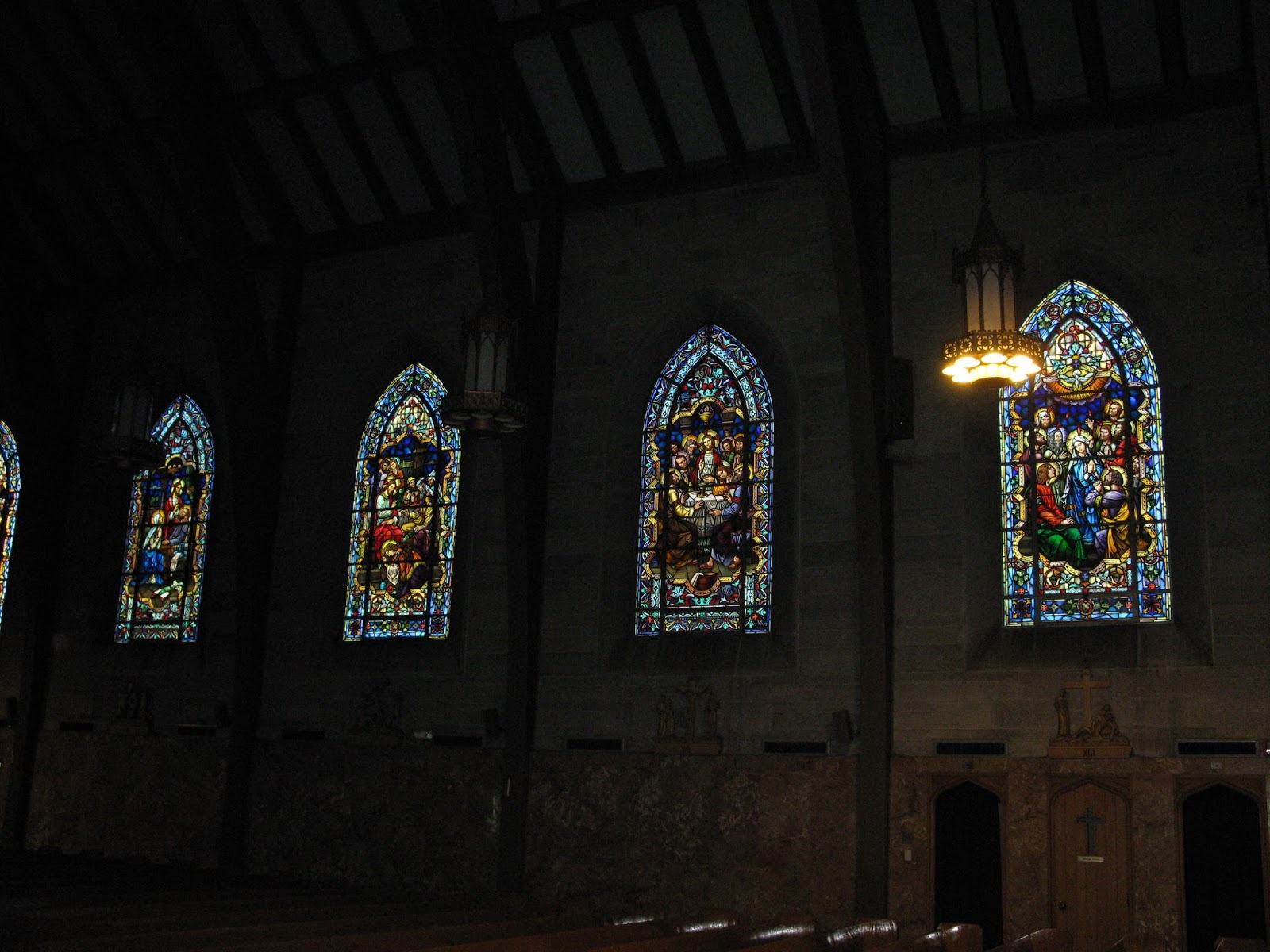


All pictures were taken by me.


