Friday, April 17, 2020

West Africa 2


This blog covers Cote d’Ivoire (the Ivory Coast), Guinea, Sierra Leone, and Liberia.

Cote d'Ivoire


Cote d’Ivoire became a French protectorate in 1843, a French colony in 1893, and became independent in 1960.  Capuchin missionaries came to the region in 1637, but it was not until 1895 that the Holy Ghost Fathers and the Society for African Missions began evangelization efforts among the native people.  Today, 43 percent of Cote d’Ivoire’s 26 million people are Muslim.  Catholics account for 17 percent and other Christian groups account for 17 percent.  About 19 percent claim no religion.  There are four ecclesiastic provinces—Abidjan, Bouake, Gagnoa, and Korhogo.

Province of Abidjan


The province consists of the southeastern part of the Ivory Coast including the Districts of Abidjan and Lagunes.  The Apostolic Prefecture of Costa D’Avorio was established in 1895 and became an apostolic vicariate in 1911.  This became the Metropolitan Archdiocese of Abidjan in 1955.

St. Paul’s Cathedral in Abidjan is a modern structure built between 1980 and 1985.  It is built on a hill overlooking downtown Abidjan and its most notable feature is a large cross suspended by cables to the Cathedral.  The exterior has 14 terracotta ceramic panels depicting the story of Christ.  The interior can hold 5,000 people and has stained glass windows, paintings, and ceramic panels, all featuring Christian images.


All pictures are from Wikipedia.

The Province has three suffragan dioceses.
  • The Diocese of Grand-Bassam was established in 1982.
  • The Diocese of Yopougon was established in 1982.
  • The Diocese of Agboville was established in 2006.

Province of Bouake


The province consists of the northeastern part of the Ivory Coast including the Districts of Comoe, Lacs, Yamoussoukro, Zanzan, and part of Vallee du Bandama.  The Apostolic Vicariate of Bouake was created in 1951 and became a diocese in 1955.  It became the Metropolitan Archdiocese of Bouake in 1994.  The Cathedral of St. Therese is in Bouake.


From Wikipedia.

The Province has three suffragan dioceses.
  • The Diocese of Abengourou was created in 1963.
  • The Diocese of Bondoukou was created in 1987.
  • The Diocese of Yamoussoukro was created in 1992.

Province of Gagnoa


The province consists of the southwestern part of the Ivory Coast including the Districts of Bas-Sassandra, Goh-Djiboua, Montagnes, and Sassandra-Marahoue.  The Diocese of Gagnoa was created in 1956 and became a metropolitan archdiocese in 1994.  The Cathedral of St. Anne is in Gognoa.


From Wikipedia.

The Province has three suffragan dioceses.
  • The Diocese of Daloa began as an apostolic vicariate in 1940 and became a diocese in 1955.
  • The Diocese of Man was established in 1968.
  • The Diocese of San Pedro-en-Cote-D’Ivoire was created in 1989.

Province of Korhogo


The province consists of northwest Ivory Coast, including the districts of Denguele, Savanes, Woroba, and part of Vallee du Bandama.  The Apostolic Prefecture of Korhogo was established in 1911, but was suppressed in 1952.  The Diocese of Korhogo was created in 1971 and became the Metropolitan Archdiocese of Korhogo in 1994.  The Cathedral of St. John the Baptist in Korhogo was built in 1957.


From Panaramio

The Province has two suffragan dioceses.
  • The Diocese of Katiola began as an apostolic prefecture in 1911, became an apostolic vicariate in 1952, and a diocese in 1955.
  • The Diocese of Odienne was established in 1994.

Guinea


France made Guinea a protectorate in 1849 and Guinea became part of French West Africa in 1895.  Guinea declared its independence in 1958.

Although Portuguese missionaries visited the area in the 15th Century, evangelization did not begin until 1877 with the arrival of the Holy Ghost Fathers.  Today, 88 percent of Guinea’s 12 million people are Muslim and 8 percent are Christian.  There are 270,000 Catholics and one ecclesiastic province—Conakry.

Province of Conakry


The province consists of the nation of Guinea.  The Apostolic Prefecture of French Guinea was established in 1897 and became an apostolic vicariate in 1920.  This became the Metropolitan Archdiocese of Conakry in 1955.  St. Mary’s Cathedral in Conakry was built in the 1930s with an Orthodox design.


The first two pictures are from Pinterest and the last is from Wikipedia.

Pictures with sources.

The Province has four suffragan dioceses.
  • The Diocese of N’Zerekore was established as an apostolic prefecture in 1937 and was promoted to a diocese in 1959.
  • The Diocese of Kankan was established as an apostolic prefecture in 1949 and was promoted to a diocese in 1993.
  • The Diocese of Gueckedou was established in 2023.
  • The Diocese of Boke was established in 2024.

Sierra Leone


The Portuguese built a fort in Sierra Leone in the late 15th Century and the Dutch, French, and British soon established bases of their own.  All four nations engaged in the slave trade.  In the 18th Century, the British, who by this time controlled Sierra Leone, relocated a few thousand former slaves to Sierra Leone from London and Canada.  Thus, Freetown was formed.  After the abolition of the slave trade in 1807, thousands more former slaves were brought to Sierra Leone by the British.  Sierra Leone became a British Crown Colony in 1808 and was granted independence in 1961.

Many of the former slaves that were settled in Sierra Leone, especially in Freetown, were Methodists.  Catholicism traces its roots in Sierra Leone to 1510 with the arrival of Portuguese missionaries.  Jesuits came in 1604 and Capuchins in 1617, but both orders had left Sierra Leon by the early 18th Century.  African Missions Society priests came to Sierra Leone in 1858 and were joined by the Holy Ghost Fathers in 1864 to restart missionary efforts.

There is one ecclesiastic province—Freetown.  Muslims make up 79 percent of Sierra Leone’s population of 6 million.  Christians make up 21 percent of the population.  About 300,000 are Catholic.

Province of Freetown


The province consists of the nation of Sierra Leone.  The Apostolic Vicariate of Sierra Leone was established in 1858 and became the Diocese of Freetown and Bo in 1950.  This became the Metropolitan Archdiocese of Freetown and Bo in 1970 and became the Metropolitan Archdiocese of Freetown in 2011.  Sacred Heart Cathedral in Freetown was built between 1884 and 1887.


From politicosi.com

The Province has three suffragan dioceses.
  • The Diocese of Makeni was established as an apostolic prefecture in 1952 and became a diocese in 1962.
  • The Diocese of Kenema was established in 1970.
  • The Diocese Bo was established in 2011.

Liberia


Portuguese explorers visited what is now Liberia as early as 1461, but never settled there and Jesuit and Capuchin missionaries visited in the 17th Century, but had little success at evangelization.  Beginning in 1822, free-born Blacks and freed slaves were encouraged by various American groups to resettle in Liberia.  Liberia became an independent republic in 1847—the first in Africa.  Many of these settlers were Protestant and Protestant missionaries had been active since the early 19th Century among the native Liberians.  Some of the settlers were Catholics from Maryland and in 1841, two U.S. priests and a catechist visited Cape Palmas and celebrated the first Mass in Liberia.  Holy Ghost Fathers came in 1843, but many of the missionaries died of fever, and evangelization work lapsed for several decades.  Missionaries returned in 1884, but were again faced with health issues and opposition from the Protestant establishment.  The Society of African Missions took charge of evangelization in 1906 and by 1910, there were almost 3,000 Catholics.

About 86 percent of Liberia’s 4.8 million people are Christian and 12 percent are Muslim.  Of the Christians, 330,000 are Catholic.  There is one ecclesiastic province—Monrovia.

Province of Monrovia


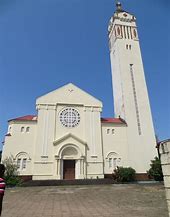
The province consists of the nation of Liberia.  The Apostolic Prefecture of Liberia was established in 1903 and became an apostolic vicariate in 1934.  It became the Metropolitan Archdiocese of Monrovia in 1981.  Sacred Heart Cathedral is in Monrovia.


The top picture is from a blog and the bottom picture is from Pinterest.

The Province has two suffragan dioceses.
  • The Diocese of Cape Palmas began as an apostolic prefecture in 1950, became an apostolic vicariate in 1962, and was promoted to a diocese in 1981.
  • The Diocese of Gbarnga was established in 1986.

Definitions


The Catholic Church is mostly divided into ecclesiastical provinces—a province consists of a metropolitan archdiocese and one or more dioceses.  The province and the archdiocese are led by an archbishop.  Each of the dioceses is called a suffragan diocese and is led by a bishop.  Archbishops have some responsibilities for the province, but all bishops answer directly to the Pope.  There are also jurisdictions below the level of a diocese.  These include apostolic vicariates and apostolic prefectures, both of which are missionary territories.

Wednesday, April 1, 2020

Nigeria

Portuguese explorers introduced Catholicism to Nigeria in the 15th Century, but serious evangelization did not begin until the 1840s.  Nigeria became a British crown colony in 1861 and gained its independence in 1960.

Slightly more than half of Nigeria’s 203 million people are Muslim.  Catholics make up 11 percent and other Christians 36 percent.  There are nine ecclesiastical provinces:  Abuja, Benin City, Calabar, Ibadan, Jos, Kaduna, Lagos, Onitsha, and Owerri.

In addition, the Maronite Diocese of Our Lady of the Annunciation of Ibadan serves Maronite-rite Catholics in Nigeria, Benin, Burkina Faso, Cameroon, Cote d’Ivoire, Ghana, Liberia, Senegal, and Togo.  It was established as an apostolic exarchate (a missionary diocese) in 2014 and became a diocese in 2018.  It reports directly to the Maronite Patriarch.

Province of Lagos


The province consists of the States of Lagos and Ogun in southwestern Nigeria.  The Apostolic Vicariate of Dahomey was established in 1860 and became the Metropolitan Archdiocese of Lagos in 1950.  The Cathedral of the Holy Cross in Lagos was built between 1934 and 1939 in a French Gothic style.  See hcclng.org.


The first and last picture are from the Cathedral's website, the second picture is from Pinterest, and the third is from Wikipedia.

The Province has two suffragan dioceses.
  • The Diocese of Ijebu-Ode was established in 1969.
  • The Diocese of Abeokuta was established in 1997.

Province of Onitsha


The province consists of the States of Anambra, Ebonyi, and Enugu in Southern Nigeria.  The Apostolic Prefecture of Lower Niger was created in 1889 and became an apostolic vicariate in 1920.  It became the Metropolitan Archdiocese of Onitsha in 1950.

The Cathedral Basilica of the Most Holy Trinity in Onitsha was built between 1930 and 1935, but was badly damaged during the Nigerian Civil War (1967-1970).  The Cathedral was restored and later enlarged.  Pope Benedict XVI designated the Cathedral as a minor basilica in 2007.  The Cathedral Basilica contains the tomb of Blessed Michael Cyprian Iwene Tansi, a Nigerian priest.


From the Diocesan website.

The Province has eight suffragan dioceses.
  • The Diocese of Enugu was created in 1962.
  • The Diocese of Abakaliki was created in 1973.
  • The Diocese of Awka was created in 1977.
  • The Diocese of Nsukka was created in 1990.
  • The Diocese of Nnewi was created in 2001.
  • The Diocese of Awgu was created in 2005.
  • The Diocese of Ekwulobia was created in 2020.
  • The Diocese of Aguleri was created in 2023.

Province of Kaduna


The province consists of the States of Kaduna, Kano, Katsina, Kebbi, Niger, Sokota, and Zamfara in northwestern Nigeria.  The Apostolic Prefecture of Eastern Nigeria was created in 1911 and became the Diocese of Kaduna in 1953.  It was promoted to the Metropolitan Archdiocese of Kaduna in 1959.  St. Joseph’s Cathedral in Kaduna was built in 1934 to replace a smaller church.  See archkd.org/about/st-josephs-cathedral.


From jubilaeummisericordiae.va

The Province has six suffragan dioceses.
  • The Diocese of Sokoto began as an apostolic prefecture in 1953 and became a diocese in 1964.
  • The Diocese of Minna was established as an apostolic prefecture in 1964 and became a diocese in 1973.
  • The Diocese of Kafanchan was created in 1995.
  • The Diocese of Kano started as a Mission sui juris in 1991, became an apostolic vicariate in 1995 and a diocese in 1999.
  • The Diocese of Zaria created in 2000.
  • The Diocese of Kontagora was established as an apostolic prefecture in 1995, became an apostolic vicariate in 2002, and a diocese in 2020.
  • The Diocese of Katsina was created in 2023.

Province of Abuja


The province consists of the Federal Capital Territory, and the States of Benue, Kogi, and Nasarawa in Central Nigeria.  The Mission sui juris of Abuja was established in 1981 and became the Diocese of Abuja in 1989.  The Metropolitan Archdiocese of Abuja was established in 1994 with the creation of the new Province.  The current Our Lady Queen of Nigeria Pro-Cathedral in Abuja was dedicated in 2012, but construction is underway on the Cathedral of St. John Paul II.  See abujacatholicarchdiocese.org.


From jubilaeummisericordiae.va

The Province has seven suffragan dioceses.
  • The Diocese of Makurdi began as an apostolic prefecture in 1934 and became a diocese in 1959.
  • The Diocese of Lokoja started as an apostolic prefecture in 1955 became a diocese in 1964.
  • The Diocese of Idah began as an apostolic prefecture in 1968 and was promoted to a diocese in 1977.
  • The Diocese of Otukpo was created in 1995.
  • The Diocese of Lafia was created in 2000.
  • The Diocese of Gboko was created in 2012.
  • The Diocese of Katsina-Ala was created in 2012.

Province of Benin City


The province consists of the States of Delta and Edo in Southwestern Nigeria.  The Apostolic Prefecture of Upper Niger was created in 1884 and became the Apostolic Vicariate of Western Nigeria in 1918.  The Diocese of Benin City was created in 1950 and was promoted to a metropolitan archdiocese in 1994.  Holy Cross Cathedral is in Benin City.  See catholicarchdioceseofbenin.com.

The Province has five suffragan dioceses.
  • The Diocese of Warri was established in 1964.
  • The Diocese of Issele-Uku was established in 1973.
  • The Diocese of Auchi was established in 2002.
  • The Diocese of Uromi was established in 2005.
  • The Diocese of Bomadi started as a Mission sui juris in 1991, became an apostolic vicariate in 1996 and a diocese in 2017.

Province of Calabar


The province consists of the States of Akwa Ibom, Bayelsa, Cross River, and Rivers in Southern Nigeria.  The Apostolic Prefecture of Calabar was established in 1934 and became an apostolic vicariate in 1947, and a diocese in 1950.  It became the Metropolitan Archdiocese of Calabar in 1994.  Sacred Heart Cathedral is in Calabar.


From Bantuphotos.

The Province has four suffragan dioceses.
  • The Diocese of Ogoja was established as an apostolic prefecture in 1938 and became a diocese in 1955.
  • The Diocese of Port Harcourt was created in 1961.
  • The Diocese of Ikot Ekpene was created in 1963.
  • The Diocese of Uyo was created in 1989.

Province of Ibadan


The province consists of the States of Ekiti, Kwara, Ondo, Osun, and Oyo in Southwestern Nigeria.  The Apostolic Prefecture of Ibadan was created in 1952 and became a diocese in 1958.  It was promoted to a metropolitan archdiocese in 1994.  The Cathedral in Ibadan is dedicated to St. Mary.  See ibadanarchdiocese.org.


From Facebook.

The Province has five suffragan dioceses.
  • The Diocese of Ondo began as an apostolic vicariate in 1943 and became a diocese in 1950.
  • The Diocese of Oyo was created as an apostolic prefecture in 1949 and became a diocese in 1963.
  • The Diocese of Ilorin started as an apostolic prefecture in 1960 and became a diocese in 1969.
  • The Diocese of Ekiti was created in 1972.
  • The Diocese of Osogbo was created in 1995.

Province of Jos


The province consists of the States of Adamawa, Bauchi, Borno, Gombe, Plateau, Taraba, and Yobe in northeastern Nigeria.  The Apostolic Prefecture of Jos was established in 1934 and became the Diocese of Jos in 1953.  The Metropolitan Archdiocese of Jos was established in 1994.  The Cathedral of Our Lady of Fatima is in Jos.


From Revolvy.

The Province has six suffragan dioceses.
  • The Diocese of Yola was established as an apostolic prefecture in 1950 and became a diocese in 1962. 
  • The Diocese of Maiduguri was established as an apostolic prefecture in 1953 and became a diocese in 1966. 
  • The Diocese of Jalingo was established in 1995.
  • The Diocese of Bauchi was established as an apostolic vicariate in 1996 and became a diocese in 2003.
  • The Diocese of Shendam was established in 2007.
  • The Diocese of Pankshin was established in 2014.
  • The Diocese of Wukari was established in 2022.

Province of Owerri


The province consists of the States of Abia and Imo in Southern Nigeria.  The Apostolic Vicariate of Owerri was established in 1948 and became a diocese in 1950.  It was promoted to a metropolitan archdiocese in 1994.  Assumption Cathedral in Owerri was built between 1954 and 1980 in a modern Renaissance style.  The dome rises 120 feet above the floor and is 101 feet in diameter.  The Cathedral can hold 3,000 people.  See owarch.org.


From the Archdiocesan website.

The Province has five suffragan dioceses.
  • The Diocese of Umuahia was established in 1958.
  • The Diocese of Orlu was established in 1980.
  • The Diocese of Okigwe was established in 1981.
  • The Diocese of Ahiara was established in 1987.
  • The Diocese of Aba was established in 1990.

Definitions


The Catholic Church is mostly divided into ecclesiastical provinces—a province consists of a metropolitan archdiocese and one or more dioceses.  The province and the archdiocese are led by an archbishop.  Each of the dioceses is called a suffragan diocese and is led by a bishop.  Archbishops have some responsibilities for the province, but all bishops answer directly to the Pope.  There are also jurisdictions below the level of a diocese.  These include apostolic vicariates and apostolic prefectures.  Both are missionary territories below the level of a diocese.  There is also a jurisdiction called a mission sui juris.  A mission sui juris may be part of a province and is often administered by a bishop of another diocese.

Most Catholics in the world belong to the Latin or Roman rite.  Rite refers to liturgical practices, ecclesiastical discipline, and spiritual heritage.  Many Catholics belong to one of two dozen Eastern rite churches.  Eastern rite churches trace their heritage to Eastern Europe and the Middle East.

A basilica is an honorary title bestowed on a church by the Pope because of the church’s antiquity, dignity, historical importance, or significance as a center of worship.  Some cathedrals are also basilicas.  Each basilica has a ceremonial umbrella in the papal colors of white and yellow and a ceremonial bell.  Both of these are symbolic of the Pope’s special relationship to the basilica.

Monday, March 23, 2020

Czech Republic and Slovakia

This blog covers two ecclesiastical provinces in the Czech Republic and three ecclesiastical provinces in Slovakia.

Czech Republic


An early ruler of Bohemia (what is now the western part of the Czech Republic) was converted to Catholicism by Saints Cyril and Methodius in the 9th Century and adopted Catholicism as the state religion.  Most Bohemians became Hussites—a form of Protestantism—in the 15th Century and by 1600, only about 20 percent of the people were Catholic.  Bohemia and Moravia (what is now the eastern part of the Czech Republic) were conquered by the Holy Roman Empire under the Hapsburgs in 1620 and the people were re-converted to Catholicism.  As recently as 1910, 97 percent of Czechs were Catholic.  After the First World War and the end of what was then called the Austro-Hungarian Empire, many Czechs abandoned the Church due to their resentment of their former Austrian rulers who were both German and Catholic.  It was at this time that the nation of Czechoslovakia was born.  The Germans conquered Czechoslovakia at the beginning of the Second World War and the Soviet Union took control after the war.  The Communists tightly controlled the Church and by 1991, after Communism fell, only 39 percent of the people claimed to be Catholic.  In 1993, the Czech Republic and Slovakia became separate nations.

The Czech Republic has 11 million people and 10 percent are Catholic and one percent are Protestant.  Almost 89 percent of Czechs are not religious.  The Czech Republic has two Catholic provinces—Prague and Olomouc.  There is also the Apostolic Exarchate of the Czech Republic, established in 1996, to serve about 17,000 Ruthenian-rite Catholics.  It is immediately subject to the Pope.

Province of Prague


The province consists of the western and central portions of the Czech Republic.  The Diocese of Prague was established in 973 and became a metropolitan archdiocese in 1344.

The Cathedral of Saints Vitus, Wenceslaus, and Adalbert in Prague is a Gothic church located within the Prague Castle complex.  It contains the tombs of many Kings of Bohemia and Holy Roman Emperors.  The cathedral is 407 feet long and 197 feet wide and has three towers.  Construction of the current cathedral began in 1344 and was not completed until early in the 20th Century.  Relics of St. Wenceslaus are contained in a chapel dedicated to him.  The chapel’s lower walls are decorated with more than 1,300 semi-precious stones.  There are also several 14th and 16th Century paintings.  Behind the Chapel is the Crown Chamber which holds the Czech Crown Jewels.  The Cathedral’s pipe organ was built by Josef Melzel in 1931 and has 4,475 pipes.


All the pictures are from Wikipedia.

The Province has four suffragan dioceses.
  • The Diocese of Litomerice was established in 1655.
  • The Diocese of Hradec Kralove was established in 1664.
  • The Diocese of Ceske Budejovice (Budweis) was established in 1785.
  • The Diocese of Plzen (Pilsen) was established in 1993.

Province of Olomouc


The province consists of the eastern portion of the Czech Republic.  The Diocese of Olomouc was created in 1063 and became a metropolitan archdiocese in 1777.

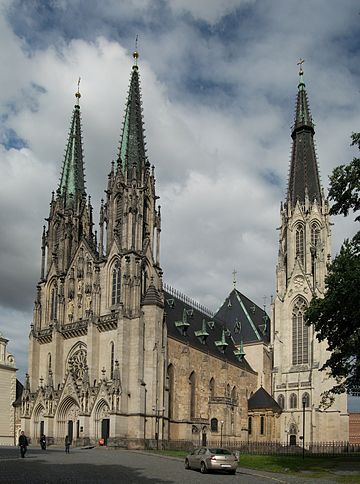
St. Wenceslas Cathedral in Olomouc was built in a Romanesque style in the 12th Century and greatly modified in a Gothic style in the 13th and 14th Centuries.  The Cathedral has three towers, with the one in the rear rising 330 feet.  Mozart composed his 6th Symphony here in 1767.  See katedralaolomouc.cz.


The first picture is from TripAdvisor and the other two are from Wikipedia.

The Province has two suffragan dioceses.
  • The Diocese of Brno was established in 1777.
  • The Diocese of Ostrava-Opava was established in 1996.

Slovakia


For 1000 years, until the end of the First World War, Slovakia was part of the Hungarian Kingdom.  After the war, the Slovaks and the Czechs formed one nation—Czechoslovakia.  This union lasted (except during the Second World War) until 1993, when they split into two nations.  Catholic missionaries (including Benedictines and Cistercians) came to Slovakia in the 8th Century and the Diocese of Nitra was established in 880.  In 1001, Slovakia became part of the Province of Esztergom (in what is now Hungary).  Even from early times, Catholics in Slovakia were divided between the Roman rite and the Eastern (Slovak) rite.  Two significant events happened in the 16th Century.  First, the Protestant Reformation was successful in Slovakia with many members of the nobility converting—by 1600, most Slovakians were Protestant.  Second, Turkey occupied Esztergom in 1543 forcing the Archbishops to flee to Trnava, where they resided for 300 years.  The archbishops began a long process of restoring the Faith to the people helped by the Jesuits.  In the 18th Century, Slovakia became part of the Holy Roman Empire by which time most Slovakians were Catholic.

Slovakia has 5.4 million people—62 percent are Catholic, 12 percent are other Christians, and 20 percent are not religious.  Slovakia has two Roman-rite Catholic provinces—Kosice and Bratislava—and one Slovak-rite province—Presov.  A military diocese was established in 2003.

Province of Kosice


The province consists of eastern Slovakia.  The Diocese of Kosice was created in 1804 and became the Metropolitan Archdiocese of Kosice in 1995.

The Cathedral of St. Elizabeth in Kosice is Slovakia’s largest church—it covers 13,000 square feet and can hold 5,000 worshipers.  It is a Gothic church, with two towers, built between 1380 and 1508.  The main altar was built in the late 15th Century and features 48 paintings featuring scenes related to St. Elizabeth, the Passion of Christ, and Advent.  There are also nine other altars.  The Cathedral’s bronze baptistery dates to the 14th Century and comes from the previous St. Elizabeth Cathedral.  Among the Cathedral’s other features are Gothic frescoes, some dating to the 16th Century; a sculpture of Calvary from 1420, and a pipe organ adorned with statues of four Kings of Hungary.  There were periods during the 16th and 17th Centuries when the church was controlled by Protestants.


The first picture is from Flickr and the others are from Wikipedia.

The Co-Cathedral of St. Nicholas in Presov was built in the 14th Century in a Gothic style.  Major changes were made in the 16th Century, in the 18th Century in a Baroque style, and in the 19th Century in a Neo-Gothic style.  In addition to the main altar, which is primarily Gothic, there are five other altars built in a variety of architectural styles.  The Cathedral’s larger pipe organ dates to the 17th Century and has 3,480 pipes.  There is also a smaller 17th Century pipe organ.


All pictures are from Wikipedia.

The Province has two suffragan dioceses.
  • The Diocese of Roznava was created in 1776.
  • The Diocese of Spis was created in 1776.

Province of Bratislava


The province consists of western Slovakia.  The Metropolitan Archdiocese of Bratislava-Trnava was established in 1995 and became the Metropolitan Archdiocese of Bratislava in 2008.

St. Martin’s Cathedral in Bratislava is a Gothic church that was constructed between 1311 and 1452, although work continued through the 18th Century.  Its 279-foot tower is topped with a gold-plated replica of the Crown of St. Stephen (weighing 330 pounds).  St. Martin’s served as the coronation church for the Kings of Hungary from 1563 to 1830.  Outside the cathedral is a Baroque equestrian statue of St. Martin.  The cathedral’s Baroque Chapel of St. John the Merciful contains the remains of this 7th Century saint.


The top two pictures are from Expedia and the bottom two are from Wikipedia.

The Province has four suffragan dioceses.
  • The Archdiocese of Trnava began as an apostolic administration in 1922 and became the Metropolitan Diocese of Trnava in 1977.  It was demoted to an archdiocese in 2008.
  • The Diocese of Nitra was established in 880.
  • The Diocese of Banska Bystrica was established in 1776.
  • The Diocese of Zilina was established in 2008.

Slovak Metropolitanate of Presov


The Metropolitanate consists of the 210,000 Slovak-rite Catholics in Slovakia.  The Diocese of Presov was established in 1818 and became the archdiocese for the Slovak-rite Metropolitan in 2008.

The Cathedral of St. John the Baptist in Presov dates to the 14th Century, but it was essentially rebuilt in a Baroque style in the 18th Century.  Over the years, various artists have painted murals and frescoes in the Cathedral.  The Archbishop’s crosier (staff) was donated by Emperor Franz Jozef in 1883.  The Cathedral has a copy of the Shroud of Turin and a statue of the Virgin and Child.  Both Mary and the Child Jesus wear gold crowns with semi-precious jewels.


Pictures are from Inspirock and Wikipedia.

The Metropolitanate has two suffragan dioceses.
  • The Diocese of Kosice began as an apostolic exarchate in 1997 and became a diocese in 2008.
  • The Diocese of Bratislava was established in 2008.

Definitions


The Catholic Church is mostly divided into ecclesiastical provinces—a province consists of a metropolitan archdiocese and one or more dioceses.  The province and the archdiocese are led by an archbishop.  Each of the dioceses is called a suffragan diocese and is led by a bishop.  Archbishops have some responsibilities for the province, but all bishops answer directly to the Pope.  There are also archdioceses that are not metropolitan archdioceses.  There are also jurisdictions below the level of a diocese.  These include apostolic administrations, which are missionary territories below the level of a diocese.

Most Catholics in the world belong to the Latin or Roman rite.  Rite refers to liturgical practices, ecclesiastical discipline, and spiritual heritage.  Many Catholics belong to one of two dozen Eastern rite churches.  Eastern rite churches trace their heritage to Eastern Europe and the Middle East.  Eastern rite churches sometimes use different terminologies.  For example, an apostolic exarchy is a missionary diocese.