Monday, June 1, 2020

India—1


India is one of the world’s oldest civilizations.  Europeans colonized portions of India in the 16th Century, including the Portuguese at Goa in 1510.  By the 19th Century, the British took control of India and it became one of England’s most important colonies.  India gained independence in 1947 before separating into the separate nations of India, Pakistan, and Bangladesh.

Tradition holds that St. Thomas the Apostle brought the Catholic Faith to India in the First Century (St. Bartholomew the Apostle may also have come to India). European missionaries visited in the 16th Century and found native Indians practicing a form of Catholicism.  These missionaries included Franciscans, Dominicans, Augustinians, and especially Jesuits.  The great Jesuit missionary, St. Francis Xavier, came to Goa in 1542 and is buried there.

The population of India is 1.3 billion and 80 percent are Hindu.  Another 14 percent are Muslim and just over 2 percent are Christian.  There are about 20 million Catholics, mostly in Southern India, at least 10 million Protestants, and about 4 million Orthodox Christians.  Indian Catholics belong to one of three liturgical rites:  Roman, Syro-Malabar, and Syro-Malankar.

Most Catholics in the world belong to the Latin or Roman rite.  Rite refers to liturgical practices, ecclesiastical discipline, and spiritual heritage.  Many Catholics belong to one of two dozen Eastern rite churches—including the Syro-Malabar and Syro-Malankar churches.

Syro-Malabar Catholics are the descendants of the St. Thomas Christians.  European missionaries converted them from a 5th Century heresy related to the human and divine natures of Jesus.  There are 4 million Syro-Malabar Catholics in India today.  Syro-Malankar Catholics broke away from the Malankara Orthodox Church in 1930 and today number 400,000 in India.

This blog will cover 10 Roman-rite provinces in southern India.

Province of Goa and Daman


The province consists of the State of Goa, the Union Territory of Daman and Diu, and part of the State of Maharashtra.  The Diocese of Goa was established in 1533 and became a metropolitan archdiocese in 1558.  It attained its current name in 1928, before being demoted to an archdiocese in 1976.  It once again became a metropolitan archdiocese in 2006.  The Archbishops of Gao and Daman were given the title, Patriarch of the East Indies, by Pope Leo XIII in 1886. 

The Cathedral of St. Catherine of Alexandria in Old Goa (also known as Se Cathedral) was built by the Portuguese between 1562 and 1619.  The Cathedral is built in a Portuguese-Manueline style with a Tuscan exterior and a Corinthian interior.  It originally had two towers, but one collapsed in 1776.  The main altar has six gilded panels depicting the life of St. Catherine.  The Cathedral also has a large bell that is reputed to be one of the best in the world.  The Chapel of the Cross of Miracles is on the site where a vision of Christ is said to have appeared in 1619.  A baptismal font from 1532 was used by St. Francis Xavier to baptize many Indian converts—St. Francis is buried in another church in Goa.  The Cathedral is one of the largest churches in Asia, measuring 250 feet long, 181 feet wide, and 115 feet tall.


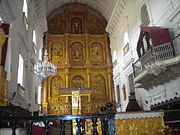


All pictures are from Wikipedia.

Holy Jesus (Bom Jesus) in Daman was built in 1603 but is no longer a cathedral.  Pope Pius XII declared the church to be a minor basilica in 1946.

The Province has one suffragan diocese.

  • The Diocese of Sindhudurg was created in 2005.


Province of Madras and Mylapore


The province is in the northern part of the State of Tamil Nadu.  The Metropolitan Archdiocese of Madras and Mylapore became as an apostolic prefecture in 1642, became an apostolic vicariate in 1642, and was promoted to a metropolitan archdiocese in 1886.

St. Thomas Cathedral Basilica is in Chennai (also known as Madras).  St. Thomas the Apostle is believed to have preached the Gospel in India between A.D. 52 and his martyrdom in A.D. 72.  The Portuguese built a church on the site of his martyrdom and tomb in 1547.  The British replaced this church with the current church in 1893.  The neo-Gothic Cathedral has stained-glass windows depicting St. Thomas’ life, 13th Century wall plaques, a 16th Century stone sundial, and a 450-year-old Madonna made in Portugal.  The chapel in the basement contains relics of St. Thomas and the lance that killed him.  Pope Pius XII honored the Cathedral as a minor basilica in 1956.


All pictures are from Wikipedia

The Co-Cathedral of St. Mary of the Angels in Chennai was built by the Capuchins in the 17th Century and served as the archdiocesan cathedral from 1886 to 1952.


As noted.

The Province has four suffragan dioceses.

  • The Diocese of Coimbatore was created as an apostolic vicariate in 1850 and became a diocese in 1886.
  • The Diocese of Vellore was created in 1952.
  • The Diocese of Ootacamund was created in 1955.
  • The Diocese of Chingleput was created in 2002.


Province of Verapoly


The province consists of the northern part of the State of Kerala.  The Metropolitan Archdiocese of Verapoly was established as the Apostolic Vicariate of Malabar in 1659 and became the Metropolitan Archdiocese of Verapoly in 1886.  St. Francis Assisi Cathedral in Ernakulam (Kochi) was built between 1977 and 1981.


Both pictures are from blogspot.com.

The Province has three suffragan dioceses.

  • The Diocese of Cochin was created in 1558, was suppressed in 1838, and restored in 1886.
  • The Diocese of Vijayapuram was created in 1930.
  • The Diocese of Kottapuram was created in 1987.

Province of Pondicherry and Cuddalore


The province consists of the central part of the State of Tamil Nadu and the Union Territory of Pondicherry.  The Metropolitan Archdiocese of Pondicherry and Cuddalore was established in 1776 as the Mission sui juris of Coromandel Coast.  It became the Apostolic Vicariate of Pondicherry in 1836 and became a metropolitan archdiocese in 1887.

Immaculate Conception Cathedral in Pondicherry was originally built by Jesuits in 1689 when Pondicherry was a French colony, but the Dutch destroyed it the next year.  A second church was built in 1699, but it was replaced by a larger church in 1736.  The British destroyed this church in 1761. The current church was built between 1765 and 1791.


All pictures are from Wikipedia.

The Province has four suffragan dioceses.

  • The Diocese of Kumbakonam was created in 1899.
  • The Diocese of Salem was created in 1930.
  • The Diocese of Tanjore was created in 1952.
  • The Diocese of Dharmapuri was created in 1997.


Province of Bangalore


The province consists of the State of Karnataka.  The Diocese of Bangalore was created in 1940 and became a metropolitan archdiocese in 1953.

St. Francis Xavier Cathedral in Bangalore was built between 1911 and 1932 and has two domed towers.  The building is made of granite with concrete roofing covered with Mangalore tiles.  The Cathedral is 160 feet wide and can hold 5,000 people. The floor is made of white and red granite. The stained glass windows depict the mysteries of the Rosary and other biblical themes.  See sfxcathedralbangalore.in.


Both pictures are from Wikipedia.

The Province has nine suffragan dioceses.

  • The Diocese of Mangalore was established as an apostolic vicariate in 1674 before being suppressed in 1700.  It once again became an apostolic vicariate in 1845 and a diocese in 1886.
  • The Diocese of Mysore was established as an apostolic vicariate in 1850 and became a diocese in 1886.
  • The Diocese of Bellary was established as a Mission sui juris in 1928 and was promoted to a diocese in 1949.
  • The Diocese of Belgaum was established in 1953.
  • The Diocese of Chikmagalur was established in 1963.
  • The Diocese of Karwar was established in 1976.
  • The Diocese of Shimoga was established in 1988.
  • The Diocese of Gulbarga was established in 2005.
  • The Diocese of Udupi was established in 2012.


Province of Hyderabad


The province consists of the States of Telangana and western Andhra Pradesh.  The Metropolitan Archdiocese of Hyderabad began as an apostolic vicariate in 1851, became a diocese in 1886, and a metropolitan archdiocese in 1953.

St. Joseph’s Cathedral in Hyderabad was constructed in the early 1870s and seats 500.  The façade and bell towers were added in 1891.  The five bells in the bell tower were made in Italy.  The Cathedral has an imitation of Michelangelo’s Pieta.  Other art work includes marble statues of the Blessed Mother and St. Anthony, an oil painting of the Madonna and Child, and bas-relief Stations of the Cross.  See stjosephcathedral.in.


Picture from Wikipedia.  See the Cathedral website for more pictures.

The Province has five suffragan dioceses.

  • The Diocese of Warangal was created in 1952.
  • The Diocese of Kurnool was created in 1967.
  • The Diocese of Nalgonda was created in 1976.
  • The Diocese of Cuddapah was created in 1976.
  • The Diocese of Khammam was created in 1988.

Province of Madurai


The province is in the southern part of Tamil Nadu civil province.  The Metropolitan Archdiocese of Madurai began as a diocese in 1938 before being promoted to a metropolitan archdiocese in 1953.

The Cathedral of Our Lady of Sorrows in Madurai was built between 1912 and 1916 in a Gothic style.  The Cathedral was expanded in the 1960s and has two spires and a marble altar.  See maduraiarchdiocese.weebly.


The top picture is from the local tourist board and the bottom picture is from Panaramio.

The Province has seven suffragan dioceses.

  • The Diocese of Tiruchirapalli was established in 1606 as a Mission sui juris, but was suppressed in 1773.  It became an apostolic vicariate in 1836 and a diocese in 1886.
  • The Diocese of Tuticorin was established in 1923.
  • The Diocese of Kottar was established in 1930.
  • The Diocese of Palayamkottai was established in 1973.
  • The Diocese of Sivagangai was established in 1987.
  • The Diocese of Dindigul was established in 2003.
  • The Diocese of Kuzhithurai was established in 2014.


Province of Visakhapatnam


The province consists of the eastern part of the State of Andhra Pradesh.  The Metropolitan Archdiocese of Visakhapatnam began as an apostolic pro-vicariate in 1845, became an apostolic vicariate in 1850, a diocese in 1886 before being promoted to a metropolitan archdiocese in 2001.

Saint Peter’s Cathedral in Visakhapatnam was completed in 1981 and became the Archdiocesan cathedral in 1986.  See archdioceseofvisakhapatnam.org.

See www.youtube.com/watch?v=UMVbZIAyLbI


St. Anne’s Co-Cathedral in Visakhapatnam traces its origins to a 1770 house church—the first Catholic church in the city.  The current church was completed in 1854 and became the Cathedral for the Diocese.  It became the Co-Cathedral in 1986.


From the Archdiocesan website.

The Province has five suffragan dioceses.

  • The Diocese of Nellore was established in 1928.
  • The Diocese of Vijayawada was established as a Mission sui juris in 1933 before becoming a diocese in 1937.
  • The Diocese of Guntur was established in 1940.
  • The Diocese of Eluru was established in 1976.
  • The Diocese of Srikakulam was established in 1993.


Province of Trivandrum


The province consists of southern Kerala civil province.  The Diocese of Trivandrum was established in 1937 and became the Metropolitan Archdiocese of Trivandrum in 2004.

The Cathedral of St. Joseph in Trivandrum began as a parish church in 1873, but has been enlarged.  The Gothic façade and bell tower were added in 1927.  The bell tower has three bells that were made in Belgium.  Renovations were done between 2008 and 2010 when the church was painted white, rather than red.  See stjosephmetropolitancathedraltrivandrum.org.


Pictures are from the Archdiocesan website, Panaramio, and Wikipedia.

The Province has four suffragan dioceses.

  • The Diocese of Alleppey was created in 1952.
  • The Diocese of Neyyattinkara was created in 1996.
  • The Diocese of Punalur was created in 1985.
  • The Diocese of Quilon was created in 1329, but suppressed in 1533.  It was restored as an apostolic vicariate in 1845 and once again became a diocese in 1886.


Province of Calicut


The province consists of part northern Kerala.  The Metropolitan Archdiocese of Calicut was established as a diocese in 1923 and became the Metropolitan Archdiocese of Calicut in 2025.  Mother of God Cathedral was built in the 18th Century.


The Province has two suffragan dioceses.

  • The Diocese of Calicut was created in 1923.
  • The Diocese of Kannur was created 1998.
  • The Diocese of Sultanpet was created in 2013.

Definitions


The Catholic Church is mostly divided into ecclesiastical provinces—a province consists of a metropolitan archdiocese and one or more dioceses.  The province and the archdiocese are led by an archbishop.  Each of the dioceses is called a suffragan diocese and is led by a bishop.  Archbishops have some responsibilities for the province, but all bishops answer directly to the Pope.  There are also jurisdictions below the level of a diocese.  These include apostolic pro-vicariates, apostolic vicariates, and apostolic prefectures.  All are missionary territories below the level of a diocese.  There is also a jurisdiction called a mission sui juris.  A mission sui juris may be part of a province and is often administered by a bishop of another diocese.

A basilica is an honorary title bestowed on a church by the Pope because of the church’s antiquity, dignity, historical importance, or significance as a center of worship.  Some cathedrals are also basilicas.  Each basilica has a ceremonial umbrella in the papal colors of white and yellow and a ceremonial bell.  Both of these are symbolic of the Pope’s special relationship to the basilica.

Friday, May 15, 2020

Oceania—3


This blog will discuss the remaining nations and territories of Oceania not covered in earlier blogs.  See my blog of June 27, 2018 for Guam, the Northern Mariana Islands, and American Samoa; my blog of June 19, 2019 (Oceania 1) for Australia and New Zealand; and my blog of December 2, 2019 (Oceania 2) for Fiji, Samoa, the Solomon Islands, French Polynesia, New Caledonia, Kiribati, Naura, the Cook Islands, Niue, Tuvalu, Tokelau, Vanuatu, and Wallis et Futuna.

Australian Territories


Christmas Island is in the Indian Ocean and was discovered by Europeans in the 17th Century.  The British settled the island in 1888 to exploit phosphate deposits, and transferred control of the island to Australia in 1958.  There are 2,200 people living on the island—70 percent are ethnically Chinese, 20 percent are of European heritage, and 10 percent are Malay.  Muslims account for 19 percent of the people, Buddhists for 18 percent, Catholics for 9 percent, and other Christians for 10 percent.  The rest have no specific religious affiliation.  The island’s 200 Catholics are served by the Archdiocese of Perth, Australia.

The Cocos Islands are 27 coral islands in the Indian Ocean.  Europeans discovered the islands in 1609, but they remained uninhabited until one family settled there and produced copra from the 1820s to 1978.  The British annexed the islands in 1857 and transferred them to Australia in 1955.  About 70 percent of the Islands’ population of 600 are Malays who live on one island and about 20 percent are of English heritage who live on another island.  Muslims account for 75 percent of the population and Christians (Anglicans and Catholics) for 6 percent.  The dozen or so Catholics are served by the Archdiocese of Perth, Australia.

Norfolk Island is an island in the Pacific Ocean which the British used as a penal colony during the late 18th and early 19th Centuries.  The British resettled several former Pitcairn Islanders there in 1856—descendants of the HMS Bounty mutineers and their Tahitian families.  The island became part of Australia in 1913.  About half the population of 1,700 are non-Catholic Christians and 13 percent are Catholic.  The rest claim no particular religion.  The island’s 200 Catholics are served by the Archdiocese of Sydney, Australia.

Former U.S. Territories


The Marshall Islands are located in the Pacific Ocean.  After the Second World War, they were administered by the United States until achieving independence in 1986.  More than 80 percent of the nation’s 78,000 people are Protestant, while the 6,000 or so Catholics account for about 8 percent.  The Catholics are served by the Apostolic Prefecture of the Marshall Islands which was established in 1993.  It is a suffragan jurisdiction of the Province of Agana, Guam.


Cathedral of the Assumption in the Marshall Islands, from Getty images.

The Caroline Islands are an archipelago in the western Pacific Ocean that were administered by the United States after the Second World War.  Independence came in 1986 with the eastern islands becoming the Federated States of Micronesia and the western islands becoming Palau.  Catholic evangelization began around 1890.

Micronesia has 102,000 people and 55 percent are Catholic and 41 percent are Protestant (mostly Congregational).  Palau has 22,000 people and 45 percent are Catholic and 35 percent are Protestant.  Catholics in Micronesia and Palau are served by the Diocese of Caroline Islands, which is a suffragan diocese of the Province of Agana, Guam.  The Diocese began as an apostolic prefecture in 1905, became an apostolic vicariate in 1911, before becoming a diocese in 1979.

Tonga


Tonga, unique among Pacific nations, has always been self-governing.  Tonga was settled for at least 1,000 years before Christ and had formed an empire by the 12th Century.  The Dutch were the first Europeans to visit Tonga beginning in 1616 and Captain James Cook of the British Royal Navy visited three times in the 1770s.  Tonga became a kingdom in 1845 and a constitutional monarchy in 1875.  Tonga was a British protected state from 1900 to 1970 and remains a member of the British Commonwealth.

Protestant missionaries came to Tonga in 1797 and the first King of Tonga converted to Methodism.  Catholic missionaries came to Tonga in 1825, although effective evangelization did not begin until 1842.  Today, 64 percent of Tonga’s 106,000 people are Protestant, 19 percent are Mormon, and 14 percent are Catholic.  The Catholics are served by the Diocese of Tonga, which is immediately subject to the Pope.  It began as an apostolic vicariate in 1842 before becoming a diocese in 1966.  The current Bishop of Tonga was made a Cardinal by Pope Francis in 2015.


St. Mary’s Cathedral, Tonga, from Wikipedia.


The Pitcairn Islands


The Pitcairn Islands are a British Overseas Territory in the Pacific Ocean that was settled in 1790 by nine mutineers from the HMS Bounty along with 18 Tahitians.  Today, there are 43 permanent residents—Pitcairn is the smallest democracy in the world by population.  The only religious institution is a Seventh-day Adventist church.  


Definitions


The Catholic Church is mostly divided into ecclesiastical provinces—a province consists of a metropolitan archdiocese and one or more dioceses.  The province and the archdiocese are led by an archbishop.  Each of the dioceses is called a suffragan diocese and is led by a bishop.  Archbishops have some responsibilities for the province, but all bishops answer directly to the Pope.  There are also jurisdictions below the level of a diocese.  These include apostolic vicariates and apostolic prefectures.  Both are missionary territories below the level of a diocese.

Friday, May 8, 2020

Colombia-2


This blog covers seven ecclesiastic provinces in central and southern Colombia.

Province of Bogota


The province consists of the Capital District and part of the civil department of Cundinamarca.  The Diocese of Santafe en Neuva Granada was established in 1562 and became a metropolitan archdiocese in 1564.  It was renamed Bogota in 1898.

The neo-classical Primatial Cathedral Basilica of the Immaculate Conception in Bogota was built between 1807 and 1823 and covers 57,000 square feet.  The Cathedral has a dozen chapels and was declared a minor basilica by Pope Pius X in 1907.  See cathedral.arquibogota.org.co.


All pictures are from Wikipedia.

The Province has six suffragan dioceses.

  • The Diocese of Zipaquira was created in 1951.
  • The Diocese of Girardot was created in 1956.
  • The Diocese of Facatativa was created in 1962.
  • The Diocese of Engativa was created in 2003.
  • The Diocese of Fontibon was created in 2003.
  • The Diocese of Soacha was created in 2003.


Province of Popayan


The province consists of the civil department of Narino and part of Cauca.  The Diocese of Popayan was created in 1546 and it was promoted to a metropolitan archdiocese in 1900.

The Cathedral Basilica of the Assumption in Popayan was built in a neoclassical colonial style in 1558.  It was rebuilt after earthquakes in 1736 and 1983.  Pope Pius XII designated the cathedral as a minor basilica in 1953.


The first picture is from Flickr and the others are from Wikipedia.

The Province has three suffragan dioceses.

  • The Diocese of Pasto was created in 1859.
  • The Diocese of Ipiales was created in 1964.
  • The Diocese of Tumaco began as an apostolic prefecture in 1927, became an apostolic vicariate in 1961, and a diocese in 1999.


Province of Manizales


The province consists of the civil departments of Caldas, Risaralda, and Quindio, and part of Cundinamarca.  The Diocese of Manizales was created in 1900 and became a metropolitan archdiocese in 1954.

The neo-classical Cathedral Basilica of Our Lady of the Rosary in Manizales is the tallest in Colombia with its central tower rising over 300 feet.  The Cathedral opened in 1939 and can hold 5,000 people.  Pope Pius XII designated the cathedral as a minor basilica in 1951.


Both pictures are from Wikipedia.

The Province has three suffragan dioceses.

  • The Diocese of Armenia was created in 1952.
  • The Diocese of Pereira was created in 1952.
  • The Diocese of La Dorada-Guaduas was created in 1984.


Province of Cali


The province consists of the civil department of Valle del Cauca and part of Cauca.  The Diocese of Cali was established in 1910 and was promoted to a metropolitan archdiocese in 1964.

The baroque Cathedral of St. Peter the Apostle in Cali was built using prison labor between 1772 and 1825.  The towers were added in 1869.  The façade was damaged by a 1925 earthquake, but has been restored.  The Cathedral’s large and expressive crucifix was made in Seville, Spain, and the Stations of the Cross were made in France in the 1940s.  The pipe organ was made in Germany and is one of the largest in Latin America.


The top picture is from Colombia.com and the other two are from Wikipedia.

The Province has four suffragan dioceses.

  • The Diocese of Palmira was created in 1952.
  • The Diocese of Cartago was created in 1962.
  • The Diocese of Buga was created in 1966.
  • The Diocese of Buenaventura was created as an apostolic vicariate in 1952 and became a diocese in 1996.


Province of Ibague


The province consists of the civil departments of Huila and Tolima.  The Diocese of Ibague was created in 1900 and became a metropolitan archdiocese in 1974.  The Cathedral of the Immaculate Conception is in Ibague.


The first picture is from the Archdiocesan website, the second is from Pinterest, and the last is from TripAdvisor.

The Province has four suffragan dioceses.

  • The Diocese of Garzon was created in 1900.
  • The Diocese of Espinal was created in 1957.
  • The Diocese of Neiva was created in 1894, suppressed in 1900, before being restored as a diocese in 1972.
  • The Diocese of Libano-Honda was created in 1989.


Province of Villavicencio


The province consists of the civil department of Guaviare and part of Meta.  Villavicencio began as a territorial prelature in 1903, became an apostolic vicariate in 1908, a diocese in 1964, and a metropolitan archdiocese in 2004.  Our Lady of Mount Carmel Cathedral in Villavicencio was built in 1894 after a fire destroyed an earlier church.


Picture is from Wikipedia.

The Province has two suffragan dioceses.

  • The Diocese of Granada was created as an apostolic prefecture in 1964, became an apostolic vicariate in 1987, and a diocese in 1999.
  • The Diocese of San Jose del Guaviare was created as an apostolic vicariate in 1989 and became a diocese in 1999.


Province of Florencia


The province consists of the civil department of Caqueta and part of Putumayo.  The Apostolic Vicariate of Florencia was established in 1951.  It was promoted to a diocese in 1985 and to a metropolitan archdiocese in 2019.

The Gothic Cathedral of Our Lady of Lourdes in Florencia was built between 1932 and 1937.  The Cathedral can seat 600 people and has a grotto of Our Lady of Lourdes that was imported from Italy.


Both pictures are from Wikipedia.

The Province has two suffragan dioceses.

  • The Diocese of Mocoa-Sibundoy was created as an apostolic vicariate in 1951 and became a diocese in 1999.
  • The Diocese of San Vincente del Caguan was created as an apostolic vicariate in 1985 and became a diocese in 2019.


Definitions


The Catholic Church is mostly divided into ecclesiastical provinces—a province consists of a metropolitan archdiocese and one or more dioceses.  The province and the archdiocese are led by an archbishop.  Each of the dioceses is called a suffragan diocese and is led by a bishop.  Archbishops have some responsibilities for the province, but all bishops answer directly to the Pope.  There are also jurisdictions below the level of a diocese.  These include territorial prelatures, apostolic vicariates, and apostolic prefectures.  All are missionary territories below the level of a diocese.

A basilica is an honorary title bestowed on a church by the Pope because of the church’s antiquity, dignity, historical importance, or significance as a center of worship.  Some cathedrals are also basilicas.  Each basilica has a ceremonial umbrella in the papal colors of white and yellow and a ceremonial bell.  Both of these are symbolic of the Pope’s special relationship to the basilica.

Friday, May 1, 2020

Colombia—1


Spanish missionaries brought the Faith to what is now Colombia in 1508 and established the first dioceses in 1534.  A nation known as Gran Colombia declared its independence from Spain in 1819.  Gran Coloumbia split into smaller nations including Colombia, Ecuador, and Venezuela in 1830.  Colombia has 48 million people and 79 percent are Catholic.  About 14 percent are Protestant.

Colombia has 14 ecclesiastical provinces.  In addition, there is a military diocese, established in 1949, and an apostolic exarchate for Maronite-rite Catholics that was established in 2016 and is immediately subject to the Pope.  Colombia also has 10 apostolic vicariates that are immediately subject to the Pope.  (The date indicates the establishment of the apostolic vicariate.)


  • Mitu (1989) serves the civil department of Vaupes. 
  • Inirida (1996) serves the department of Guainia.
  • Puerto Carreno (1999) serves the department of Vichada.
  • Puerto Gaitan (1999) serves part of the department of Meta.
  • Trinidad (1999) serves part of the department of Casanare.
  • Tierradentro (2000) and Guapi (2001) serve parts of the department of Cauca.
  • Leticia (2000) serves the department of Amazonas.
  • San Andres y Providencia (2000) serves the department of San Andres y Providencia.
  • Puerto Leguizamo-Solano (2013) serves part of the department of Putumayo.  


This blog covers seven ecclesiastic provinces in northern Colombia.

Province of Cartagena


The province consists of the civil departments of Bolivar, Cordoba, and Sucre.  The Diocese of Cartagena was created in 1534 and became the Metropolitan Archdiocese of Cartagena in 1900.

The Cathedral Basilica of St. Catherine of Alexandria is in Cartagena and was built between 1577 and 1612.  Work on the cathedral was interrupted in 1586 when the English, led by Francis Drake, attacked the city and caused severe damage to the unfinished cathedral.  The stone church has a gilded wooden altar, a Carrara marble pulpit, Italian marble floors, a domed clock tower, and a yellow-painted façade.  The Cathedral also has stone-carved Stations of the Cross and statues of Saints Peter, Paul, Gregory, and Sebastian.  Pope Pius XII designated the Cathedral as a minor basilica in 1953.


All pictures are from Wikipedia.

The Province has four suffragan dioceses.

  • The Diocese of Monteria was created in 1954.
  • The Diocese of Magangue was created in 1969.
  • The Diocese of Sincelejo was created in 1969.
  • The Diocese of Montelibano was created as an apostolic prefecture in 1924, an apostolic vicariate in 1950, a territorial prelature in 1969, and a diocese in 1998.


Province of Medellin


The province consists of part of the civil department of Antioquia.  The Diocese of Medellin-Antioquia was created in 1868 and was renamed Medellin in 1872.  It became a metropolitan archdiocese in 1902.

The Cathedral Basilica of the Immaculate Conception in Medellin was designed by a French architect in a Romanesque style.  It was built using over a million bricks.  Construction of the church started in 1875 but was soon interrupted by civil war.  Construction resumed in 1886 and was completed in 1917.  The Cathedral has 76 stained glass windows made in Europe and a pipe organ made by the E.F. Walcker Company in Germany in 1932.  There are also many paintings and sculptures.  Pope Pius XII designated the Cathedral as a minor basilica in 1948.


All pictures are from Wikipedia.

The Province has four suffragan dioceses.

  • The Diocese of Jerico was created in 1915, suppressed in 1917, and restored in 1941.
  • The Diocese of Sonson-Rionegro was created as the Diocese of Sonson in 1957 and acquired its current name in 1968.
  • The Diocese of Caldas was created in 1988.
  • The Diocese of Girardota was created in 1988.


Province of Nueva Pamplona


The province consists of the civil departments of Norte de Santander and Arauca.  The Diocese of Nueva Pamplona was created in 1835 and became a metropolitan archdiocese in 1956.

The Cathedral of St. Clare in Pamplona was built in the 17th Century and was originally a convent chapel.  The stone façade uses both Baroque and Rococo styles and is flanked by a bell tower.  The main altar was made with carved and gilded wood and also employs Baroque and Rococo styles.  The oldest part of the altar dates to 1628.  The Cathedral also has other wood carvings dating to the 16th and 17th Centuries.  See www.youtube.com/watch?v=9HPuZUN3DPE.


From Panaramio and Wikipedia.

The Province has four suffragan dioceses.

  • The Diocese of Cucuta was created in 1956.
  • The Diocese of Ocana was created in 1962.
  • The Diocese of Arauca was created as an apostolic prefecture in 1915, became an apostolic vicariate in 1970, and a diocese in 1984.
  • The Diocese of Tibu was created as a territorial prelature in 1951 and became a diocese in 1998.


Province of Tunja


The province consists of parts of the departments of Boyaca and Casanare.  The Diocese of Tunja was created in 1880 and it was promoted to a metropolitan archdiocese in 1964.

The Cathedral Basilica of St. James the Apostle in Tunja dates to the late 16th Century and is the oldest cathedral building in Columbia.  It has a single tower and was built using Neoclassical and Renaissance styles.  Pope John Paul II declared it a minor basilica in 1980.


The top picture is from Flickr and the bottom picture is from Wikipedia.

The Province has four suffragan dioceses.

  • The Diocese of Duitama-Sogamoso was created as the Diocese of Duitama in 1955 and acquired its current name in 1994.
  • Diocese of Chiquinquira was created in 1977.
  • The Diocese of Garagoa was created in 1977.
  • The Diocese of Yopal was created in as an apostolic vicariate in 1893 and became a diocese in 1999.


Province of Barranquilla


The province consists of the civil departments of Atlantico, Cesar, La Guarjira, and Magdalena.
The Diocese of Barranquilla was established in 1932 and became a metropolitan archdiocese in 1969.  The Cathedral of Mary, Our Queen, in Barranquilla was built in a modern design and can seat 4,000.  The building was completed in 1982 after 27 years of construction.


Both pictures are from Wikipedia.

The Province has four suffragan dioceses.

  • The Diocese of Santa Marta was created in 1534, suppressed in 1562, and was restored as a diocese in 1577.
  • The Diocese of Valledupar was created as an apostolic vicariate in 1952 and became a diocese in 1969.
  • The Diocese of Riohacha was created as an apostolic vicariate in 1952 and was promoted to a diocese in 1988.
  • The Diocese of El Banco was created in 2006.


Province of Bucaramanga


The province consists of the civil departments of Santander and part of Boyaca.  The Diocese of Bucaramanga was established in 1952 and was promoted to a metropolitan archdiocese in 1974.

The Cathedral of the Holy Family in Bucaramanga was built in the late 19th Century and has two towers and a dome.  The main altar is made from Carrara marble.  The Cathedral also has paintings by noted Columbian artists.


The first picture is from Flickr and the second from TripAdvisor.

The Province has four suffragan dioceses.

  • The Diocese of Socorro y San Gil was created as the Diocese of Socorro in 1895 and acquired its current name in 1928.
  • The Diocese of Barrancabermeja was created as a territorial prelature in 1928, became an apostolic vicariate in 1950, before being raised to a diocese in 1962.
  • The Diocese of Malaga-Soata was created in 1987.
  • The Diocese of Velez was created in 2003.


Province of Santa Fe de Antioquia


The province consists of the departments of Choco and part of Antioquia.  The Diocese of Antioquia was established in 1804, but was suppressed between 1868 and 1872.  It became the Metropolitan Archdiocese of Santa Fe de Antioquia in 1988.

The Cathedral Basilica of the Immaculate Conception in Santa Fe de Antioquia was designed by the same friar who designed the Cathedral in Bogota.  The 19th Century church was built using Neoclassical and Baroque styles.  The single tower is 150 feet tall.  Pope Pius XII designated the Cathedral as a minor basilica in 1941.


Both pictures are from Wikipedia.

The Province has four suffragan dioceses.

  • The Diocese of Santa Rosa de Osos was created in 1917.
  • The Diocese of Apartado was created in 1988.
  • The Diocese of Istmina-Tado was created as an apostolic vicariate in 1952 and became a diocese in 1990.
  • The Diocese of Quibdo was created as an apostolic vicariate in 1952 and was promoted to a diocese in 1990.


Definitions


The Catholic Church is mostly divided into ecclesiastical provinces—a province consists of a metropolitan archdiocese and one or more dioceses.  The province and the archdiocese are led by an archbishop.  Each of the dioceses is called a suffragan diocese and is led by a bishop.  Archbishops have some responsibilities for the province, but all bishops answer directly to the Pope.  There are also jurisdictions below the level of a diocese.  These include territorial prelatures, apostolic vicariates, and apostolic prefectures.  All are missionary territories below the level of a diocese.

Most Catholics in the world belong to the Latin or Roman rite.  Rite refers to liturgical practices, ecclesiastical discipline, and spiritual heritage.  Many Catholics belong to one of two dozen Eastern rite churches.  Eastern rite churches trace their heritage to Eastern Europe and the Middle East.  Eastern rite churches sometimes use different terminologies.  For example, an apostolic exarchate is equivalent to a vicariate apostolic.

A basilica is an honorary title bestowed on a church by the Pope because of the church’s antiquity, dignity, historical importance, or significance as a center of worship.  Some cathedrals are also basilicas.  Each basilica has a ceremonial umbrella in the papal colors of white and yellow and a ceremonial bell.  Both of these are symbolic of the Pope’s special relationship to the basilica.