Friday, July 3, 2020


Peru


Peru was the center of the Incan Empire until the Inca were conquered by Spain in 1533.  The Catholic Faith was introduced by Spanish missionaries and the first diocese (Cusco) was erected in 1536.  The first New World saint was St. Rose of Lima, who died in 1617.  Today, Peru has 31 million people and over 70 percent are Catholic.  About 15 percent are Protestant. 

Peru has seven ecclesiastical provinces.  In addition, there is a military diocese created in 1943.  Peru also has eight apostolic vicariates that are all immediately subject to the Pope.  (Five of the eight began as apostolic prefectures.  The date shown is the establishment of the apostolic vicariate.)
  • Civil Department of Cajamarca (portions): Jaen en Peru (1971).
  • Department of Junin (portions): San Ramon (1925).
  • Department of Loreto: Iquitos (1921), Yurimaguas (1936), San Jose de Amazonas (1955), and Requena (1956).
  • Department of Madre de Dios: Puerto Maldonado (1913).
  • Department of Ucayali: Pucallpa (1956).


Province of Lima


The province consists of the civil Departments of Lima and Ica, including the Provinces of Lima and Callao, in west central Peru.  The Diocese of Lima was created in 1541 and became a metropolitan archdiocese in 1546.

The Baroque Basilica Cathedral of St. John the Apostle and Evangelist in Lima was built between 1572 and 1649.  The Cathedral has been damaged by earthquakes several times and restored.  The Cathedral has two neoclassical towers dating to 1797 and 14 side chapels.  The façade has statues of the Sacred Heart of Jesus and of the Twelve Apostles.  The main altar is embossed in gold and the wooden choir stalls have carvings of saints.  The Cathedral contains the tomb of Francisco Pizarro and has been visited by five canonized saints:  St. Rose of Lima, St. Martin de Porres, St. Juan Macias, St. Francis Solano, and St. Pope John Paul II.  Pope Benedict XV designated the Cathedral as a minor basilica in 1921—the first in Peru.


All pictures are from Wikipedia.

The Province has seven suffragan jurisdictions.
  • The Diocese of Ica was created in 1946.
  • The Diocese of Huacho was created in 1958.
  • The Diocese of Callao was created in 1967.
  • The Diocese of Carabayllo was created in 1996.
  • The Diocese of Chosica was created in 1996.
  • The Diocese of Lurin was created in 1996.
  • The Territorial Prelature of Yauyos was created in 1957.


Province of Arequipa


The province consists of the Departments of Moquegua, Puno, Tacna, and portions of Arequipa, in southern Peru.  The Diocese of Arequipa was created in 1577 and became a metropolitan archdiocese in 1943.

The Cathedral Basilica of St. Mary in Arequipa was initially built of white volcanic stone beginning in 1544, but because of earthquakes, construction was not completed until 1656.  The Cathedral is 180 feet long and 84 feet wide with brick vaults in a neo-Renaissance style.  The Cathedral has five chapels, a main altar made of Carrara marble, and twelve wooden statutes of the Apostles made in Belgium.  Pope Pius XII declared the Cathedral to be a minor basilica in 1940.


The first picture is from Flickr and the second is from Wikipedia.

The Province has six suffragan jurisdictions.
  • The Diocese of Puno was established in 1861.
  • The Diocese of Tacna y Moquegua was established in 1944.
  • The Territorial Prelature of Juli was established in 1957.
  • The Territorial Prelature of Ayaviri was established in 1958.
  • The Territorial Prelature of Chuquibamba was established in 1962.
  • The Territorial Prelature of Santiago Apostol de Huancane was established in 2019.


Province of Cusco


The province consists of the Departments of Cusco and Apurimac in southeastern Peru.  The Diocese of Cusco was established in 1536 and was promoted to a metropolitan archdiocese in 1943.

The Cathedral Basilica of Our Lady of the Assumption in Cuzco was built between 1559 and 1654 using a combination of Gothic and Renaissance styles.  The Cathedral covers 43,000 square feet and is made of stone.  The main altar is embossed in silver and the choir stalls are made of cedar.  The north tower has a 17th Century bell that weighs six and a half tons and can be heard 20 miles away.  The Cathedral has many paintings, including several paintings from Marcos Zapata and others from the Cuzco School of art.  Zapata’s 1753 painting of the Last Supper features Jesus and the Apostles dining on traditional Peruvian food.  One painting of the crucifixion is commonly attributed to Anthony van Dyck.  Pope Pius XI declared the Cathedral a minor basilica in 1928.


The top picture is from Pinterest and the others are from Wikipedia.

The Province has three suffragan jurisdictions.
  • The Diocese of Abancay was created in 1958.
  • The Territorial Prelature of Sicuani was created in 1959.
  • The Territorial Prelature of Chuquibambilla was created in 1968.


Province of Trujillo


The province consists of the Departments of La Libertad, Ancash, San Martin, and portions of Cajamarca, in northern Peru.  The Diocese of Trujillo was established in 1577 and became the Metropolitan Archdiocese of Trujillo in 1943.

The Cathedral Basilica of St. Mary in Trujillo was built between 1647 and 1666 in a colonial style.  It has domed towers and a wooden altar with sculptures of Christ and many saints.  Pope Paul VI designated the cathedral as a minor basilica in 1967.


The top picture is from Expedia, the second from TripAdvisor, and the last two are from Wikipedia.

The Province has six suffragan jurisdictions.
  • The Diocese of Huaraz was created in 1899.
  • The Diocese of Cajamarca was created in 1908.
  • The Diocese of Chimbote began as a territorial prelature in 1962 before being promoted to a diocese in 1983.
  • The Diocese of Huari was created as a territorial prelature in 1958 and became a diocese in 2008.
  • The Territorial Prelature of Moyobamba was created in 1948.
  • The Territorial Prelature of Huamachuco was created in 1961.


Province of Ayacucho


The province consists of the Departments of Ayacucho, Huancavelica, and portions of Arequipa, in southwestern Peru.  The Diocese of Ayacucho was established in 1609 and became a metropolitan archdiocese in 1966.

The Cathedral Basilica of St. Mary in Ayacucho was built in a renaissance baroque style between 1632 and 1672.  There are two towers—one made of stone and the other made of brick and lime.  The interior is decorated in the Churrigueresque style (a form of Spanish baroque).  Pope John XXIII declared it a minor basilica in 1960.


Pictures are from Flickr, Wikipedia, and Youtube.

The Province has two suffragan jurisdictions.
  • The Diocese of Huancavelica was established in 1944.
  • The Territorial Prelature of Caraveli was established in 1957.


Province of Huancayo


The province consists of the Departments of Huanuco and Pasco and portions of the Department of Junin in central Peru.  The Diocese of Huancayo was created in 1944 and became the Metropolitan Archdiocese of Huancayo in 1966.

The Cathedral of the Holy Trinity in Huancayo was built between 1799 and 1831 using the neoclassical architectural style.  It has several paintings from the Cusco School of art.


From Flickr and Wikipedia.

The Province has two suffragan dioceses.
  • The Diocese of Huanuco was established in 1865.
  • The Diocese of Tarma was created as a territorial prelature in 1958 before becoming a diocese in 1985.


Province of Piura


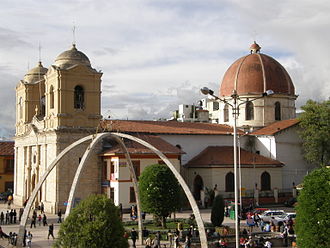
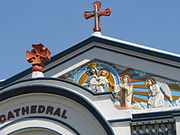
The province consists of the Departments of Piura, Amazonas, Lambayeque, Tumbes, and portions of Cajamarca, in northern Peru.  The Diocese of Piura was established in 1940 and became a metropolitan archdiocese in 1966.  The Neo-Renaissance Cathedral of St. Michael the Archangel in Piura was completed in 1588.


The top picture is from Perutraveltips.org and the other two are from Wikipedia.

The Province has four suffragan jurisdictions.
  • The Diocese of Chachapoyas was created in 1803.
  • The Diocese of Chiclayo was created in 1956.
  • The Diocese of Chulucanas began as a territorial prelature in 1964 before becoming a diocese in 1988.
  • The Territorial Prelature of Chota was created in 1963.


Definitions


The Catholic Church is mostly divided into ecclesiastical provinces—a province consists of a metropolitan archdiocese and one or more dioceses.  The province and the archdiocese are led by an archbishop.  Each of the dioceses is called a suffragan diocese and is led by a bishop.  Archbishops have some responsibilities for the province, but all bishops answer directly to the Pope.  There are also mission territories below the level of a diocese.  These include apostolic vicariates, apostolic prefectures, and territorial prelatures.

A basilica is an honorary title bestowed on a church by the Pope because of the church’s antiquity, dignity, historical importance, or significance as a center of worship.  Some cathedrals are also basilicas.  Each basilica has a ceremonial umbrella in the papal colors of white and yellow and a ceremonial bell.  Both of these are symbolic of the Pope’s special relationship to the basilica.


Tuesday, June 16, 2020

Other Nations—4
Central Asia


This blog is the fourth of six to discuss nations that do not have ecclesiastic provinces.  Typically these jurisdictions are subject directly to the pope.  This blog covers the Central Asian nations of Afghanistan, Armenia, Azerbaijan, Georgia, Kyrgyzstan, Tajikistan, Turkmenistan, and
Uzbekistan.

Afghanistan


Afghanistan became a nation in 1747, but later came under British control which lasted until 1919.  Tradition has it that the Apostles Thomas and Bartholomew preached in Afghanistan and there is a record of a Diocese of Herat in the 5th Century.  Eventually there were Orthodox and Nestorian Christians in Afghanistan, but today the nation’s 35 million people are almost 100 percent Muslim.  The Italian Embassy in Kabul was allowed to open a chapel in 1921 for foreign Catholics only.  Pope John Paul II established the Mission sui juris of Afghanistan in 2002 to serve the needs of the few hundred foreign Catholics in the country.  The mission is immediately subject to the Pope.  U.S. military personnel in Afghanistan are served by military chaplains.

Armenia


Armenia has been ruled by a succession of stronger neighbors for most of the last 2,000 years.  It became part of the Soviet Union in 1920 and gained independence in 1991.  Catholicism came to Armenia during Apostolic times—it is thought that the Apostles Bartholomew and Jude Thaddeus preached there and that Bartholomew was martyred there.  Armenia claims to be the first nation to have made Christianity the State Religion.  Almost 93 percent of Armenia’s three million people belong to the Armenian Apostolic (Orthodox) Church.  Estimates of the number of Catholics varies from 14,000 to 280,000—most Catholics live in Shirak Province in the northwestern part of the country.  Roman Rite Catholics are served by the Apostolic Administration of Caucasus (Georgia and Armenia) headquartered in Tbilisi, Georgia—see Georgia below.  The Armenian Ordinariate of East Europe serves over 600,000 Armenian Rite Catholics in Armenia, Georgia, Russia, and the Ukraine.  It was established in 1991 and is immediately subject to the Pope.  It is headquartered in Gyumri, Armenia.


Cathedral of the Holy Martyrs in Gyumri.  Both pictures are from Wikipedia.

Azerbaijan


Like most nations in this region, Azerbaijan became part of the Russian Empire in the 19th Century and became a Soviet republic in the 1920s.  It gained independence in 1991 with the collapse of the Soviet Union.  Catholicism was introduced in Azerbaijan during the time of the Apostles, but Islam eventually became dominant.  Catholic missionaries came to the region starting in the 14th Century and established Catholic centers, but the by the 19th Century, there were few Catholics.  As part of the Russian Empire, Catholics from Germany, Poland, the Ukraine, and other European nations, came to Azerbaijan on a temporary or permanent basis.  A church was built in Baku in 1912, but it was destroyed by the Soviets in 1931, who also killed the parish priest.  Today, 97 percent of the 10 million people of Azerbaijan are Muslim.  The remainder are Orthodox Christians.  There are 600 Catholics served by the Apostolic Prefecture of Azerbaijan which has one parish in Baku (built in 2007).  The Prefecture was founded as a Mission sui juris in 2000 and became an apostolic prefecture in 2011.  It is immediately subject to the Pope.

Georgia


Georgia was part of the Roman Empire in the first centuries after Christ and eventually was dominated by the Persians, Arabs, and Turks.  Georgia became part of the Russian Empire in the 19th Century and later became part of the Soviet Union.  It gained its independence in 1991.    St. Nino brought Catholicism to Georgia in the 4th Century, but most Georgians eventually became Orthodox Christians.  Catholic missionaries have been active in Georgia for the last 400 years.  Over 83 percent of Georgia’s four million people today are Orthodox.  Catholics number about 100,000—equally divided between the Roman Rite and the Armenian Rite.  Most Catholics are in Tbilisi, the capital, or in the southern part of Georgia.  Roman Rite Catholics are served by the Apostolic Administration of Caucasus (Georgia and Armenia) headquartered in Tbilisi.  The Administration was established in 1993 and is immediately subject to the Pope.  The Armenian Ordinariate of East Europe serves over 600,000 Armenian Rite Catholics in Armenia, Georgia, Russia, and the Ukraine—see Armenia above.


Cathedral of the Assumption of the Blessed Virgin Mary in Tbilisi.  Both pictures are from Wikipedia.

Kyrgyzstan


Kyrgyzstan became part of the Russian Empire in 1876 and became a Soviet Republic in 1936. It gained its independence in 1991.  About 85 percent of Kyrgyzstan’s 6 million people are Muslim and most of the rest are Russian Orthodox.  Although there is some evidence that there were Catholics in the region as early as the 14th Century, most of today’s Kyrgyzstani Catholics are descendants of the Germans, Poles, and other Europeans who were exiled to Kyrgyzstan by the Soviets in the 1930s and 1940s.  Germans built the first Catholic church in 1969 and today there are about 1,000 Catholics in the country served by three parishes and some missions.  The Mission sui juris of Kyrgyzstan was created in 1997 and became an Apostolic Administration in 2006.  It is immediately subject to the Pope.

Tajikistan


Tajikistan came under the control of Russia in the 19th Century and became a Soviet Republic in 1929.  It gained independence in 1991.  During the Soviet period, German Catholics came to Tajikistan from Lithuania, Russia, and the Ukraine.  Many of these Catholics left during the civil war in Tajikistan in the 1990s.  Today, 98 percent of Tajikistan’s 8.6 million people are Muslim.  The number of Catholics is estimated to be as low as 150 and as high as 4,000.  They are served by the Mission sui juris of Tajikistan and its four priests and two parishes.  The Mission was established in 1997 and is immediately subject to the Pope.

Turkmenistan


Turkmenistan has been ruled by the Persians, the Greeks, the Muslims, the Mongols, the Turks, and most recently by the Russians.  Turkmenistan became a Soviet republic in 1924 before gaining its independence in 1991.  There were Catholic churches in Turkmenistan, but all were destroyed by the Soviets in the 1920s.  About 89 percent of Turkmenistan’s 5.4 million people today are Muslim and 9 percent are Russian Orthodox.  Estimates of the number of Catholics in Turkmenistan ranges from 250 to 1,000.  Pope John Paul II established the Mission sui juris of Turkmenistan in 1997 that has one parish and two priests.  It is immediately subject to the Pope.

Uzbekistan


What is now Uzbekistan was conquered by the Russians in the 19th Century.  Uzbekistan became a Russian republic in 1924 before gaining its independence in 1991.  There is evidence that there were Christians in the area by the 7th Century, but most of the people eventually became Muslim.  Russia’s dominance of Uzbekistan resulted in a small population of Russian Orthodox Christians.  Today, 88 percent of the 30 million Uzbeks are Muslim and about 9 percent are Russian Orthodox.  There are about 4,000 Catholics, many of whom are of Polish ethnicity.  A Mission sui juris of Uzbekistan was established in 1997 and this became an apostolic administration in 2005.  The apostolic administration is immediately subject to the Pope.


Cathedral of the Sacred Heart of Jesus in Tashkent.  All pictures are from Wikipedia.

Definitions


The Catholic Church is mostly divided into ecclesiastical provinces—a province consists of a metropolitan archdiocese and one or more dioceses.  The province and the archdiocese are led by an archbishop.  Each of the dioceses is called a suffragan diocese and is led by a bishop.  Archbishops have some responsibilities for the province, but all bishops answer directly to the Pope.  There are also jurisdictions below the level of a diocese.  These include apostolic prefectures, apostolic administrations, ordinariates, and missions sui juris.

Most Catholics in the world belong to the Latin or Roman rite.  Rite refers to liturgical practices, ecclesiastical discipline, and spiritual heritage.  Many Catholics belong to one of two dozen Eastern rite churches.  Eastern rite churches trace their heritage to Eastern Europe and Asia.

Saturday, June 6, 2020

India—2


This blog will cover seven Roman-rite provinces in northeastern India.

Province of Calcutta


The province consists of the State of West Bengal.  The Metropolitan Archdiocese of Calcutta began as an apostolic vicariate in 1834 and became a metropolitan archdiocese in 1886.

The Cathedral of the Most Holy Rosary in Calcutta was built by the Portuguese in 1799.  The Cathedral has two domed towers and contains many sculptures including a Madonna and Child near the main altar.  The Cathedral also has bas relief Stations of the Cross.


All pictures are from Wikipedia.

The Province has seven suffragan dioceses.

  • The Diocese of Krishnagar was established as a Mission sui juris in 1855, became an apostolic prefecture in 1870, before being promoted to a diocese in 1886.
  • The Diocese of Jalpaiguri was established in 1952.
  • The Diocese of Darjeeling was established as a Mission sui juris in 1929, became an apostolic prefecture in 1931, and was promoted to a diocese in 1962.
  • The Diocese of Baruipur was established in 1977.
  • The Diocese of Raiganj was established in 1978.
  • The Diocese of Bagdogra was established in 1997.
  • The Diocese of Asansol was established in 1997.


Province of Ranchi


The province consists of the State of Jharkhand and the Union Territory of Andaman and Nicobar Islands.  The Diocese of Ranchi was created in 1927 and became the Metropolitan Archdiocese of Ranchi in 1953.  The Cathedral of St. Mary of the Immaculate Conception in Ranchi was built in the first half of the last century.


From Wikipedia.

The Province has eight suffragan dioceses.

  • The Diocese of Jamshedpur was established in 1962.
  • The Diocese of Dumka was established as an apostolic prefecture in 1952 and was promoted to a diocese in 1962.
  • The Diocese of Daltonganj was established in 1971.
  • The Diocese of Port Blair was established in 1984.
  • The Diocese of Gumla was established in 1993.
  • The Diocese of Simdega was established in 1993.
  • The Diocese of Hazaribag was established in 1995.
  • The Diocese of Khunti was established in 1995.


Province of Shillong


The province consists of the States of Meghalaya, Tripura, Mizoram, and part of Assam.  The Metropolitan Archdiocese of Shillong began as an apostolic prefecture in 1889, became a diocese in 1934, and a metropolitan archdiocese in 1969.

The Cathedral of Mary Help of Christians in Shillong was built in 1936 in a Gothic style.  It is built on sand so as to better withstand earthquakes.  The Cathedral’s terra cotta Stations of the Cross were made by the Art Institute of Munich, Germany.  The stained glass windows were made in France.


All pictures are from Wikipedia.

The Province has five suffragan dioceses.

  • The Diocese of Aizawl was established as an apostolic prefecture in 1952 and became a diocese in 1969.
  • The Diocese of Tura was established in 1973.
  • The Diocese of Agartala was established in 1996.
  • The Diocese of Jowai was established in 2006.
  • The Diocese of Nongstoin was established in 2006.


Province of Cuttack-Bhubaneswar


The province consists of the State of Odisha.  The Metropolitan Archdiocese of Cuttack-Bhubaneswar began as the Mission sui juris of Cuttack in 1928, became the Diocese of Cuttack in 1937, and the Metropolitan Archdiocese of Cuttack-Bhubaneswar in 1974.  The Cathedral of the Most Holy Rosary is in Cuttack—the parish was established in 1850.

The Province has five suffragan dioceses.

  • The Diocese of Sambalpur was established in 1951.
  • The Diocese of Berhampur was established in 1974.
  • The Diocese of Rourkela was established in 1979.
  • The Diocese of Balasore was established as an apostolic prefecture in 1968 and became a diocese in 1989.
  • The Diocese of Rayagada was established in 2016.


Province of Guwahati


The province consists of the States of Arunachal Pradesh and Sikkim, and most of the State of Assam.  The Metropolitan Archdiocese of Guwahati began as a diocese in 1992 and became a metropolitan archdiocese in 1995.

Christ the Bearer of Good News Cathedral in Guwahati was built between 2008 and 2010.  See guwahatiarchdiocese.org.


All are from the Archdiocesan website.

St. Joseph’s Co-Cathedral in Guwahati dates to the 19th Century, but the current church was completed in 1991.  The following year it became a Cathedral for the new Diocese of Guwahati and remained so until 2010 when it was replaced by Christ the Bearer of Good News Cathedral.

The Province has six suffragan dioceses.

  • The Diocese of Dibrugarh was established in 1951.
  • The Diocese of Tezpur was established in 1964.
  • The Diocese of Diphu was established in 1983.
  • The Diocese of Bongaigaon was established in 2000.
  • The Diocese of Itanagar was established in 2005.
  • The Diocese of Miao was established in 2005.


Province of Imphal


The province consists of the States of Manipur and Nagaland.  The Diocese of Imphal was created in 1973 and became a metropolitan archdiocese in 1995.  St. Joseph’s Cathedral in Imphal was built in 1999 in a style described as Anglo Manipuri fusion.


The top picture is from Flickr and the other two are from Wikipedia.

The Province has one suffragan diocese.

  • The Diocese of Kohima was established in 1980.


Province of Patna


The province consists of the State of Bihar.  The Apostolic Vicariate of Patna was created in 1845, suppressed in 1886, and was restored in 1917.  Patna became a diocese in 1919 and a metropolitan archdiocese in 1999.

Queen of Apostles Cathedral in Patna was built in the 1970s.  The Cathedral has 10,000 parishioners. See queenoftheapostleskurji.com.


From the Cathedral website.

The Province has five suffragan dioceses.

  • The Diocese of Bhagalpur was established as an apostolic prefecture in 1956 and became a diocese in 1965.
  • The Diocese of Muzaffarpur was established in 1980.
  • The Diocese of Bettiah was established as an apostolic prefecture in 1892, was suppressed in 1918, and became a diocese in 1998.
  • The Diocese of Purnea was established in 1998.
  • The Diocese of Buxar was established in 2005.


Definitions


The Catholic Church is mostly divided into ecclesiastical provinces—a province consists of a metropolitan archdiocese and one or more dioceses.  The province and the archdiocese are led by an archbishop.  Each of the dioceses is called a suffragan diocese and is led by a bishop.  Archbishops have some responsibilities for the province, but all bishops answer directly to the Pope.  There are also jurisdictions below the level of a diocese.  These include apostolic vicariates and apostolic prefectures.  Both are missionary territories below the level of a diocese.  There is also a jurisdiction called a mission sui juris.  A mission sui juris may be part of a province and is often administered by a bishop of another diocese.