Basilicas in Southern Netherlands
Basilica of Our Lady of the Sacred Heart, Sittard, Limburg
Declared a minor basilica by Pope Leo XIII in 1883—the first in the Netherlands.
The Basilica was built between 1875 and 1879 specifically for Devotion to the Sacred Heart of Mary. The neo-Gothic basilica is a pilgrimage church rather than a parish church.


The first two pictures are from Pinterest and the rest are from Wikipedia.
Basilica of SS Agatha and Barbara, Oudenbosch, North Brabant
Declared a minor basilica by Pope Pius X in 1912—the second in the Netherlands.
The Basilica was built between 1867 and 1880 and is modeled on St. Peter’s Basilica in Rome with a façade modeled on the Basilica of St. John Lateran in Rome. Even the interior is modeled after St. Peter’s complete with a reproduction of Michelangelo’s Pieta and Bernini’s baldachin. There are several statues, including one for each of the Apostles.


The top picture is from Flickr and the rest from Wikipedia.
Cathedral Basilica of St. John the Evangelist, ‘s-Hertogenbosch, North Brabant
Declared a minor basilica by Pope Pius XI in 1929.
The Basilica is the Cathedral for the Diocese of ‘s-Hertogenbosch. The church, built between 1370 and 1530 is an excellent example of Brabant Gothic. Among the features are 96 flying buttresses, a copper baptismal font from 1492, a 16th Century wood-carved altar piece, at 16th Century wood-carved pulpit, and a 17th Century 65-foot pipe organ case. The Cathedral Basilica has about 600 statues, including an oak statue of Jesus and Mary from the early 14th Century. The choir stalls date to the mid-15th Century. Protestants controlled the church from 1629 to 1810.


All pictures are from Wikipedia.
Basilica of Our Lady’s Assumption, Maastricht, Limburg
Declared a minor basilica by Pope Pius XI in 1932.
There has likely been a church on this site since the time of the late Roman Empire. The current Romanesque church (with some Gothic elements) dates to the early 11th Century. The Basilica was built with coal sandstone. Major renovations were made between 1886 and 1916. The church was used from 1797 to 1837 by first the French Army and then the Dutch Army for military purposes. Among the Basilica’s treasures are a 15th Century baptismal font and a medieval statue of Our Lady, Star of the Sea.


The first picture is from a local website and the others are from Wikipedia.
Basilica of St. Willibrord, Hulst, Zeeland
Declared a minor basilica by Pope Pius XI in 1935.
The Gothic Basilica is dedicated to an 8th Century missionary and was completed in 1535. The church was taken by the Dutch Reformed Church in the 17th Century and was jointly held by Catholics and Protestants from the early 19th Century until 1929. The pipe organ dates to 1612 and one of the bells to 1563.
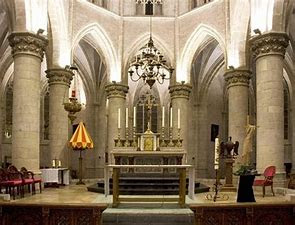


The first picture is from TripAdvisor and the rest from Wikipedia.
Basilica of the Holy Sacrament, Meerssen, Limburg
Declared a minor basilica by Pope Pius XI in 1938.
The Basilica is built in a Maas Gothic style and is considered the best of this style in the Netherlands. A Romanesque church was built around 1100, but was enlarged in a Gothic style after a Eucharistic miracle in 1222 brought pilgrims to the church. The church was set on fire by invaders in 1465 and a second miracle occurred. The church continued to be modified over time including recent years. The Basilica’s bells and carillon were taken by German forces in 1944, but have been replaced.


All pictures are from Wikipedia.
Basilica of SS. Wiro, Plechelm, and Otger, Sint-Odilienberg, Limburg
Declared a minor basilica by Pope Pius XII in 1957.
Around 700 on the site of the current Basilica, three Anglo-Saxon monks—Wiro, Plechelm, and Otger, established an abbey. Although portions of the church date to medieval times, the current Romanesque Basilica was mostly rebuilt with limestone and sandstone after the Second World War. The Chapel of Our Lady has a 12th Century statue of Our Lady and the Child Jesus. The Chapel, which is next door to the Basilica, dates to the 11th or 12th Century.


The first picture is from Pinterest and the others from Wikipedia.
Basilica of St. John the Baptist, Oosterhout, North Brabant
Declared a minor basilica by Pope Paul VI in 1977.
The Gothic Basilica dates to the 16th Century, but has been restored and rebuilt several times. It was a Protestant church from 1648 to 1809 even though most of Oosterhout’s people were Catholic.


The first picture is from a local site and the second is from Wikipedia.
Basilica of St. Servatius, Maastricht, Limburg
Declared a minor basilica by Pope John Paul II in 1985.
The current Basilica is likely the fourth church built to house the remains of St. Servatius, a 4th Century Armenian missionary who was an early bishop in what is now the Netherlands. The Basilica was built in the 11th and 12 Centuries using mostly a Romanesque style, but with some aspects of early Gothic. Some Baroque elements were added later. French revolutionaries used the church for a stable starting in 1797 and much of the interior furnishings were lost or destroyed. Early 19th Century renovations resulted in the loss of additional features. Some of the damage was reversed in a late 19th Century renovation. Renovations were needed again after a 1955 fire.


All pictures are from Wikipedia.
Basilica of SS Peter and Paul, Boxmeer, North Brabant
Declared a minor basilica by Pope John Paul II in 1999.
There has been a church on the site of the Basilica since before 1000. At some point, a Gothic church was constructed, but this church was mostly destroyed during the Second World War. The current Basilica was built between 1946 and 1952. The crypt contains remnants of the earlier churches. The crypt is also the location of a Eucharistic miracle. During a Mass in 1400, the species of wine was transformed into Blood and it splashed onto the altar linens. The priest, terrorized at the sight, asked God to forgive his doubts, and the Blood immediately stopped bubbling out of the chalice. The Blood that had spilled coagulated into a lump the size of a walnut, which can be seen today. The Basilica also has some 15th and 16th Century statues.


Both pictures are from Wikipedia.
Basilica of St. Amelberga, Susteren, Limburg
Declared a minor basilica by Pope Benedict XVI in 2007.
An abbey was established in Susteren as early as 711. It was destroyed by Vikings in 882 but was soon reestablished by St. Amelberga and her Benedictine nuns. The abbey was suppressed in the late 18th Century by the French Revolution and today only the abbey church remains. The Romanesque church dates to the 11th Century and was rededicated to St. Amelberga in 1886 upon the discovery of her relics in the church.


All pictures are from Wikipedia.
Basilica of the Chair of St. Peter of Antioch, Boxtel, North Brabant
Declared a minor basilica by Pope Benedict XVI in 2011.
The Basilica was built in the 15th and 16th Centuries in a Gothic style. It was built to replace an earlier church in which a Eucharistic Miracle is said to have occurred. In 1380, a priest was celebrating Mass and after the consecration inadvertently knocked over the chalice containing consecrated wine which immediately changed into blood and stained the altar linens. The miracle attracted many pilgrims to Boxtel. The church was Protestant from 1648 to 1798 and the building was neglected. It was later restored.


All pictures are from Wikipedia.
Basilica of St. Peter, Oirschot, North Brabant
Declared a minor basilica by Pope Benedict XVI in 2013.
The Gothic Basilica was built in 1515 and was controlled by Protestants from 1648 to 1799. The brick church was badly damaged during the Second World War and was restored from 1945-1952. The tower has six bells.

From Wikipedia.
Basilica of St. Martin, Venlo, Limburg
Declared a minor basilica by Pope Francis in 2018.
The Basilica was built between 1410 and 1610 in a Romanesque style. The church was expanded and restored using a Neo-Gothic style in 1879. The church was badly damaged during the Second World War and the onion-domed tower was destroyed completely. All was restored after the War. The Basilica has one of the largest carillons in Europe and a Baroque pulpit dating to 1701.


The first picture is from a local source and the other two are from Wikipedia.


