Sunday, January 22, 2023

Basilicas in Germany—Baden Wurttemberg and Hesse

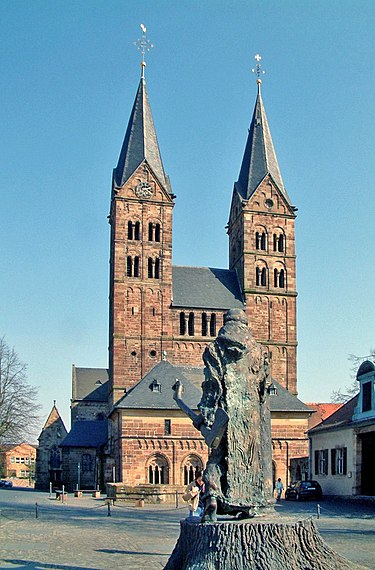
Basilica of SS. Marcellinus and Peter, Seligenstadt, Hesse

Declared a minor basilica by Pope Pius XI in 1925.

The Basilica was originally built as a monastery church in the 11th Century.  The building has been renovated in various styles over the centuries but is today mostly Romanesque and Baroque.  The monastery closed in 1803 and the building became a parish church.


The first picture is from Pinterest and the others are from Wikipedia.


Basilica of the Immaculate Conception, Sts. Peter and Paul, Niddatal-Ilbenstadt, Hesse

Declared a minor basilica by Pope Pius XI in 1928.

The Romanesque and Baroque church was built in the early 12th Century as a chapel for a Premonstratensian monastery.  The monastery was dissolved in 1803 and the abbey church became a parish church.


The first two pictures are from Flickr and the other is from Wikipedia.


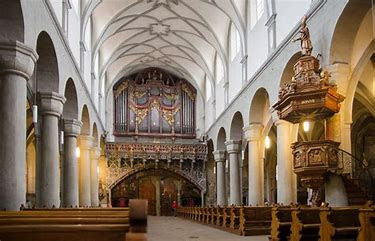
Basilica Minster of Our Lady of the Nativity and Sts. Pelagius and Conrad, Konstanz, Baden-Wurttemberg

Declared a minor basilica by Pope Pius XII in 1955.

The Basilica was built in the 11th Century and predominately employs both Romanesque and Gothic styles.  It served as the Cathedral for the former Diocese of Constance (founded in the late 6th Century) until the Diocese was suppressed in 1821.  During the Protestant Reformation, the church served briefly as a Protestant church and the Cathedral’s precious vessels, artwork, vestments and even the carpets were sold.  Relics were dumped in the Rhine River.  The church was reestablished as a cathedral in the mid-1500s.


The top three pictures are from local sources and the others are from Wikipedia.


Basilica of St. Martin of Tours and St. Oswald, Weingarten, Baden-Wurttemberg

Declared a minor basilica by Pope Pius XII in 1956.

The Baroque Basilica was built between 1715 and 1724 to replace an 11th Century Romanesque abbey church.  It is the largest Baroque church north of the Alps.  Several members of the prominent Guelph family are buried in the Basilica’s crypt.  The Basilica contains a relic of the Precious Blood of Jesus.  Longinus, a Roman soldier, opened Jesus’ side with a lance to make sure he was dead and caught some of Jesus’ blood in a box which was preserved and eventually came to Weingarten.  A large equestrian procession takes place every year to honor the Precious Blood.


The top picture is from a local source and the others are from Wikipedia.


Basilica of St. George and the Holy Blood, Walldurn, Baden-Wurttemberg

Declared a minor basilica by Pope John XXIII in 1962.

The Basilica was built between 1698 and 1728 and replaced an earlier church.  Walldurn had become a pilgrimage destination since 1330, when a priest while celebrating Mass, accidentally knocked over the chalice containing the Blood of Christ.  He was amazed the see that the altar cloth where the Blood was spilled now contained an image of the Crucified Christ.  Aside from the altar cloth, the red sandstone church contains several works of art. 


All pictures are from Wikipedia.


Basilica of St. Vitus, Ellwangen, Baden-Wurttemberg

Declared a minor basilica by Pope Paul VI in 1964.

Frankish nobles built a church on this site in 764 to house the relics of 16 Roman martyrs.  The current Basilica was built probably between 1182 and 1233 in a Romanesque style with Gothic elements.  The church was renovated in the 18th Century in a Baroque style.


The first picture is from a local source and the others are from Wikipedia.


Basilica of the Assumption of Our Lady, Uhldingen-Birnau, Baden-Wurttemberg

Declared a minor basilica by Pope Paul VI in 1971.

The Basilica was built in a Rococo style between 1747 and 1740 near the shore of Lake Constance.


The first picture is from Getty, the second from a local source, and the last two from TripAdvisor.


Basilica of St. Martin, Ulm-Wiblingen, Baden-Wurttemberg

Declared a minor basilica by Pope John Paul II in 1993.

Wurttemberg Abbey was established in 1093 as a Benedictine monastery.  It closed in 1806.  From earliest times, the Abbey had a cross that contained fragments of the True Cross of Christ.  The current Basilica was once the Abbey church and today contains the True Cross relics.  The Neo-Classic and Baroque church was built in the late 18th Century.   


The first picture is from a local source and the rest are from Wikipedia.


Basilica of St. Peter, Fritzlar, Hesse

Declared a minor basilica by Pope John Paul II in 2004.

The Basilica was originally built in the late 11th and early 12th centuries but has been renovated and restored over time in both Romanesque and Gothic styles.  St. Boniface built a church near here in 723, but it no longer exists.  The current church also once served as a Cathedral for a diocese that no longer exists.


Pictures are from Flickr, a local source, and Wikipedia.


Basilica of SS. Dionysius and Valentinus, Kiedrich im Rheingau, Hesse

Declared a minor basilica by Pope Benedict XVI in 2010.

The Gothic basilica was built near the end of the 15th Century and has long been a pilgrimage destination for those with epilepsy as St. Valentine is the patron saint of those suffering from the disease.  The church has unique carved stalls for to better accommodate epileptics.  The pipe organ dates to around 1500 and is the oldest in Hesse.  The boys’ choir dates to at least 1333 and girls have been allowed to join the choir since the early 1980s.   


All pictures are from Wikipedia.


Basilica of St. George, Ochsenhausen, Baden-Wurttemberg

Declared a minor basilica by Pope Francis in 2019.

Ochsenhausen Abbey was a Benedictine monastery that may date to the 9th Century, but certainly to the 10th Century.  It closed in 1803.  The Gothic abbey church was built in the late 15th Century and is now the parish church of St. George—the current basilica.  The church was renovated in the early 18th Century in a Baroque style.  One of the ten side altars was built using the Rococo style.  Between 1727 and 1729, a German artist painted the 32 ceiling frescoes.


The first picture is from a local source and the others are from Wikipedia.


Basilica of St. Mary and Mark, Reichenau-Mittelzell (Baden-Wurremberg)

Declared a minor basilica by Pope Francis in 2024.

This church is located on the island of Reichenau in Lake Constance.  A Benedictine abbey was established here in 724 with a small wooden church.  This church was replaced in the 9th Century and has been renovated and enlarged several times.  Today’s church is Romanesque.  The church has a relic of the Precious Blood and of St. Mark.  It also has many medieval artifacts.


Pictures with sources


Saturday, January 21, 2023

Pioneer Bishops of Delaware

This blog will discuss bishops that served in Delaware up to 1900.  For more information about Delaware, see my blog of February 11, 2017.

The first European visitor to what is now Delaware was likely Henry Hudson, of the Dutch East India Company, who sailed into Delaware Bay in 1609.  Early colonists in the territory tended to be Dutch or Swedish, but there were small Catholic communities near Middletown and at Willow Grove by the mid-1700s.  Those few Catholics were several periodically by Jesuit priests from St. Xavier Mission in Cecil County, Maryland.  The first Catholic Church in Delaware was built by a Jesuit priest from the Mission, Father Matthew Sittensperger (also known as Matthew Manners), at Coffee Run, 1775.  The successor to this church is St. Mary of the Assumption Church in Hockessin.

Father Patrick Kenny became pastor of St. Mary’s in 1805, and in 1816, he built Delaware’s second Catholic church—St. Peter’s in Wilmington.  This church became the cathedral of the Diocese of Wilmington when it was created in 1868.  Immigrants from Ireland and Haiti had come to Wilmington starting in the late 1700s.  The 19th Century would see large numbers of immigrants from Ireland, Germany, Poland, and Italy. 

Thomas A. Becker was born to German Protestant parents in Pittsburgh in 1832.  While studying at the University of Virginia, he met Bishop John McGill of Richmond, who convinced him to convert to Catholicism in 1853.  The following year, Becker started seminary in Rome and was ordained a priest for the Diocese of Richmond in 1859.   He was born as Thomas Baker, but his parents asked him to change his name after his conversion to Catholicism.  Becker served at parishes with the Diocese until the Civil War when he was appointed to the faculty at Mount St. Mary’s College in Maryland.  He later became secretary to the Archbishop of Baltimore and then as rector for the cathedral in Richmond.  Becker had been arrested at some point during the Civil War because of his pro-secessionist sympathies.

Becker was appointed the first Bishop of Wilmington, Delaware, in 1868.  His new Diocese, which included Delaware and parts of Maryland and Virginia, had 18 churches and 8 priests.  Becker greatly increased the number of churches (especially in rural areas), schools, and priests.  He also defended the Faith against accusations made by the Episcopal bishop of Wilmington.  Becker was appointed Bishop of Savanna, Georgia, in 1886, and died in 1899.  Becker was also one of the first bishops to advocate for a national Catholic university and he was a widely read author and noted speaker.  He was an advocate of temperance and an early defender of workers’ rights. 

Alfred A. Curtis was born in Maryland in 1831.  His parents were Episcopalians and Curtis was ordained an Episcopal priest in 1859.  He served at several Episcopal churches in Maryland and began an austere lifestyle of fasting and sleeping on the floor.  He studied with a Jewish rabbi and began reading early church documents.  His parishioners complained to the bishop that Curtis was becoming “Catholic,” which he denied.  But Curtis was gradually becoming Catholic, and he resigned as pastor of his Episcopal parish in Baltimore in 1871 and traveled to England to meet with John Henry Newman.  Curtis became a Catholic in 1872 and he returned to Baltimore and entered a Catholic seminary.  He was ordained a priest for the Archdiocese of Baltimore in 1874.  Curtis served as the Archbishop’s private secretary and was known for his compassion for the needy.  He also treated African Americans with great respect.  In his spare time, he enjoyed sailing on Chesapeake Bay.  Curtis was appointed the second Bishop of Wilmington, Delaware, in 1886, only 14 years after his conversion to Catholicism. 

Bishop Curtis invited members of the Benedictine, Ursuline, and Visitation orders to serve the people of his diocese.  He was a noted preacher and built several new churches and put the Diocese on a firm financial footing.  He also established a church, school, orphanage, and training school for African Americans with the help of the Josephite Fathers and Mother Katherine Drexel.  Curtis continued his austere lifestyle eating mostly vegetables and fruit and wearing a hair shirt and chains under his clothing.  Curtis resigned in 1896 because of poor health at which time the Diocese had 22 churches and 18 missions served by 30 priests.  His health improved and he was appointed auxiliary bishop of Baltimore in 1897.  He died from cancer in 1908.

John J. Monaghan was born in South Carolina in 1856 to Irish immigrant parents.  He was educated in Maryland and ordained a priest for the Diocese of Charleston, South Carolina, in 1880.  He served as a pastor at parishes in South Carolina and eventually held leadership positions for the Diocese.  Monaghan was appointed Bishop of Wilmington in 1897.

Bishop Monaghan created seven new parishes as well as several missions and schools, including the Salesianum School, run by the Oblates of St. Fances de Sales.  He also established St. Francis Hospital (operated by the Sisters of St. Francis of Glen Riddle) and a home for the aged (operated by the Little Sisters of the Poor).  He resigned in 1925 due to poor health and died in 1935.


Tuesday, January 17, 2023

Pioneer Bishops of Connecticut

This blog will discuss bishops that served in Connecticut up to 1900.  For more information about Connecticut, see my blog of November 25, 2016.

Several English settlements, including Hartford, were established in what is now Connecticut in the 1630s.  Almost all of the white residents of Connecticut were English Puritans (later referred to as Congregationalists) up until the 1840s when Irish immigrants came in great numbers.  In 1639 the people of Connecticut adopted the first written constitution in history—the “Fundamental Orders."  This document was considered progressive at the time as citizens were provided a great deal of autonomy from the King of England.  Nevertheless, under this constitution, Congregationalism was the established church supported by tax dollars.  This remained true until the Constitution was rewritten in 1818.

By the early 1830s, there were enough Catholics, about 700, to support churches in Hartford and New Haven.  Pope Gregory XVI created the Diocese of Hartford in 1843, which at the time consisted of Connecticut and Rhode Island.  At that time, Catholics numbered about 10,000 in the new diocese, about equally divided between the two states.  They were served by only 6 priests.  In the second half of the 19th Century, Irish, Germans, French Canadians, Poles, and Italians, came to Connecticut cities to work in manufacturing jobs.  By 1908, the Catholic population of Connecticut was almost 400,000.  Further growth—the Hartford diocese had the second largest Catholic population of all U.S. dioceses—led Pope Pius XII to create the Province of Hartford in 1953, comprising the Archdiocese of Hartford, the Diocese of Providence (Rhode Island), and the newly created Dioceses of Bridgeport and Norwich in Connecticut.

William Tyler was born in Vermont in 1806.  He was one of eight children of a Protestant farmer and his wife.  Tyler’s uncle and cousin had been Protestant ministers who converted to Catholicism and Tyler himself converted as a teenager.  He was ordained a priest for the Diocese of Boston in 1829.  Tyler served as a priest in Boston and Maine before becoming vicar general for the Diocese.  Tyler was appointed the first Bishop of Hartford, Connecticut, in 1843, but chose to live in Providence, Rhode Island—his Diocese consisted of all Connecticut and Rhode Island.  Of the 10,000 Catholics in his diocese, only 600 lived in Hartford, versus 2,000 in Providence.  Bishop Tyler, with financial help from the Vatican, expanded the Cathedral of SS. Peter and Paul in Providence.  He was an active pastor for the Cathedral parish—starting a school, providing food and money to the poor, and encouraging temperance.  He led a poor diocese and struggled to find sufficient funds to carry out the Church’s mission, especially with increased numbers of Irish and German immigrants.  He often visited the poor and sick and he recruited priests from Ireland to serve in the Diocese.  He died in 1849 of rheumatic fever at which time the Diocese had 12 churches and 14 priests.

Bernard O’Reilly was born in Ireland in 1803 and came to the United States in 1825.  He was ordained a priest for the Diocese of New York in 1831 and served in parishes in Brooklyn and Rochester.  While in Brooklyn, O’Reilly was noted for his care for victims of an 1832 cholera outbreak, despite falling ill himself on two occasions.  He was appointed vicar general for the Diocese of Buffalo in 1847 and was named the second Bishop of Hartford, Connecticut, in 1850.  The diocese consisted then of Connecticut and Rhode Island.  Like his predecessor, Bishop O’Reilly took up residence in Province, Rhode Island, rather than Hartford.  There were about 45,000 Catholics in the Diocese in 1850, served by only a dozen priests and a similar number of parishes.  O’Reilly recruited priests from Ireland and was able to expand the number of churches in the Diocese to 34 during his six-year tenure as Bishop.  He also invited the Irish Mercy Sisters to teach in Providence’s Catholic schools.  The growing numbers of Irish in Providence concerned the anti-Catholic Know-Nothing Party.  Two thousand men and boys gathered near the Mercy Sisters’ convent in 1855.  Bishop O'Reilly and Mayor Edward Knowles of Providence met with the crowd, who eventually dispersed peacefully.  O’Reilly wrote newspaper articles defending Catholicism.  Bishop O’Reilly went to Ireland in 1855 to recruit priests.  Returning early the next year, his steamship sank in the Irish Sea, with no survivors.

Francis P. MacFarland was born in 1819 in Pennsylvania.  His parents were both born in Ireland.  MacFarland worked as a teacher as a young man, but soon entered Mount St. Mary’s College in Maryland and was ordained a priest in 1845 for the Diocese of New York.  He was initially assigned to teach at what is now Fordham University and he later served at St. Joseph’s Church in Greenwich Village.  In 1846, he was assigned upstate to Watertown.  This became part of the new Diocese of Albany in 1847 and MacFarland became a priest for the new Diocese.  

MacFarland was named Bishop of Hartford in 1858, after declining the appointment as Vicar Apostolic of Florida the previous year.  Bishop MacFarland also lived in Providence, at least initially.  MacFarland made frequent pastoral visits to all the parishes in the Diocese and also spoke frequently with Protestant groups which dampened anti-Catholicism which was strong in Connecticut in the 1850s.  The Civil War led to the growth in manufacturing facilities in Connecticut and Rhode Island and brought Irish, French-Canadian, and German immigrants to work in the factories and mills.  This led to him inviting several religious orders to work in the Diocese and it also led to the need for more churches, which Bishop MacFarland built and staffed with new priests—he ordained 34 priests between 1867 and 1871.  He established the first national church (one specifically for an immigrant group) in 1868—St. Boniface for the Germans in New Haven.  This growth also led to the establishment of a separate diocese for Rhode Island—the Diocese of Providence—in 1872.  This left the Diocese of Hartford with 140,000 Catholics in 76 parishes served by 77 priests.  Bishop MacFarland moved to Hartford and began the efforts that led to the construction of the first Cathedral of St. Joseph prior to his death in 1874.  He left many writings and theological books to the Diocese.

Thomas Galberry was born in Ireland in 1833 and moved with his family in 1836 to Philadelphia.  He later studied at Villanova College and joined the Augustinian Order in 1852.  He taught at Villanova and was ordained an Augustinian priest in 1856.  He served at parishes in Pennsylvania, New York, and Massachusetts before being named President of Villanova College in 1872, a position he held until 1876.  He was also named first Augustinian Provincial for the United States in 1874.  Pope Pius IX appointed him Bishop of Hartford, Connecticut, but Galberry initially declined the appointment.  He accepted in 1876 under obedience to the Pope.

Bishop Galberry initiated construction of the first Cathedral of St. Joseph in Hartford in 1877, established other parishes, and established a diocesan newspaper.  He discouraged Catholic ethnicity in favor of an American identity.  Not in good health, he died of a hemorrhage in 1878 on his way to Villanova, where he hoped to recover his health. 

Lawrence S. McMahon was born in Canada in 1835 and moved with his parents to Boston in 1839.  He studied in Massachusetts, Canada, Baltimore, and France, before being ordained a priest for the Diocese of Boston in 1860.  He served at the cathedral in Boston before being assigned as a chaplain to a Massachusetts regiment fighting in the Civil War. After the war, he served as a pastor in Massachusetts before being named vicar general of the new Diocese of Providence, Rhode Island, in 1872.  He was appointed Bishop of Hartford in 1879.

Bishop McMahon established 48 new parishes—including national parishes for Poles, Lithuanians, Italians, and French Canadians—and many new schools.  He was also responsible for completing the construction of the first Cathedral of St. Joseph—including the collection of more than $500,000 to pay for it.  While McMahon served as Bishop, Father Michael McGivney organized a group of Catholic men in New Haven in 1882, who became the first Knights of Columbus.  These first Knights were mostly Irish, but Bishop McMahon ensured that the Knights were open to all Catholic men.  Bishop McMahon died in 1893.

Michael Tierney was born in Ireland in 1839 and came to Norwalk, Connecticut, with his parents in 1850.  He studied in Kentucky and New York before being ordained a priest for the Diocese of Hartford in 1866.  He served at parishes in Rhode Island and Connecticut and served as chancellor for the Diocese.  He was appointed Bishop of Hartford in 1894—the first priest of the Diocese to become its bishop. 

Bishop Tierney established St. Thomas Seminary, a home for the aged, an industrial school, and five hospitals, as well as many new parishes and schools.  He tried to visit every parish in the diocese at least once a year, supported labor unions and temperance, and embraced Catholic ethnicity.  He ordered a standardized school curriculum, improved teacher training, and established a missionary group to hold retreats for Catholics and non-Catholics.   He died in 1908.  During his tenure, the number of Diocesan Catholics increased from 250,000 to 395,000, the number of parishes from 98 to 166, and the number of schools from 48 to 76.


Saturday, January 14, 2023

Basilicas in Northern Germany

I blogged about the following basilica on August 1, 2020.

  • Cathedral Basilica of St. Hedwig in Berlin.


Basilica Cathedral of St. John the Baptist Patron of Breslavia, Berlin, Berlin

Declared a minor basilica by Pope Pius X in 1906.

The Basilica is the Cathedral for the Military Ordinariate of Germany and was built between 1894 and 1897 in a Romanesque style.


The first picture is from Flickr and the other two are from Wikipedia.


Basilica of Our Lady Queen of the Rosary, Berlin, Berlin

Declared a minor basilica by Pope Pius XII in 1950.

The Neo-Romanesque Basilica was completed in 1900.  The murals were done by Friedrich Stummel and his students.


All pictures are from Wikipedia.


Basilica of St. Godehard, Hildesheim, Lower Saxony

Declared a minor basilica by Pope Paul VI in 1963.

The Basilica was completed in 1172 as a church for a Benedictine abbey.  It is considered to be an important example of Romanesque architecture in Germany.  It is named for an 11th Century bishop of Hildesheim.


The first picture is from Flickr, the second from a local source, and the last two are from Wikipedia.


Basilica of St. Mary, Mother of the Seven Sorrows, Cloppenburg, Lower Saxony

Declared a minor basilica by Pope Paul VI in 1977.

The location has been the site of pilgrimages to venerate a 14th Century Pieta.  The current neo-Baroque Basilica was built in the 1920s.


Both pictures are from Wikipedia.


St. Clement’s Basilica, Hanover, Lower Saxony

Declared a minor basilica by Pope John Paul II in 1998.

St. Clement’s was constructed between 1712 and 1718 and was the first Catholic church built in Hanover after the Reformation.  The church was almost totally destroyed during the Second World War and was rebuilt in an Italian style between 1946 and 1957.


Pictures are from Pinterest and Wikipedia.


Basilica of St. Cyriacus, Duderstadt, Lower Saxony

Declared a minor basilica by Pope Francis in 2015.

The Basilica was built between 1250 and 1490 using a Half-timber style.


Pictures are from Flickr, Pinterest, and TripAdvisor.


Basilica of the Holy Cross, Wechselburg, Saxony

Declared a minor basilica by Pope Francis in 2015.

The Basilica is the church for Wechselburg Abbey.  The Abbey was established in the 12th Century by the Augustinians and the church was built prior to 1200.  It was secularized (and occasionally Protestant) between 1543 and the early 20th Century when it became a parish church.  The church was damaged during the Second World War and was restored between 1953 and 1965.  During the Communist rule, the abbey was used as a hospital.  Benedictines reestablished the Abbey in 1993.  The biblically-themed rood screen is considered an outstanding example of 13th Century German art.  The Basilica has several sculptures and paintings.


All pictures are from Wikipedia.


Tuesday, January 10, 2023

Pioneer Bishops of Colorado

This blog will discuss bishops that served in Colorado up to 1900.  For more information about Colorado, see my blog of February 20, 2017.

Spanish explorers likely came to Colorado as early as 1541, but it was not until 1706 that Juan de Ulibarri claimed the land for Spain.  A fur trader, James Purcell, was the first American to come to Colorado in 1803.  More American explorers and fur traders followed, but the first permanent settlement was not made until 1851 at San Luis.  The discovery of gold in 1858 led to increased settlement—several towns were established over the next three years, including Denver.  Eastern Colorado had become a part of the United States as a result of the Louisiana Purchase in 1803, but it was not until 1848 that the Nation gained full control of Colorado.  Congress created the Territory of Colorado in 1861 and Colorado became the 38th State in 1876.

Part of Colorado came under the jurisdiction of the Vicariate Apostolic (a missionary diocese) of the Indian Territory East of the Rocky Mountains in 1850—a territory covering all or part of 8 future states—and the first Catholic church was built in Canejos in 1858.  Colorado was transferred to the jurisdiction of the Bishop of Santa Fe in 1860 who that same year sent Fathers Joseph Machebeuf and John Raverdy to Denver.  Pope Pius IX established the Vicariate Apostolic of Colorado and Utah in 1868 and appointed Machebeuf as the Vicar Apostolic.  Colorado became the Vicariate Apostolic of Colorado two years later with Machebeuf remaining in charge.  Colorado’s population grew from 34,000 in 1860 to 412,000 in 1890 and the Church served many ethnic groups including Mexicans, Irish, Italians, Germans, and Slovaks.

Pope Leo XIII created the Diocese of Denver in 1887, consisting of the State of Colorado, and appointed Machebeuf as the first Bishop.  Denver was Colorado’s capital and largest city with a population of about 100,000.  By 1940, Colorado’s population had grown to 1.1 million.  Pope Pius XII created the Province of Denver the following year, thus raising Denver to an Archdiocese, and also created the Diocese of Pueblo for the Catholics in the southern half of the State.  Pueblo was then Colorado’s second largest city.  By 1980, Colorado’s population had risen to 2.9 million and Pope John Paul II created the Diocese of Colorado Springs in 1983. 

Joseph Projectus Machebeuf was born in France in 1812 and ordained a priest there in 1836.  At the invitation of the Bishop Purcell of Cincinnati, Machebeuf came to Ohio in 1839 and established and served at parishes in northern Ohio.  At the request of his friend, Bishop Jean-Baptiste Lamy, of Santa Fe, Machebeuf moved to New Mexico in 1851.  There he served in Albuquerque and Santa Fe before in 1860 he was sent by Lamy to minister to the few Catholics who then lived in Colorado and Utah.  He traveled throughout these territories in a covered wagon which served as both chapel and home.  (At one point, he was thrown from his carriage and was lame for the rest of his life.)  He was appointed first bishop of the Vicariate Apostolic (a missionary diocese) of Colorado and Utah in 1868.  He became Vicar Apostolic of Colorado in 1870 (after Utah was split off) and he was named the first Bishop of Denver in 1887.

Machebeuf built St. Mary’s Church in Denver in 1860—the first Catholic church in the town—and he went on to build over 100 churches and chapels.  He increased the number of priests from 3 in 1860 to 64 in 1889 and invited religious orders to establish schools.  He also invited the Jesuits to take charge of many of the parishes in southern Colorado in 1871.  Machebeuf established St. Vincent Orphanage, Sacred Heart College (now Regis University), St. Joseph Hospital in Denver and 10 other hospitals.  He died in 1889 and was known as the Apostle of Colorado.  His life was the basis for the character of Joseph Vaillant in Willa Cather’s 1927 novel Death Comes for the Archbishop, which was primarily about Lamy’s life.

Nicholas C. Matz was born in France in 1850 and attended seminary there before coming with his family to Cincinnati in 1868.  He briefly attended seminary in Cincinnati before going to Colorado in 1869.  He was ordained a priest in 1874 for the Apostolic Vicariate of Colorado and Utah.  He served at parishes in Denver and in Georgetown, Colorado, until 1887 when he was named coadjutor bishop of Denver.  Matz became Bishop of Denver upon the death of Bishop Machebeuf in 1889.

The Catholic population increased from 40,000 to 110,000 under Bishop Matz and he increased the number of parishes from 49 to 88.  These new Catholics were not only Irish and Spanish, but Italian, German, and Polish as well, and Bishop Matz opened several ethnic parishes to serve them.  He also welcomed St. Frances Xavier Cabrini who opened a school at an Italian parish, an orphanage, and what is now known as the Mother Cabrini Shrine in Golden.  He also built St. Thomas Seminary and the Cathedral of the Immaculate Conception and started The Denver Catholic Register.  He convened the first diocesan synod in 1890.  He opposed the formation of a miner's union and faced opposition from some of his priests for the debt incurred for his building program.  He died in 1917 following a period of poor health, including strokes and a nervous breakdown.

Saturday, January 7, 2023

Pioneer Bishops of California

This blog will discuss bishops that served in California up to 1900.  For more information about California, see my blogs of February 16, 2018, and May 4, 2018.

Several Spanish explorers were aware of California by the middle decades of the 16th Century and Jesuits were active in Lower California (Mexico’s Baja peninsula) from 1697 to 1767, but no serious attempt at colonization of Upper California (now the State of California) was made until the 18th Century.  Spain, fearful that the English or Russians might attempt to colonize Upper California, sent the Spanish military and Franciscan priests to establish a Spanish presence there.  The military built forts and the Franciscans, led by Father Junipero Serra, established missions to bring the Faith to the Native Americans.  (Father Serra was canonized by Pope Francis in 2015.)  The first mission was at San Diego in 1769 and the second was at Carmel in 1770.  Nineteen others would follow.

California became part of the newly formed Republic of Mexico in 1821 and Monterey was made the provincial capital.  Americans had long coveted California and a few had settled there by the 1840s.  The United States and Mexico fought a war between 1846 and 1848 and as a result, the United States gained a territory that included California and all or part of six other states.  Gold was discovered in California in January 1848—one month before the Mexican War ended.  About 80,000 men, mostly Americans, came to California the next year looking to get rich.  California became the 31st State in 1850.  

Most early Californians were Catholic and California became part of the Diocese of Sonora (Mexico) in 1779.  Pope Gregory XVI established the Mexican Diocese of Two Californias (Upper and Lower) in 1840.  With Statehood in 1850, Pope Pius IX created the Diocese of Monterey, although the Diocese included the Mexican Lower California until 1852.  Northern California became the Archdiocese of San Francisco in 1853.  

The southern diocese was renamed the Diocese of Monterey-Los Angeles in 1859.  Pope Pius XI split this diocese in 1922 forming the Diocese of Monterey-Fresno and the Diocese of Los Angeles-San Diego.  Pius XI created the Province of Los Angeles in 1936 which raised Los Angeles to an Archdiocese and at the same time created a separate Diocese of San Diego.  Pope Paul VI separated Monterey and Fresno into separate dioceses in 1967 and in 1976 separated Orange County from the Archdiocese creating the Diocese of Orange.  One month before his death in 1978, Pope Paul took half of the Diocese of San Diego and created the Diocese of San Bernardino.

In northern California, Pius IX established the Vicariate Apostolic of Marysville in 1861, which became the Diocese of Grass Valley in 1868 and the Diocese of Sacramento in 1886.  With increased population growth in the region, Pope John XXIII created three new Northern California dioceses in 1962—Oakland, Stockton, and Santa Rosa.  Pope John Paul II created the Diocese of San Jose in 1981.

Francisco Garcia Diego y Moreno was born in Mexico in 1785, became a Franciscan in 1801, and was ordained a Franciscan priest in 1808.  He worked as a missionary in Mexico until he was sent to what is now California.  He arrived in Monterey in 1833 and took charge of the missions in California and Texas.  Father Diego was appointed the first Bishop of Two Californias in 1840.  

His Diocese consisted of what is now the State of California, the Mexican Baja Peninsula, and extended east to the Colorado River.  He initially established his See in San Diego before moving to Santa Barbara.  Bishop Diego y Moreno faced a shortage of funding for the Diocese—the Mexican government cut off its funding in 1842 and many of the Spanish settlers did not contribute to the Diocese.  He was never able to establish a reliable source of funding for the Diocese.  He also faced a shortage of priests.  There were 17 Franciscan priests, but most were old or infirm.  Diego established a seminary, but it only produced three priests.  Bishop Diego was able to visit all the churches in the Diocese before he died of tuberculosis in 1846.  

Father Gonzalez Rubio administered the Diocese after the death of Bishop Diego y Moreno.  Pope Pius IX changed the name of the diocese in 1849 to the Diocese of Monterey.  

Joseph S. Alemany was born in what is now Spain in 1814.  He was ordained a Dominican priest in Rome in 1837.  The Dominicans sent him to Tennessee in 1841 and he was named Prior Provincial of the Dominican Province of St. Joseph (which now covers the northeastern United States) in 1848.  He was appointed Bishop of Monterey, California, in 1850.  Alemeny successfully petitioned the Vatican to separate the Mexican territory of Baja California from his diocese (in 1852) and to split California into two dioceses (in 1853).  He also began legal action against the Mexican government to recover the Pious Fund—a trust fund that had been set up to fund mission activities in California.  (The legal issues were not resolved until 1967.)  He also brought in French and Irish priests to serve in the Diocese as well as Dominican sisters.

Alemeny was appointed the first Archbishop of San Francisco in 1853.  Archbishop Alemany was initially responsible for an Archdiocese that included all of Northern California, Nevada, Utah, and part of Colorado.  As Archbishop, he attended the First Vatican Council in Rome in 1869-70 and the historic Third Plenary Council of Baltimore in 1884.  He built the first St. Mary’s Cathedral in 1854 and established an Archdiocesan newspaper.  He continued his legal action against the Mexican government to recover the Pious Fund.  When Alemany first arrived in San Francisco in 1853, there were only three Catholic churches in the city.  As immigrants from Mexico, Ireland, Germany, France, and Italy came to the Archdiocese, Alemany built schools, colleges, hospitals, and institutions for the poor and needy, often recruiting religious orders to administer them.  When Alemany retired in 1884 after serving as Archbishop for 31 years, there were over 150 churches and chapels in the Archdiocese with 160 priests to serve 400,000 Catholics.  Archbishop Alemany returned to his native Spain after his retirement.  He died in 1888.  His body was returned to San Francisco in 1965.

Thaddeus Amat y Brusi was born in Spain in 1811 and ordained a Vincentian priest in Paris in 1837.  The Vincentians sent him to serve as a missionary in the United States.  Amat was serving as rector of the seminary in Philadelphia when, in 1853, Pope Pius IX appointed him Bishop of Monterey, California.  Amat chose to live in Santa Barbara and seeing that Los Angeles was growing faster than Monterey, moved to Los Angeles in 1859.  The name of the Diocese changed to Monterey-Los Angeles the same year.

Bishop Amat faced the daunting task of governing a diocese that included all of southern California with only 16 priests and few financial resources.  He found some success with obtaining both priests and funding from Europe.  He met resistance from his mostly Hispanic followers in his attempt to Americanize Catholicism and he disputed the ownership of the California missions (which had recently been returned to the Church by President Lincoln) with the Franciscans.  He built St. Vibiana’s Cathedral in Los Angeles in 1876 (which is no longer the Cathedral) and wrote a widely used catechism on matrimony.  He invited the Sisters of Charity and the Sisters of the Immaculate Heart of Mary to establish schools in the Diocese and invited the Vincentians to open what is now Loyola Marymount University.  Bishop Amat died in 1878.

Note:  the Americanization movement in the U.S. church in the late 1800s is a complicated subject.  I invite you to go online to learn more about it.  Archbishop John Ireland of St. Paul, Minnesota, who I discussed earlier, was a leader in the Americanist movement.  The movement sought to bring Catholicism in line with American concepts, such as religious liberty, separation of church and state, cooperation with non-Catholics, and lay participation in ecclesiastical decision-making.  These ideas were anathema to many bishops in Europe, where Church and State were often combined.

Francis Mora y Borrell was born near Barcelona, Spain, in 1827.  Eventually he came to California and was ordained a priest by Bishop Amat in 1856.  He served in several rural parishes until 1863 when he became pastor in Los Angeles.  By this time he had become vicar general of the Diocese and in 1873 was appointed coadjutor bishop.  Mora became Bishop of Monterey-Los Angeles in 1878 upon the death of Bishop Amat.

Bishop Mora established 72 parishes in the Diocese to keep up with population growth, especially caused by the immigration of European Catholics due to the railroad, oil, and citrus industries. He also established the Diocese’s first Catholic newspaper and brought in religious orders to establish schools and homes for orphans and the elderly.  He successfully litigated to protect the rights of the Church and to recover property wrongfully appropriated.  Bishop Mora resigned in 1896 due to poor health brought about by a carriage accident and died in Barcelona in 1905.

George T. Montgomery was born in Kentucky in 1847 and ordained a priest for the Archdiocese of San Francisco in 1879.  His first cousin was Supreme Court Justice Oliver Wendell Holmes, Jr.  He was also related to aviation pioneer John J. Montgomery.  Montgomery was named coadjutor bishop of Monterey-Los Angeles in 1894 and became Bishop upon the resignation of Bishop Mora in 1896. 

Bishop Montgomery was the first American-born Bishop of the Diocese.  When he became Bishop, the Diocese had 52,000 Catholics in 72 parishes and missions.  He built more churches, schools, and charitable institutions to keep up with the increasing number of Catholics coming to the area.  The influx of Catholics was not welcomed by anti-Catholic groups such as the American Protective Association, but Montgomery countered this with groups that promoted tolerance.  He was a capable church and civic leader.  Montgomery was appointed coadjutor archbishop of San Francisco in 1903.  Montgomery was expected to succeed Archbishop George Riordan, but Montgomery died in 1907, seven years before Riordan died.  Montgomery served with great distinction, especially during and after the 1906 San Francisco earthquake.

Patrick W. Riordan was born in Canada in 1841 and moved with his family to Chicago when he was seven.  He graduated from Notre Dame in 1858 and attended seminary in Europe.  He was ordained a priest in 1865 for the Diocese of Chicago.  He became a seminary professor in Chicago and later a pastor before being named coadjutor archbishop of San Francisco in 1883.  Riordan became Archbishop upon the retirement of Archbishop Alemany in 1884.

Riordan successfully concluded the Archdiocese’s case against the Mexican government concerning the Pious Fund, although it would take decades for settlement to be completely repaid.  He built the second St. Mary’s Cathedral in 1891, St. Patrick’s Seminary in Menlo Park in 1898, and he replaced many wooden churches with brick and stone buildings.  He also was successful in amending California’s constitution to make church buildings tax exempt.  Riordan promoted Catholic education, in part because public schools at the time used anti-Catholic textbooks, and he supported the rights of workers.  His greatest challenge was the devastating earthquake of 1906.  The earthquake and subsequent fire destroyed or damaged 12 churches and many other Catholic buildings.  Riordan reopened 11 of the churches within two years.  Overall, Riordan more than doubled the number of parishes and more than tripled the number of priests serving the Archdiocese.  Riordan was fluent in six languages, which endeared him to immigrant Catholics. Archbishop Riordan died of pneumonia in 1914.

Eugene O’Connell was born in Ireland in 1815 and ordained a priest there in 1842.  He came to San Francisco in 1851 and served in parishes there (where he learned Spanish) until he returned to Ireland in 1854 to be a seminary dean.  In 1860, O’Connell reluctantly accepted the assignment as first Vicar Apostolic of Marysville, California, telling Pope Pius IX that he was being “condemned to the mines.”  He had six priests serving six parishes in Northern California, Nevada, and Utah.  He recruited priests from Ireland (some of whom he found were drunks or otherwise unsatisfactory).  Seven years later, there were enough Catholics to justify the creation of the Diocese of Grass Valley, California, and O’Connell became its first Bishop, even though he continued to live in Marysville.  The new Diocese had 15 parishes (11 in California and 4 in Nevada) served by 19 priests.  O’Connell attended to First Vatican Council in 1870.  Bishop O’Connell retired in 1884 and died in 1891.

Patrick Manogue succeeded Bishop O’Connell.  Manogue was born in Ireland in 1831 but left there at the age of 18 and came to the United States looking to support his family back in Ireland.  He eventually came west and went to California to mine gold and to Nevada to mine silver.  He earned enough money in four years as a miner, to not only support his family, but to enroll in seminaries in Chicago and Paris and travel throughout Europe.  After his ordination in Paris in 1861, he was assigned to St. Mary’s Church in Virginia City, Nevada, where he served for 20 years and befriended miners who eventually became very wealthy.  Manogue was appointed coadjutor bishop of Grass Valley in 1881 and became bishop upon the retirement of Bishop O’Connell in 1884.  Two years later, Pope Leo XIII suppressed the Diocese of Grass Valley in favor of the new Diocese of Sacramento and Manogue became its first bishop.  Manogue used his knowledge of European cathedrals and his friendships with wealthy miners to build the Cathedral of the Blessed Sacrament.  He built many other churches, schools, hospitals, and other Catholic institutions as well.  He converted many Native Americans to the Faith.  Although he was well educated—he read French, Greek, Hebrew, and Latin, as well as English—he never forgot that he grew up poor and worked to see that the needs of the poor were met.  Bishop Manogue died in 1895.

Thomas Grace was born in Ireland in 1841 and was ordained a priest in 1876 for the American missions.  He served at parishes in California and Nevada before becoming pastor of the pro-cathedral in Sacramento.  Grace was appointed Bishop of Sacramento in 1896.  Bishop Grace governed the Diocese during a time of growth.  The number of Catholics rose from 25,000 to 55,000 as immigrants from Ireland, Germany, Italy, and other European countries came to Northern California.  Bishop Grace traveled throughout his vast diocese to strengthen the Faith of these diverse Catholics.  He tried to provide churches for these different ethnic groups despite difficult financial times.  He established lay organizations and a diocesan newspaper.  He also established the first day-care center in California in 1920.  Bishop Grace died in 1921.