Friday, April 14, 2023

Basilicas in Eastern Belgium

St. Martin’s Basilica, Liege, Liege

Declared a minor basilica by Pope Leo XIII in 1886.

The 16th Century Gothic Basilica replaced a 10th Century Romanesque church.  It was in the original church in 1246 that the Feast of Corpus Christi was celebrated for the first time.  Felix Mendelssohn’s Lauda Sion was first performed in the church in 1846.


From the Basilica website and Wikipedia.


Basilica Abbey of St. Benedict of Maredsous, Anhee, Namur

Declared a minor basilica by Pope Pius XI in 1926.

Maredsous Abbey is a Benedictine monastery that was founded in 1872.  The Basilica, which is the Abbey church, is built in a Gothic Revival style.


The first picture is from a local source and the others from Wikipedia.


Abbey Basilica of SS. Peter and Paul, Saint-Hubert, Luxembourg

Declared a minor basilica by Pope Pius XI in 1927.

An abbey was on this site from 687 until 1797 (the French Revolution).  The current Gothic and Baroque church was built in the mid-16th Century to replace a 12th Century Romanesque church which was mostly destroyed by fire.  The current towers survived the fire.  French Huguenot soldiers burned the church in 1568, but it was repaired.  The current classical façade was added in 1702.  The church was largely abandoned from 1797 until 1841. 


The first picture is from a local source and the others are from Wikipedia.


Our Lady of Chevremont Basilica, Chaudfontaine, Liege

Declared a minor basilica by Pope Pius XI in 1928.

A castle was established on this site in the 7th Century and around the same time, veneration began after the finding of a statue of Our Lady.  The castle was destroyed in 987 although veneration of Our Lady continued.  Jesuits, who had fled England, built a small chapel in 1688 which still stands.  Pilgrimages continued and the current Gothic basilica was built between 1877 and 1899.  The church was heavily damaged during the First World War, but was repaired.  Further damage was sustained in the Second World War, but restoration has been slow as most pilgrims now go to nearby Banneux, a Marian apparition site.  The Basilica’s future is uncertain since it was purchased in 2020 by a real estate developer. 


Both pictures are from Wikipedia.


Basilica of Our Lady, Tongeren, Limburg

Declared a minor basilica by Pope Pius XI in 1930.

The Gothic Basilica was built beginning in the 13th Century and continuing for the next three centuries.  The Basilica was once the cathedral for the former Diocese of Tongeron and houses an image of Our Lady dating to 1475.


The top picture is from a local source and the others are from Wikipedia.


Basilica of the Assumption of Mary, Kortenbos, Limburg

Declared a minor basilica by Pope Pius XI in 1936.

A woman placed a statue of the Virgin Mary in an oak tree at this site in 1636 to protect the few inhabitants of the area from robbers.  A chapel was built in 1639 and pilgrims started coming to venerate Mary.  The current brick Baroque church was built between 1641 and 1648 but was soon enlarged.  Thousands of pilgrims continue to come to the church every year.


All pictures are from Wikipedia.


Abbatial Basilica of Our Lady d’Orval, Florenville, Luxembourg

Declared a minor basilica by Pope Pius XII I 1939.

An abbey was established by Benedictines in 1070, but they left after 40 years.  Cistercian monks arrived in 1132 and served there until driven out during the French Revolution at which time the abbey was completely destroyed.  A family acquired the property in 1887 and returned it to the Cistercians in 1926.  The Basilica—the abbey church—opened in 1948.  Today the monks brew beer and make cheese.


Pictures are from a local source and Wikipedia.


Abbatial Basilica Our Lady of Val-Dieu, Aubel, Liege

Declared a minor basilica by Pope Pius XII in 1946.

Val-Dieu Abbey was established by the Cistercians in the 13th Century and remained despite wars until the French Revolution at which time the fourth abbey church was destroyed.  The abbey reopened in 1844 and remained open until 2001.  The abbey church—the Basilica—opened at some point during those years.  A small lay community now lives there and brews beer for income.


The first two pictures are from local sources and the last is from Wikipedia.


Basilica of St. Maternus (also Basilica of Our Lady), Walcourt Namur

Declared a minor basilica by Pope Pius XII in 1950.

St. Maternus was a missionary to this area in the early 4th Century and a Romanesque church was built on this site in the 11th Century in his honor.  A statue of Our Lady was in this new church.  The wooden statue survived a 1228 fire that destroyed the rest of the church.  Pilgrims started coming to the site to pray to Our Blessed Mother and the current Gothic basilica was built from the 13th to the 16th Centuries.  The rood screen was likely donated by Emperor Charles V in 1531.


All pictures are from Wikipedia.


Virga Jesse Basilica, Hasselt, Limburg

Declared a minor basilica by Pope John Paul II in 1998.

The first church on this site was built in the 14th Century and was replaced with the current church in 1731.  The building was heavily damaged during the Second World War but has been repaired.


Pictures are from Flickr, Pinterest, and TripAdvisor


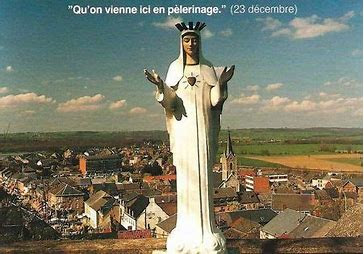
Basilica of the Virgin with a Heart of Gold, Beauraing, Namur

Declared a minor basilica by Pope Benedict XVI in 2012.

The Virgin Mary appeared to five children in Beauraing 30 times between November 1932 and January 1933.  These apparitions have been approved as real by the Vatican.  The neo-Romanesque Basilica was built in 1954 on the site of the apparitions.


The first picture is from Pinterest and the others are from Wikipedia.


Thursday, April 6, 2023

Pioneer Bishops of Missouri

This blog will discuss bishops that served in Missouri up to 1900.  For more information about Missouri, see my blog of November 25, 2018.

Louis Joliet and Father Jacques Marquette had explored the Mississippi River near what is now Missouri in 1673; and LaSalle claimed the Mississippi River valley for France in 1682; but the first French settlements in the area were on the east side (Illinois) of the river.  A French mining engineer, Phillippe Renault, came to the west side of the river to conduct mining operations in what is now Old Mines in 1723.  He built a Catholic chapel and priests from Illinois would periodically come to minister to the miners.  Ste. Genevieve was founded in 1735 and was the first permanent settlement in what is now Missouri.  The Treaty of Paris in 1763 ended French colonization in what is now the United States and the Mississippi River became the dividing line between English territory on the east and Spanish on the west.  St. Louis was established as a trading post in 1764 and received an influx of French-speaking people who preferred to live under the rule of Catholic Spain rather than that of Protestant England.

Missouri became part of the United States as a result of the Louisiana Purchase in 1803.  At that time, Missouri also became part of the Diocese of Louisiana and the Two Floridas.  This Diocese stretched from Florida to the Canadian border and from the Mississippi River to the Rocky Mountains covering almost 900,000 square miles and for many years it had no bishop.  Archbishop Carroll of Baltimore administered the Diocese until 1812, when he appointed Louis Dubourg as diocesan administrator.  Dubourg was consecrated Bishop of the Diocese in 1815 in Europe and remained in Europe until 1818 raising money and recruiting priests and nuns for his Diocese.  When he returned to the United States, he chose not to live in New Orleans, the seat of the Diocese, but rather in St. Louis, due to conflicts with some members of the clergy and laity in New Orleans.  He resided in St. Louis until 1823 when he moved to New Orleans.

While in St. Louis, Dubourg started what is now Kenrick-Glennon Seminary and St. Louis University, built a brick St. Louis Church, and invited several religious orders to the Diocese including Vincentian and Jesuit priests and Sacred Heart nuns.  The Jesuits started missions to the Native American peoples and the Sacred Heart sisters started schools and did missionary work among the Native Americans.  The Sisters were led by Mother Rose Duchesne, who was canonized in 1988.

Missouri was organized as a Territory in 1812 and it became the 24th State in 1821.  Missouri had about 70,000 people when it became a State and over 10,000 of those people lived in St. Louis.  By 1821, St. Louis was becoming less French and more Irish and German.  The Diocese of St. Louis was established in 1826—the 10th diocese in the United States.  By the late 1840s, Missouri had over 600,000 residents and St. Louis had a population of about 75,000.  Pope Pius IX raised St. Louis to an Archdiocese in 1847—the third in the United States.

Catholic fur traders had been coming to Western Missouri since at least the early 1700s and missionaries had traveled through the area as well.  Kansas City and St. Joseph both began as trading posts—Kansas City in 1821 and St. Joseph in 1826.  Both were founded by French Catholics.  In 1860, St. Joseph had a population of 9,000 and Kansas City of 4,000.  In 1868, Pope Pius IX created a new Diocese for Western Missouri—the Diocese of St. Joseph.  By 1880, Kansas City had grown significantly larger than St. Joseph—56,000 people versus 32,000—and Pope Leo XIII created a second diocese in Western Missouri in 1880—the Diocese of Kansas City.  Missouri continued to grow—from 2.2 million people in 1880 to 4 million in 1950.  Pope Pius XII created two new dioceses in Missouri in 1956—the Diocese of Jefferson City and the Diocese of Springfield-Cape Girardeau—and merged the Dioceses of Kansas City and St. Joseph into a single diocese.

Joseph Rosati was born in Italy in 1789 and joined the Vincentian Order in 1807.  He was ordained a Vincentian priest in 1811 and was recruited by Bishop Louis DuBourg of the Diocese of Louisiana and the Two Floridas to become a missionary in the United States.  Rosati left in 1816 to sail from France to Baltimore, a journey of 43 days, during which time he was continuously seasick.  Rosati eventually made his way to Kentucky where he taught in a seminary and perfected his English.  In 1818, Rosati was put in charge of the church in Perryville, Missouri.  While there, he opened St. Mary of the Barrens Seminary to train new priests for the Vincentian Order.  He was appointed Vincentian Provincial Superior for the United States in 1820.

Pope Pius VII appointed Rosati as Vicar Apostolic of Mississippi and Alabama in 1822, but Rosati declined, and the appointment was rescinded.  He was appointed coadjutor bishop of Louisiana in 1823 and then was appointed the first Bishop of St. Louis in 1827.  (He also served as Apostolic Administrator of New Orleans from 1826 to 1829).  The new Diocese of St. Louis covered territory from Arkansas to the Canadian border and from the Mississippi River to the Rocky Mountains.  It also included western Illinois.  At the time of its creation, this vast territory had about 25,000 Catholics served by about 40 churches and 20 priests. Rosati invited additional religious orders to the Diocese (including the Jesuits who administered St. Louis University), opened the first hospital west of the Mississippi River, and started a Catholic newspaper published in both English and French (Rosati spoke seven languages).  He also built what is now called the Basilica of St. Louis, King of France (Old Cathedral).  He attended several Provincial Councils in Baltimore (and wrote many of the resulting documents) and along with another bishop translated St. Robert Bellarmine’s catechism into English.  He traveled to Europe in 1840 to raise funds and recruit priests and nuns for his Diocese and died in Rome in 1843.

Peter R. Kenrick was born in Ireland in 1806 and ordained a priest there in 1832.  He came to Philadelphia the following year with his older brother Francis (who also  became a bishop).  While in Philadelphia, in addition to his priestly duties, Kenrick wrote papers on theology and church history.  Kenrick was appointed coadjutor bishop of St. Louis in 1841 and became bishop upon the death of Bishop Rosati in 1843.  His diocese initially consisted of much of the Louisiana Purchase.  He was named the first Archbishop of St. Louis in 1847.  

Kenrick inherited a large diocesan debt, which he paid off despite little help from prominent local Catholics.  In 1845, Kenrick established the first U.S. chapter of the Saint Vincent de Paul Society at the Old St. Louis Cathedral in 1845 and the first U.S. chapter of the Ladies of Charity at St. Vincent de Paul parish in St. Louis in 1857.  After becoming archbishop, he immediately began a 10-week trip to parishes throughout Missouri.  Immigrants, especially from Germany, were coming to St. Louis in large numbers during the middle of the 19th Century and Kenrick invited religious orders to build parishes, schools, and charitable organizations for them and he also established a successful immigrants’ bank.  He also opened a seminary and started a Catholic newspaper.  Kenrick remained neutral during the Civil War but took a strong stand against the doctrine of papal infallibility on matters of Faith during the First Vatican Council in 1870.  His argument was based on the theological point that infallibility was shared by the Pope with the other bishops and on the practical point that such a proclamation would be unpopular in countries, such as the United States, where Catholics were a minority.  He left before the vote.  His opposition led him to cede management of the Archdiocese to Patrick Ryan, who was appointed coadjutor Archbishop in 1872.  For twelve years, until Ryan was appointed Archbishop of Philadelphia in 1884, Kenrick spent much of his time devoted to spiritual and scholarly activities.  Kenrick resumed his role as Archbishop after the departure of Ryan.  John Kain was appointed coadjutor archbishop in 1893 (at the request of some of the Archdiocese’s priests), but the two did not enjoy a good relationship.  Kenrick resigned in 1895 (upon orders from Pope Leo XIII) and died the next year.  Kenrick served as Bishop and Archbishop of St. Louis for almost 52 years—longer than any other U.S. bishop in a single diocese.  Even though the Archdiocese was much smaller in geographic size, the number of Catholics doubled to 200,000 in the period from 1843 to 1895 and the number of parishes increased from 75 to 175.

John J. Kain was born in what is now Martinsburg, West Virginia in 1841.  He was educated in Maryland and was ordained a priest for the Diocese of Wheeling, West Virginia, in 1866.  He was assigned to Harper’s Ferry where his parish consisted of eight counties in West Virginia and four in Virginia.  He restored several churches destroyed during the Civil War.  One of his sisters was a religious sister in Wheeling and another served as his housekeeper.  Kain was appointed Bishop of Wheeling in 1875, coadjutor Archbishop of St. Louis in 1893 and became Archbishop of St. Louis two years later.

Archbishop Kain faced a crisis in 1896 when a tornado damaged much of St. Louis, including several Catholic churches and other Catholic properties, which Kain rebuilt.  Kain implemented several of the decrees of the Third Plenary Council of the U.S. bishops held in Baltimore in 1884.  These included establishing parochial schools in each parish, if possible, and granting full parish status to National (ethnic) churches.  He also required each parish to submit an annual report on its activities.  Kain called for the building of a new cathedral, bought the land on which the current St. Louis Cathedral is located and donated his estate to the building fund.  Kain died in 1903 in Baltimore after a long illness.

John J. Hogan was born in Ireland in 1829 and came to St. Louis in 1847.  He attended seminary there and was ordained a priest for the Archdiocese of St. Louis in 1852.  He was initially sent to minister to slaves working in lead mines southwest of St. Louis before being assigned parish work at various Missouri locations.  These locations usually had larger numbers of Catholic settlers and transient Irish railroad workers.  Hogan was appointed the first Bishop of Saint Joseph in 1868.

There were only about 3,000 Catholics in his northwest Missouri Diocese in 1868, but Bishop Hogan built new churches (including the current Co-Cathedral of St. Joseph), schools, and charitable institutions.  Hogan was appointed the first Bishop of Kansas City in 1880 but continued to administer the Diocese of St. Joseph until 1893.  In Kansas City, the number of priests and Catholics increased, new religious communities came to the diocese, and new churches, including the Cathedral of the Immaculate Conception, were built. Hogan also wrote two books.  He died of pneumonia in 1913.

Maurice F. Burke was born in Ireland in 1845 and came with his family to Chicago when he was four years old.  He was educated in Illinois, Indiana, and in Rome before being ordained a priest for the Diocese of Chicago in 1875.  He served at parishes in Chicago and Joliet before his appointment as the first Bishop of Cheyenne, Wyoming, in 1887.  Burke was appointed the second Bishop of St. Joseph in 1893.

Bishop Burke paid off the debt for the construction of the Co-Cathedral of St. Joseph and built new churches and schools for a Diocese that covered all of northern Missouri.  Burke was considered an authority on Dante Alighieri and served as president of the American Dante Society.  Bishop Burke died in 1923 after a long illness and his collection of 3,000 books were donated to the Catholic University of America. 


Sunday, April 2, 2023

Pioneer Bishops of Mississippi

This blog will discuss bishops that served in Mississippi up to 1900.  For more information about Mississippi, see my blog of March 18, 2017.

Spanish explorers were the first Europeans to come to what is now Mississippi in the early 16th Century.  Hernando DeSoto came to the area in 1640 and his party became the first Europeans to see the Mississippi River the following year.  LaSalle claimed the whole Mississippi River delta area for France in 1682 and the French built colonies along the Gulf Coast around 1700 and established Fort Rosalie (Natchez) in 1716.  Mississippi became part of the State of Georgia after the American Revolution and became the Territory of Mississippi in 1798.  The United States acquired the southeastern portion of Mississippi from Spain in 1813 and four years later Mississippi became the 20th State.

French and Spanish missionaries worked in Mississippi throughout the 18th Century serving Catholic communities at Natchez, Vicksburg, and along the Gulf Coast, and attempted to convert the local Natchez, Yazoo, Choctaw, and Chickasaw tribes.  Some of the missionaries were martyred in their attempts to convert the Native Americans to the Faith.  After Mississippi became part of the United States, Mississippi Catholics only rarely saw a priest and there were no churches or other Catholic institutions.

Pope Pius VII created the Vicariate Apostolic of Mississippi and Alabama (headquartered in Mobile) in 1822—Joseph Rosati was appointed vicar apostolic, but he declined the appointment, and it was later withdrawn.  Pope Leo XII established a separate Vicariate Apostolic of Mississippi in 1825.  Mississippi became part of the Diocese of New Orleans in 1826 and became a separate diocese in 1837 when Pope Gregory XVI established the Diocese of Natchez.  By 1850 there were about 10,000 Catholics and parishes had been established primarily in three areas:  the Gulf Coast (Biloxi and Bay Saint Louis), along the Mississippi River (Natchez, Vicksburg, and Port Gibson), and near Jackson (Jackson, Camden, and Paulding).  Few Catholics lived in Northern Mississippi—by 1900 there were only about six parishes in that part of the State.

The name of the Diocese of Natchez was changed to the Diocese of Natchez-Jackson in 1956 and became the Diocese of Jackson in 1977.  Pope Paul VI created the Diocese of Biloxi in 1977.

John J. Chanche was born in Baltimore in 1795.  His parents were of French ancestry who had fled Haiti during the Haitian Revolution.  Chanche’s father was a merchant and Chanche was educated at St. Mary’s College in Baltimore.  He was ordained a Sulpician priest in 1819.  He became a professor at St. Mary’s and eventually became its president.  Chanche declined appointments as coadjutor archbishop of Baltimore and Bishop of Boston before accepting the appointment as first Bishop of Natchez in 1840.

When he first arrived in Natchez in 1841, there were only two other priests in the state—in Natchez and Vicksburg.  As bishop, he brought more priests to the Diocese and built almost 10 new churches, including St. Mary’s Cathedral in Natchez.  He also established schools and orphanages and invited the Sisters of Charity to the Diocese.  Bishop Chanche died in 1852, probably of cholera, shortly after attending the First Plenary Council in Baltimore.

James O. Van de Velde was born in 1795 in what is now Belgium.  He entered the seminary in Belgium in 1815 after teaching French and Flemish for two years.  He was recruited by Father Charles Nerinckx in 1817 to come to Kentucky, but Van de Velde became ill during the voyage and stayed in Baltimore.  He attended seminary at what is now Georgetown University and entered the Jesuit order.  He was ordained a Jesuit priest in 1827.  Van de Velde developed two major skills.  He was Georgetown’s librarian from 1818 to 1831 and grew the book collection from 200 to 20,000.  He also was fluent in English, Flemish, French, German, Italian, Spanish, and Latin.  After his ordination he was assigned as chaplain of Georgetown Visitation School and as pastor of two churches in Montgomery County, Maryland.  He was sent in 1831 to what is now St. Louis University in Missouri, first as a professor, and after 1840, as president.  He was named Jesuit vice-provincial in 1843 and Western Provincial in 1846.  He was appointed the second Bishop of Chicago in 1848.

Van de Velde did not enjoy good health in Chicago and was granted permission by the Vatican in 1853 to become Bishop of Natchez, Mississippi, in an attempt to regain his health.  Unfortunately, Van de Velde broke his leg three months after his arrival in Natchez.  Shortly thereafter, he contracted yellow fever, and he died in 1855.  Despite his short tenure as bishop and his poor health, Bishop Van de Velde was able to establish two schools, complete the cathedral in Natchez, repair some church buildings, and establish a college.

William H. Elder was born in Baltimore in 1819 to a Maryland Catholic family.  He was related to the Spalding family which produced two 19th Century bishops and one foundress of a religious order.  Elder attended seminary at Mount St. Mary’s in Maryland and in Rome before being ordained a priest for the Archdiocese of Baltimore in 1846.  He taught at Mount St. Mary’s until he was appointed Bishop of Natchez, Mississippi, in 1857, which then included the entire State.  Bishop Elder presided over the Church in Mississippi during the Civil War.  At the beginning of the War, there were 10,000 Mississippi Catholics served by 18 priests, 13 parishes, and 28 missions.  In 1864, the Union Army, which occupied Natchez, ordered that all church services include prayers for President Abraham Lincoln.  Bishop Elder, who had tried to remain neutral during the war, refused to allow this on the basis of government interference with religious activities.  He was arrested by the Army and imprisoned for about three weeks.  He was released upon appeal to President Abraham Lincoln.  He ministered to victims of a yellow fever epidemic that struck Mississippi in 1878—he survived the disease but six of his priests did not.  Elder attempted to meet the spiritual and temporal needs of freed slaves after the Civil War.  By 1880, there were 12,500 Mississippi Catholics, 19 priests, 48 churches, and 15 schools.  Bishop Elder was named coadjutor archbishop of Cincinnati in 1880 and became Archbishop of Cincinnati in 1883.  He was a good and holy priest, hearing confessions almost to the day he died in 1904 from influenza.

Francis A. Janssens was born in Holland 1843 and ordained a priest in Belgium in 1867.  His interest in serving in the American missions brought him to Richmond, Virginia, in 1868.  Two years later, he was appointed rector of the Cathedral and later became vicar general for the Diocese of Richmond.  Janssens was named Bishop of Natchez, Mississippi, in 1881.  Bishop Janssens built churches and schools, including a parish for African Americans in Natchez—there were about 1,500 African American Catholics in Mississippi—and a mission for the Choctaw Indians.  He also paid off the debt on St. Mary’s Cathedral in Natchez and established mission schools to evangelize African Americans.  He also completed what is now St. Peter’s Cathedral in Jackson.  Bishop Janssens was appointed Archbishop of New Orleans in 1888 and he died at sea in 1897 sailing from New Orleans to New York.

Thomas Heslin was born in Ireland in 1845 as one of seven children and came to New Orleans in 1863.  He was ordained a priest for the Archdiocese of New Orleans in 1869.  He served at several New Orleans parishes until his appointment as Bishop of Natchez in 1889.  Bishop Heslin sought to evangelize African Americans and he established half a dozen African American parishes—administered by the Society of St. Joseph and the Society of the Divine Word.  He also invited Mother (Saint) Katharine Drexel to establish a school for African Americans.  He also opened other parishes and invited the Brothers of the Sacred Heart to start a boy’s school in Natchez.  Bishop Heslin died in 1911, possibly from pneumonia following a fall from a mule cart.


Monday, March 27, 2023

Pioneer Bishops of Minnesota

This blog will discuss bishops that served in Minnesota up to 1900.  For more information about Minnesota, see my blog of March 12, 2017.

The first Catholics to come to what is now Minnesota were French fur traders, including Groseilliers, Radisson, and Du Lhut in the mid- to late-17th century.  Father Louis Hennepin accompanied a party of fur-traders to the Falls of St. Anthony in 1680 (today’s Minneapolis).  Other Frenchmen explored northern Minnesota the same year and the area was claimed by France in 1689.  The French soon established forts on Lake Pepin, one of which, Fort Beauharnois, was established in 1727 near what is now Old Frontenac.  Jesuit missionaries, Michel Guignas and Nicholas de Gonnor, built a small Catholic chapel dedicated to St. Michael the Archangel within the fort, and celebrated the first Mass in Minnesota.  Over the next century, missionaries would occasionally visit the area to attend to the spiritual needs of the few Catholics, including those among the Dakota and Ojibwa tribes. 

Minnesota became part of the United States in three phases—the last of which included northwestern Minnesota in 1818.  The United States Army established Fort Snelling in 1819 at the confluence of the Mississippi and Minnesota Rivers.  A Swiss Catholic colony (Mendota) was established near Fort Snelling in the 1830s and Bishop Mathias Loras of Dubuque, whose diocese included a portion of Minnesota, visited this area in 1839.  The next year, Loras sent a missionary to Minnesota, Father Lucien Galtier, to minister to the 200 or so Catholics in the area.  In 1841, Father Galtier built a log chapel dedicated to St. Paul in a village known as Pig’s Eye, located on a bluff along the northern side of the Mississippi River.

Father Galtier, not surprisingly, did not like the name Pig’s Eye, so he started to call the town St. Paul—after the name of his church.  The name became popular, and the City of St. Paul grew up around this small chapel.  In 1850, shortly after Minnesota became a Territory, Pope Pius IX created the Diocese of St. Paul, which consisted of the current states of Minnesota, and portions of North Dakota, South Dakota, and Wisconsin.  Minnesota became the 32nd State in 1858.

Meanwhile, in northern Minnesota, in 1835, Bishop Frederick Baraga of Marquette, Michigan, landed on the north shore of a river at the site of present-day Duluth.  Bishop Baraga named the river, Cross River, because he had erected a cross at the site in thanksgiving for a safe crossing of Lake Superior.  German Catholics started settling near St. Cloud in the 1850s and in 1875 Pope Pius IX created the Vicariate of Northern Minnesota to provide the spiritual needs of immigrants and Native Americans.  Rupert Seidenbusch, a Benedictine priest from Germany, served as vicar apostolic of Northern Minnesota from 1875 until 1888.  The following year, Pope Leo XXIII split the Vicar Apostolic of Northern Minnesota into the Dioceses of Duluth and St. Cloud.  Catholic settlement in Southern Minnesota dates to 1683 when Nicolas Perrot established a trading post near what is now Wabasha, but few towns were established in the area until the 1850s.  Bishop Cretin, the first Bishop of St. Paul, established parishes in Mankato and Winona in the mid-1850s.  By 1860, with an influx of immigrants from Ireland, Germany, Poland, and Eastern Europe, there were about 10 parishes.

The population of Minnesota almost doubled between 1880 and 1890.  Minneapolis’ population grew from 47,000 to 165,000 during the decade to become the nation’s 18th largest city.  Similarly, St. Paul’s population increased from 41,000 to 133,000.  The population of the Dakotas tripled during the decade.  In response to this growth, Pope Leo XIII raised the see of St. Paul to the level of an archdiocese in 1888.  The new Province of St. Paul included the states of Minnesota, North Dakota, and South Dakota.  The following year, the Pope created the Dioceses of Duluth, St. Cloud, and Winona, as suffragan sees of the Archdiocese of St. Paul.  Pope Pius X created the Diocese of Crookston in 1909 and Pope Pius XII created the diocese of New Ulm in 1957.  The Archdiocese of St. Paul was renamed as the Archdiocese of St. Paul and Minneapolis in 1966.  The Diocese of Winona was renamed Winona-Rochester in 2018.

Joseph Cretin was born in France in 1799 and ordained a priest there in 1823.  He had success reviving the Faith among his parishioners, but he longed to be a missionary.  His friend, Mathias Loras, the Bishop of Dubuque, Iowa, invited Cretin to come to the United States.  Cretin did so in 1838.  Cretin served in parishes in Iowa and western Wisconsin until his appointment as the first Bishop of St. Paul, Minnesota, in 1850. 

Bishop Cretin’s new Diocese covered Minnesota and both Dakotas.  There were 1,000 Catholics served by four log churches (in St. Paul, Mendota, and St. Anthony, in Minnesota, and Pembina in North Dakota).  He actively recruited Irish, German, and Canadian Catholics to settle in Minnesota and the Dakotas and he built new churches and schools for them.  He established St. Joseph’s Hospital—the first in Minnesota.  He brought in religious orders, including Benedictine priests and sisters and the Sisters of St. Joseph of Carondelet, to teach in the schools and staff hospitals.  He was a leader in the temperance movement, and he built the second and third Cathedrals of St. Paul.  (The current cathedral is the fourth.)  At the time of his death, there were about 50,000 Catholics, 29 churches, and 35 stations in the Diocese.  Bishop Cretin died in 1857.

Thomas L. Grace was born in Charleston, South Carolina, in 1814.  He studied in Cincinnati, Kentucky, and Rome, and was ordained a Dominican priest in Rome in 1839.  Grace was the first South Carolinian to be ordained a Catholic priest.  Grace returned to the United States in 1844 and served in churches first in Kentucky and then for 13 years in Memphis.  Grace was appointed Bishop of St. Paul in 1859.

Bishop Grace was a skilled administrator who worked to increase vocations, improve Catholic education, and he wrote a constitution to govern the Diocese.  He also built schools, hospitals, and homes for orphans and the elderly, and gave special attention to Native Americans and immigrants.  Grace established lay organizations and a Diocesan newspaper to counter anti-Catholic attacks by the Know-Nothing party.  The Catholic population continued to grow and at the time of the Bishop’s resignation in 1884 due to poor health, numbered 130,000 served by 195 churches and 51 missions.  Grace was given the personal title of Archbishop in 1889 and he died in 1897.

John Ireland was born in Ireland in 1838, moved with his parents to the United States in 1848 and came to St. Paul, Minnesota in 1852.  Ireland was ordained a priest for the Diocese of St. Paul in 1861 and served as a chaplain during the Civil War and then as cathedral rector.  Pope Pius IX appointed Ireland as Vicar Apostolic of Nebraska in 1875, but Bishop Thomas Grace of St. Paul convinced the Pope to appoint Ireland as coadjutor bishop of St. Paul instead.  Thus, Ireland became Bishop of St. Paul upon Bishop Grace’s retirement in 1884.  He became the first Archbishop of St. Paul in 1888.

Archbishop Ireland worked with railroad magnet, James Hill (whose wife was Catholic), to establish Catholic colonies in rural areas, especially for the Irish living in urban slums, along railroad lines.  Ireland, an advocate for total abstinence, banned saloons in the towns.  More than 4,000 Catholic families were resettled in rural Minnesota.  Ireland built both the current Cathedral of St. Paul and the Basilica of St. Mary, helped establish the University of St. Thomas and St. Catherine’s College, founded St. Paul Seminary, and promoted the Catholic University of America.  He devised a creative, though unsuccessful method of public funding for Catholic schools.  He was a leading figure in the Americanist movement—a movement that sought to show that Catholics could be good American citizens while remaining Catholic.  Ireland took progressive stands on labor and race relations.  Ireland gave a sermon in 1890 at St. Augustine’s Church in Washington, DC, an African-American parish, and argued that people should be judged on their own merits and not on their race—a radical concept at the time.  Ireland was not as tolerant of Eastern-rite Catholics.  Ireland would not allow Alexis Toth, a Ruthenian-rite Catholic priest to serve Ruthenian-rite Catholics in Minnesota.  As a result, Toth and many other Ruthenian-rite Catholics left the Church and became Orthodox Christians.  Ireland was regarded as one of the most prominent U.S. Catholics of his time and he eloquently presented his thoughts orally and in writing.  Archbishop Ireland died in 1918.

James McGolrick was born in Ireland in 1841.  Two of his brothers became priests and two of his sisters became religious sisters.  Recruited by Bishop Thomas Grace to come to Minnesota while he was still in seminary, McGolrick completed his studies in Ireland and was ordained a priest for the Diocese of St. Paul in 1867.  Arriving in Minnesota in 1867, he served first at the Cathedral of St. Paul before being assigned as pastor of the new Immaculate Conception parish in Minneapolis.  While in Minneapolis, McGolrick built a new parish church, started an orphan asylum, an abstinence group, and became a trustee of the Minnesota Academy of Science.  McGolrick was appointed first Bishop of Duluth in 1889.

Bishop McGolrick’s new diocese had a Catholic population of 20,000 served by 32 churches and 22 priests.  At the time of his death from acute indigestion in 1918, there were 60,000 Catholics in almost 90 churches served by 59 priests.  There were also 11 parochial schools.  He built a new cathedral in 1894 to replace one destroyed by fire and he also founded St. Mary’s Hospital and St. James Orphanage.  McGolrick also served on Duluth’s library board and park board.

Rupert Seidenbusch was born in 1830 in Munich and came to the United States in 1850.  He finished his seminary training at Saint Vincent Abbey in Pennsylvania and joined the Benedictines in 1852.  He was ordained a priest the following year.  He served at parishes in Pennsylvania until 1857 when he was assigned to a Germany parish in Newark, New Jersey.  He came back to Saint Vincent Abbey as prior in 1862.  In 1866, he became the first abbot of what is now St. John’s Abbey in Minnesota.  He authorized the construction of several Abbey-related buildings and increased the enrollment of St. John’s College from 28 to 150.  Seidenbusch was appointed first (and only) Vicar Apostolic of Northern Minnesota in 1875.

Seidenbusch’s Vicariate was the frontier and consisted of all of northern Minnesota.  One source says that there were more bears and coyotes than people.  Primitive roads were often impassable in winter.  That did not deter Bishop Seidenbusch who traveled throughout the vicariate.  He also built Holy Angels Cathedral in 1884—the original cathedral in St. Cloud.  At the time of his resignation in 1888, the Vicariate had 45,000 people, 70 priests, 140 churches and chapels, 14 convents, and one hospital.  Bishop Seidenbusch died in Virginia in 1895.

Otto Zardetti was born in Switzerland in 1847 although his family was originally from Italy.  He studied in Switzerland and Austria and became fluent in French, English, German, and Italian.  He was ordained a priest in 1870 and was appointed director of an abbey library in Switzerland.  He visited the United States in 1879 and was accepted a teaching position at the seminary in Milwaukee in 1881.  He was appointed the first Bishop of St. Cloud in 1889.  Pope Leo XXIII split the Vicariate of Northern Minnesota into the new Dioceses of St. Cloud and Duluth in 1889.

In 1889, and appointed Otto Zardetti as the first Bishop of St. Cloud.  Bishop Zardetti established a monthly newspaper, promoted Catholic schools, imported priests, and brought Franciscan sisters to Little Falls.  Most Catholics were German, but there were Poles, French-Canadian, and Irish as well.  Nearly all were poor and were often in isolated parishes serving a particular ethnic group.  Churches and schools were built through hard work and sacrifice by these good people.  Bishop Zardetti worked to unite his Diocese and was also known as being a good homilist.  Bishop Zardetti grew tired of the difficulties of travel within his Diocese, and he had health issues that were aggravated by the Minnesota climate.  He returned to Europe in 1894 and was named Archbishop of Bucharest, Romania, the same year.  His health led him to resign as archbishop in 1895 and he accepted a position in Rome.  He wished to return to St. Cloud but was not healthy enough to do so and he died in 1902. 

Martin Marty was born in Switzerland in 1834 and was ordained a Benedictine priest there in 1856.  His Swiss abbot sent him to take charge of St. Meinrad’s Abbey in Indiana in 1860.  He was successful there and in 1876 was sent to the Dakota Territory to work in the Native American missions.  The Native Americans referred to him as Black Robe Lean Chief and he often traveled long distances in harsh conditions.  Pope Leo XIII appointed him Vicar Apostolic of the Dakota Territory in 1879 and he became the first Bishop of Sioux Falls, South Dakota, in 1889.  He was named Bishop of St. Cloud, Minnesota, in 1894.  Bishop Marty served slightly more than a year in St. Cloud before his death in 1896.  His major contribution there was the incorporation of parishes.  At a time and place when churches and schools were often built by the labor and funds of the parishioners, there was often confusion about parish ownership and finances.  Incorporation legally brought the parishes into control of the Diocese.

James Trobec was born in Slovenia in 1838 as Jakob Trobez.  He initially entered seminary in his native land, but he and 15 other seminarians were recruited to come to America.  Trobec arrived in 1864 and completed his training in Pennsylvania.  He was ordained a priest for the Diocese of St. Paul in 1865 and served in parishes n Belle Prairie and Wabasha until 1887.  He was then assigned by Archbishop Ireland to establish a new parish—St. Agnes for German-speaking people in St. Paul.  He built a church and a school and was in the process of building a larger church when he was appointed Bishop of St. Cloud in 1897.

Bishop Trobec found a Diocese that was no longer on the frontier—transportation and commercial systems were well in place.  It was a period of great growth and the number of parishes, priests, and Catholic students nearly doubled while he was Bishop.  Trobec retired in 1914 due to ill health at which time the Diocese had 123 parishes and 25 schools.  He spent his retirement living with his sisters and a nephew, who was the pastor of the parish in St. Stephen, Minnesota.  Trobec had two other nephews who were priests in Minnesota.  Trobec died in 1921.

Joseph B. Cotter was born in England in 1844 and moved with his family to the United States in 1849.  The family lived in New York City and Cleveland before settling in St. Paul, Minnesota, in 1855.  Cotter attended seminaries in Wisconsin, Pennsylvania, and Minnesota, before being ordained a priest for the Diocese of St. Paul in 1871.  Cotter was serving as pastor of what became St. Thomas Cathedral in Winona when he was named the first Bishop of Winona in 1889.

As bishop, he increased the number of parishes in the diocese from 45 to 72, the number of diocesan priests from 45 to 85, and the number of Catholic school students from 2,700 to 4,600.  Bishop Cotter also invited orders of religious sisters to work in the Diocese.  Mother Alfred Moes had already moved her Sisters of St. Francis to Rochester, Minnesota, in 1882.  They opened what later became the College of St. Teresa in Winona in 1894.  Mother Alfred also wanted to build a hospital in Rochester and worked with local physicians William Mayo and his sons William and Charles to open St. Mary’s Hospital 1889.  This hospital evolved into the Mayo Clinic.  Bishop Cotter died in 1909 of a heart condition.


Sunday, March 26, 2023

Basilicas in Western Belgium

Basilica of Our Lady of Dadizele, Dadizele, West Flanders

Declared a minor basilica by Pope Leo XIII in 1882.

The neo-Gothic Basilica was built between 1857 and 1867 and replaced a 15th Century Gothic church that was a pilgrimage destination.  The Basilica has a 15th Century Madonna made of alabaster.


All pictures are from Wikipedia.


Basilica of Our Lady of Good Help, Bon-Secours, Hainaut

Declared a minor basilica by Pope Pius X in 1910.

The Neo-Gothic Basilica was built between 1885 and 1892 on the site of an oak tree that once had a statue of Our Lady.  Pilgrimages date to the Middle Ages.  The current statue was carved from the wood of the oak tree that died in the 17th Century.


All pictures are from the Basilica website.


Holy Savior Cathedral Basilica, Bruge, West Flanders

Declared a minor basilica by Pope Pius XI in 1921.

The Basilica is the Cathedral for the Diocese of Bruges.  The Romanesque church was constructed over a one-hundred-year period starting in 1250.  Originally a parish church, it did not become the Cathedral until 1834 at which time improvements were made.  It has artwork from the former cathedral which was destroyed by the French in the 19th Century.


The first picture is from a local website and the others are from Wikipedia.


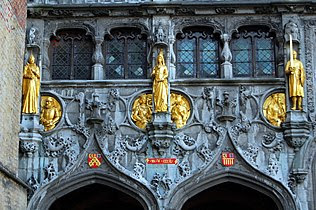
Basilica of the Holy Blood, Bruge, West Flanders

Declared a minor basilica by Pope Pius XI in 1923.

Thierry of Alsace, Count of Flanders, built the current Basilica between 1134 and 1157 as a chapel and to contain a relic of Christ’s Holy Blood.  Thierry had participated in the Second Crusade and obtained the relic from his brother-in-law in Jerusalem.  The church has two chapels.  The Romanesque lower chapel is dedicated to St. Basil the Great.  The upper chapel, which contains the Precious Blood, was originally built in a Romanesque style, but was changed to a Gothic style in the 16th Century and to a Gothic Revival style in the 19th Century.  The reliquary used to hold the phial with the Precious Blood contains 66 pounds of gold and silver and has more than 100 precious stones.


The first picture is from Flickr and the rest from Wikipedia.


Basilica of Our Lady of Lourdes, Oostakker, East Flanders

Declared a minor basilica by Pope Pius XI in 1924. 

A grotto dedicated to Our Lady of Lourdes was built on the estate of a member of the royal family in 1873.  Local people requested that they be allowed to visit the Grotto especially after a reputed healing attributed to Our Lady’s intercession in 1875.  As a result, the current neo-Gothic church was completed in 1876 and given to the Jesuits.  It is the most important pilgrimage destination in Flanders.


All pictures are from Wikipedia.


Abbatial Basilica of Saints Peter and Paul, Dendermonde, East Flanders

Declared a minor basilica by Pope Pius XI in 1938.

Dendermonde Abbey is a Benedictine monastery founded in 1837.  The Abbey became a center for a Belgian Liturgical Movement between 1890 and 1910.  The Abbey church was built in 1901-1902 but was heavily damaged by fire in 1914.  It was renovated in a Flemish neo-Renaissance style between 1919 and 1924.


From Wikipedia.


Basilica of Our Lady of Tongre, Tongre-Notre-Dame, Hainaut

Declared a minor basilica by Pope Pius XII in 1951.

An image of the Madonna mysteriously appeared at this site in 1081.  Pilgrims soon started coming to the site and the image was moved to the parish church.  A chapel was later built at the original site and a Gothic church was built in the 13th Century.  The current Baroque church was built in 1777.  Pilgrims, including Belgian royalty and other European royalty, have donated jewels and other precious objects to Our Lady.


The first two pictures are from Wikipedia and the last two are from local sources.


Abbatial Basilica of St. Andrew’s, Sint-Andries, West Flanders

Declared a minor basilica by Pope Pius XII in 1952.

St. Andrew’s Abbey is a Benedictine monastery founded in the 12th Century.  The Basilica, which is the Abbey church, was built around 1900 in a neo-Romanesque style.  The church has seven chapels, one for each of the “seven great churches in Rome.” 


From Wikipedia.


Basilica of Our Lady of Good Hope, Vellereille-les-Brayeux, Hainaut

Declared a minor basilica by Pope Pius XII in 1957.

Bonne-Esperance (Good Hope) Abbey was a Premonstratensian abbey that existed from 1130 until the French Revolution in the late 18th Century.  It now serves as a diocesan seminary and the seminary church dates to at least the early 17th Century.


All pictures are from Wikipedia.


Basilica of St. Hermes, Ronse, East Flanders

Declared a minor basilica by Pope Francis in 2018.

There have been several churches on this site to hold relics of St. Hermes.  The first church was built in the 9th Century and was replaced in the 12th Century.  This church was burnt by the English in 1424 and replaced with the current Gothic church over the next century. 


All pictures are from Wikipedia.


Friday, March 24, 2023

Pioneer Bishops of Michigan

This blog will discuss bishops that served in Michigan up to 1900.  For more information about Michigan, see my blog of March 31, 2018.

The first Europeans to visit Michigan were the Jesuit priests, Charles Raymbault and (now Saint) Isaac Jogues who came as missionaries to the Native Americans living near what is now Sault Ste. Marie in 1641.  Throughout the rest of the 17th Century, other missionaries, such as Marquette, Menard, Allouez, Nouvel, Dollier, and Hennepin, established missions for the conversion of the Native Americans at various locations including Sault Ste. Marie, St. Ignace, Keweenaw Bay, Thunder Bay, Niles, and Saginaw.  The French established a fort at Detroit in 1701.

The British gained control of Michigan by 1761 and as a result, many of the French settlers left and Catholic missionary activity was curtailed.  Michigan became part of the United States following the American Revolution (except for Detroit and Mackinac which remained British until 1796).  Congress created the Northwest Territory in 1787, which included Michigan.  The Lower Peninsula and part of the Upper Peninsula became the Michigan Territory in 1805, which by 1810 only had a population of about 4,800.  By 1820, the population was only 8,100 (including about 2,000 Catholics), but between 1830 and 1840 the population rose from 32,000 to 212,000 as European immigrants settled in Michigan.  All of what is now Michigan became the 26th State in 1837.

Pope Gregory XVI created the Diocese of Detroit in 1833.  Detroit then was Michigan’s capital and largest city (with over 2,000 people).  The Diocese initially included what are now the states of Michigan, Wisconsin, Iowa, Minnesota, and parts of North and South Dakota.  Pope Pius IX established the Vicariate Apostolic of Upper Michigan in 1853, which became the Diocese of Sault Ste. Marie in 1857, the Diocese of Sault Ste. Marie and Marquette in 1865, and the Diocese of Marquette in 1937.  Pope Leo XIII made southwestern Michigan the Diocese of Grand Rapids in 1882.  Michigan’s population grew from 2.4 million in 1900 to 5.3 million in 1940 and in response, Pope Pius XI raised Detroit to an Archdiocese in 1937 and created the Dioceses of Lansing in 1937 and Saginaw in 1938.  By 1970, Michigan’s population has risen to 8.9 million and Pope Paul VI created the Dioceses of Gaylord and Kalamazoo in 1971.

Gabriel Richard will be an exception to my discussion of bishops.  Many expected him to be named the first Bishop of Detroit, but he died while caring for cholera victims during an 1832 epidemic, six months before Detroit became a diocese.  He nevertheless had an interesting life.  Father Richard was born in France in 1767, ordained a Sulpician priest in 1790, and came to the United States in 1792.  After serving in Baltimore and Kaskaskia, Illinois, he was transferred to Ste. Anne’s Church in Detroit in 1798.  He would remain in Detroit for over 30 years.  He opened a school that was destroyed by a widespread fire in 1805 and started a food program to help the people of Detroit who had lost everything.  He then wrote what became Detroit’s official motto: “We hope for better things; it will arise from the ashes.”

Richard’s ministry extended to Native American tribes in the area.  He was imprisoned by the British after they captured Detroit during the War of 1812, because he would not swear an oath of loyalty to the King.  He was released after Shawnee chief Tucumseh refused to fight for the British while Richard was still imprisoned.

Father Richard brought the first printing press to Michigan and in 1809 published a newspaper, which was the first in Michigan and the first Catholic newspaper in the United States.  In 1817, he co-founded what is now the University of Michigan—he served as vice president and taught classes in six of the university’s 13 departments.  He served on the university’s board of trustees until his death.  Richard was elected in 1823 to represent the Michigan Territory in the U.S. House of Representatives—the first Catholic priest so honored.  He only served one term, but managed to secure funding for a highway from Detroit to Chicago—today’s Michigan Avenue in Detroit (and part of U.S. 12).  

Frederick J. C. Rese was born to a poor family in Germany in 1791.  He apprenticed as a tailor and later became a soldier and fought against Napoleon in the 1815 Battle of Waterloo.  After his days as a soldier ended, he went to seminary in Rome where he was ordained a priest in 1823.  Shortly after his ordination, he met Bishop Edward Fenwick of Cincinnati who recruited him for his Diocese.  Rese arrived in Cincinnati in 1825 and soon became the vicar general of the Diocese.  He returned to Europe in 1828 and spent the next three years recruiting clergy and religious and encouraging immigrants to the United States.  Rese was named the first Bishop of Detroit in 1833—the first German-born U.S. bishop.  The Diocese at that time included Michigan, Wisconsin, Minnesota, Iowa, and part of the Dakotas.  There were 8 churches and one mission served by 11 priests.  He established Holy Trinity Church in Detroit for English-speaking Catholics, and other new parishes and schools.  He built a hospital and other charitable institutions and brought the Poor Clares to establish a convent and school.  By 1838, there were about 22,000 Catholics in the Diocese, half of whom were French speaking.  In 1840, Rese began suffering from a mental illness (perhaps caused by alcohol abuse).  He was recalled to Rome and Peter Lefevere was named coadjutor bishop and apostolic administrator.  Rese lived the rest of his life in Germany and officially remained Bishop of Detroit until his death in 1871.

Peter Paul Lefevere was born in Belgium in 1804 and came to the United States in 1828.  He was ordained a priest for the Diocese of St. Louis in 1831 and spent the next decade as a missionary priest in Missouri, Illinois, and Iowa.  Lefevere was appointed coadjutor bishop and apostolic administrator of Detroit in 1841, although he never became Bishop of Detroit because he died before Bishop Rese.  Bishop Lefevere took over a Diocese that (by 1843) included only the State of Michigan and had 24,000 Catholics, served by 30 churches and 18 priests.  Lefevere established fiscal control in the Diocese, opened a seminary, and built a new cathedral.  He brought in religious orders to open schools and charitable institutions, including St. Joseph's Retreat in Dearborn, which was run by the Daughters of Charity and was Michigan's first and the nation's second hospital to care exclusively for the mentally ill.  He also established a Diocesan newspaper (now the Michigan Catholic) and was one of the bishops primarily responsible for the American College at Louvain in Belgium—a seminary to train European men to serve as priests in America and to offer training to American priests.  He also gained control of church property under an 1867 Michigan law.  He was especially attentive to the needs of Native American Catholics.  He died in 1869 at which time there were 150,000 Catholics in the Diocese, 80 churches, and 88 priests.

Casper H. Borgess was born in Germany in 1826 and came to the United States as a child.  He was ordained a priest for the Diocese of Cincinnati in 1848 and served in Columbus until 1859, when he was named cathedral rector in Cincinnati.  Borgess was named coadjutor bishop and apostolic administrator of Detroit in 1870 after the death of Bishop Lefevere and was named second Bishop of Detroit in 1871 after the death of Bishop Rese.  Bishop Borgess helped establish what is now the University of Detroit Mercy and SS. Cyril and Methodius Seminary.  He also established the Diocese’s first St. Vincent de Paul Society in 1871 at St. Patrick’s Church.  He attempted to increase the number of U.S.-born priests and bring discipline to all of his priests, which sometimes caused conflict with European-born priests who made up almost half of his clergy.  He also fought the Michigan legislature over its attempts to force lay control of parishes and he established the first Diocesan school board.  At the time of his resignation in 1887, due to poor health, the Diocese, reduced in size by the creation of the Dioceses of Grand Rapids and what is now Marquette, had 120,000 Catholics served by about 90 churches and 60 schools.  He died in 1890.

John S. Foley was born in Baltimore in 1833 to parents who had been born in Ireland.  His older brother, Thomas, served as apostolic administrator and coadjutor bishop of Chicago.  John Foley was educated in Maryland until 1853 when his archbishop sent him to complete his studies in Rome.  He was ordained in Rome for the Archdiocese of Baltimore in 1856.  He returned to Maryland in 1857 and served in parishes in Baltimore and Ellicott City.  A childhood friend of Cardinal James Gibbons of Baltimore, Foley was secretary of the Third Plenary Council of Baltimore in 1884 and co-authored the Baltimore Catechism.  He was nominated to be the Bishop of Wilmington, Delaware, in 1886, but was rejected by the Vatican.  He was appointed the third Bishop of Detroit in 1888.

Bishop Foley was Detroit’s first American-born bishop and he led the Diocese for 30 years during a time when whites came from Europe and African Americans came from the South to work in Detroit’s new automotive industry.  He established the Diocese’s first Eastern-rite Catholic parish in 1908 and the first African American parish in 1911.  He also helped establish the League of Catholic Women in 1906 and what is now Marygrove College in 1910.  Foley established a seminary for Polish Americans and also resolved a schism among Polish American Catholics.  At the time of Foley’s death in 1918, the Diocese had 386,000 Catholics served by 318 priests, 246 churches, and 102 parish schools.

I. Frederick Baraga was born in what is now Slovenia in 1797 to a wealthy family.  Unfortunately, both his parents died by the time he turned 15.  He graduated from the University of Vienna law school in 1821 and then entered the seminary.  He was ordained in 1823 by the Bishop of Ljubljana (Slovenia) and served in parishes in the Diocese.  Bishop Edward Fenwick of Cincinnati requested European priests to come to the United States and Baraga decided to answer the call.  He arrived in Cincinnati in January 1831 and began ministering to German immigrants.  He also began the study of the Ottawa language and in May 1831 was sent to Michigan to master the language.  Baraga spent the next two decades bringing the Faith to the Ottawa and Ojibway tribes and to other Native Americans throughout Michigan and along the southern shore of Lake Superior (modern day Michigan and Wisconsin), traveling on foot and by canoe during the summer and on snowshoes during the winter, which he did well into his sixties.  He wrote several publications in Native American languages, including the first Objibwe grammar and dictionary, catechism, and prayer books, and the first book written in the Ottawa language—a catechism and prayer book.  He wrote many other publications as well—he spoke seven languages—and by the 1840s began to minister to European immigrants who came to the Upper Peninsula of Michigan to mine iron and copper. 

Baraga was named Bishop of the Apostolic Vicariate of Upper Michigan (a missionary diocese) in 1853, which became the Diocese of Sault Ste. Marie in 1857 and the Diocese of Sault Ste. Marie and Marquette in 1865.  (Today it is the Diocese of Marquette.)  When he became a bishop in 1853, his apostolic vicariate had three churches and two other priests, but he greatly increased both numbers by the time of his death.  Baraga wrote letters to the Society for the Propagation of the Faith describing his missionary activities.  These letters were widely distributed throughout Europe and inspired John Neumann (later Bishop of Philadelphia and now a canonized saint) and Francis Xavier Pierz (a missionary in Minnesota) to come to the United States.  Baraga was known for his saintliness throughout his life—he got up every morning at 3:30 a.m., to pray for three hours.  Bishop Baraga died in 1868 after suffering several strokes and is buried at St. Peter Cathedral in Marquette.  Baraga was raised to the status of Venerable by Pope Benedict XVI in 2012—the second step toward canonization.  The U.S. Postal Service issued a commemorative stamp honoring Baraga in 1984.

Ignatius Mrak was born in Slovenia in 1810 and was ordained a priest in Ljubljana in 1837.  He served as an assistant pastor and as a tutor to the son of a baron before coming to Detroit in 1845 to be a missionary.  He was sent by Bishop Peter Lefevere to serve at churches in the very northern part of the Lower Peninsula of Michigan.  He soon learned to speak the Ottawa language.  This part of Michigan came under the auspices of the new Apostolic Vicariate of Upper Michigan in 1853 and became the Diocese of Sault Sainte Marie in 1857.  Mrak was appointed vicar general of the Diocese in 1859 and was named Bishop of the newly named Diocese of Sault Saint Marie and Marquette in 1868 after the death of Bishop Baraga.  Reluctant to accept the position, Mrak did not respond to the Pope’s letters for a few months but finally accepted in 1869.

Mrak took over a diocese that had 20,000 Catholics served by 14 priests.  Mrak continued his work with Native American missions, worked to improve the education of his priests, opened schools, and sought lay participation in the administration of parishes.  His health failed—he suffered from rheumatism—and he was allowed to resign as bishop in 1879.  At that time, the Diocese had 27 churches and 20 priests.  He eventually regained his health and returned to the Indian missions where he served until 1891.  Bishop Mrak spent the last years of his life in Marquette serving as a hospital chaplain and he died in 1901. 

John Vertin was born in 1844 in what is now Slovenia.  His father, a merchant, brought the family to Michigan in 1852, but they returned to Slovenia in 1857.  The family returned to the United States in 1863 and Vertin entered seminary in Wisconsin in 1864.  He was ordained a priest for the Diocese of Sault Sainte Marie and Marquette in 1866—he was the last priest ordained by Bishop Baraga.  He served as pastor in Houghton and Negaunee before being named Bishop of Sault Sainte Marie and Marquette in 1879.  He was the youngest U.S. Catholic bishop at the time.

Bishop Vertin built new parishes to keep up population growth caused by ore and timber booms—partially with his own money.  He built the current St. Peter’s Cathedral (after a fire destroyed the previous Cathedral), as well as three high schools and four hospitals.  He also convened a synod in 1889 that created a fund to help infirm priests and that required Catholic children to attend Catholic schools.  Bishop Vertin died in 1899.  Over his 20 years as bishop, the Catholic population rose from 20,000 to 60,000, the number of churches from 27 to 56, and the number of priests from 20 to 62.

Frederick Eis was born in Germany in 1843—the youngest of four children.  His family moved to Wisconsin in 1855, then to Minnesota, before settling in Rockland, Michigan.  He attended seminary in Milwaukee and Quebec before being ordained a priest for the Diocese of Sault Sainte Marie and Marquette in 1870.  He served in parishes in northern Michigan until 1890 when his health failed.  For the next four years, he spent summers in Michigan, but winters in California and Colorado.  In 1894, he resumed pastoral work and in 1899 was appointed Bishop of Sault Sainte Marie and Marquette.  Bishop Eis convened a Diocesan synod in 1905 and built several hospitals and homes for the needy.  He also actively encouraged vocations to the priesthood and religious life.  Eis retired in 1922 and died in 1926.

Henry J. Richter was born in what is now Germany in 1838 and came to Cincinnati in 1854.  He was educated in Ohio and Kentucky before going to the Pontifical North American College in Rome in 1860.  He was ordained a priest for the Archdiocese of Cincinnati in 1865.  He spent his first years as a priest as a seminary professor and administrator as well as a chaplain to a religious order.  He was appointed pastor of a Cincinnati parish in 1870 and was named first Bishop of Grand Rapids, Michigan, in 1883. 

Bishop Richter organized the new Diocese and established the Seminary of St. Joseph in 1909.  He also helped establish Nazareth College in Kalamazoo and brought in Dominican Sisters from New York to establish an orphanage and Aquinas College in Grand Rapids.  Richter invited the Sisters of Mercy to establish what is now Mercy Health Saint Mary’s Hospital in Grand Rapids and Mercy Health in Muskegon.  During Bishop Richter’s tenure, the number of Catholics in the Diocese increased from 50,000 to 150,000, and Richter was able to increase the number of churches from 33 to 56, the number of schools from 17 to 38, and the number of priests from 36 to 75.  Bishop Richter died after a short illness in 1916.